

OX Alpha AI Explained: The Stealth Model for Coding and Agentic Work
OX Alpha AI is a stealth coding and reasoning model built for long-horizon software work, agentic tasks, and multimodal input. It is available through OpenRouter and promoted by OpenCode as a free preview.
OX Alpha AI Specs and Pricing
|
Field |
Verified detail |
|---|---|
|
Model name |
Ox Alpha |
|
Model ID |
stealth/ox-alpha |
|
Release date |
August 20, 2026 |
|
Access paths |
OpenRouter, OpenCode |
|
Modalities |
Text, images, video |
|
Context window |
1,048,576 tokens |
|
Max completion |
131,072 tokens |
|
Preview pricing |
$0.00 input, output, cache-read |
|
Free preview duration |
1 week |
|
Throughput |
23 tokens/sec P50 |
|
Latency |
4.39 seconds P50 |
|
Uptime |
99.99% / 99.46% |
|
Retention policy |
Prompts and completions retained by provider; not used for training |
What Is OX Alpha AI?
OX Alpha AI is a stealth model aimed at coding, agent runs, and multimodal reasoning.
The model has a 1,048,576-token context window, a 131,072-token completion cap, and free preview access. Its scale suits large codebases, long prompts, and workflows that use images or video alongside text.
How to Access It
Use stealth/ox-alpha in OpenRouter or OpenCode to send text, image, or video requests.
-
Open OpenRouter or OpenCode.
-
Select stealth/ox-alpha.
-
Send a text, image, or video prompt.
-
Compare the output with your current coding or agent workflow.
What Early Tests Suggest
Early coding signals look strong. In a user-run test, Ox Alpha scored above 80% on DeepSWE, ahead of about 65% for Claude Opus 5 and 52% for GPT 5.6 SOL. Since DeepSWE measures long-horizon software work, that result points to real promise on sustained engineering tasks.
Public benchmark discussion places Ox Alpha alongside Claude Opus 5 and GPT 5.6 SOL, with best pass@1 results in the low 70s on public leaderboard discussions. Users also reported that Ox Alpha found two real bugs in a Python project.
The most useful test is still your own workload. Run it on repo-wide debugging, agent loops, and multimodal prompts, then compare the quality and speed with the models you already use.
Pros, Limitations, and Best Use Cases
-
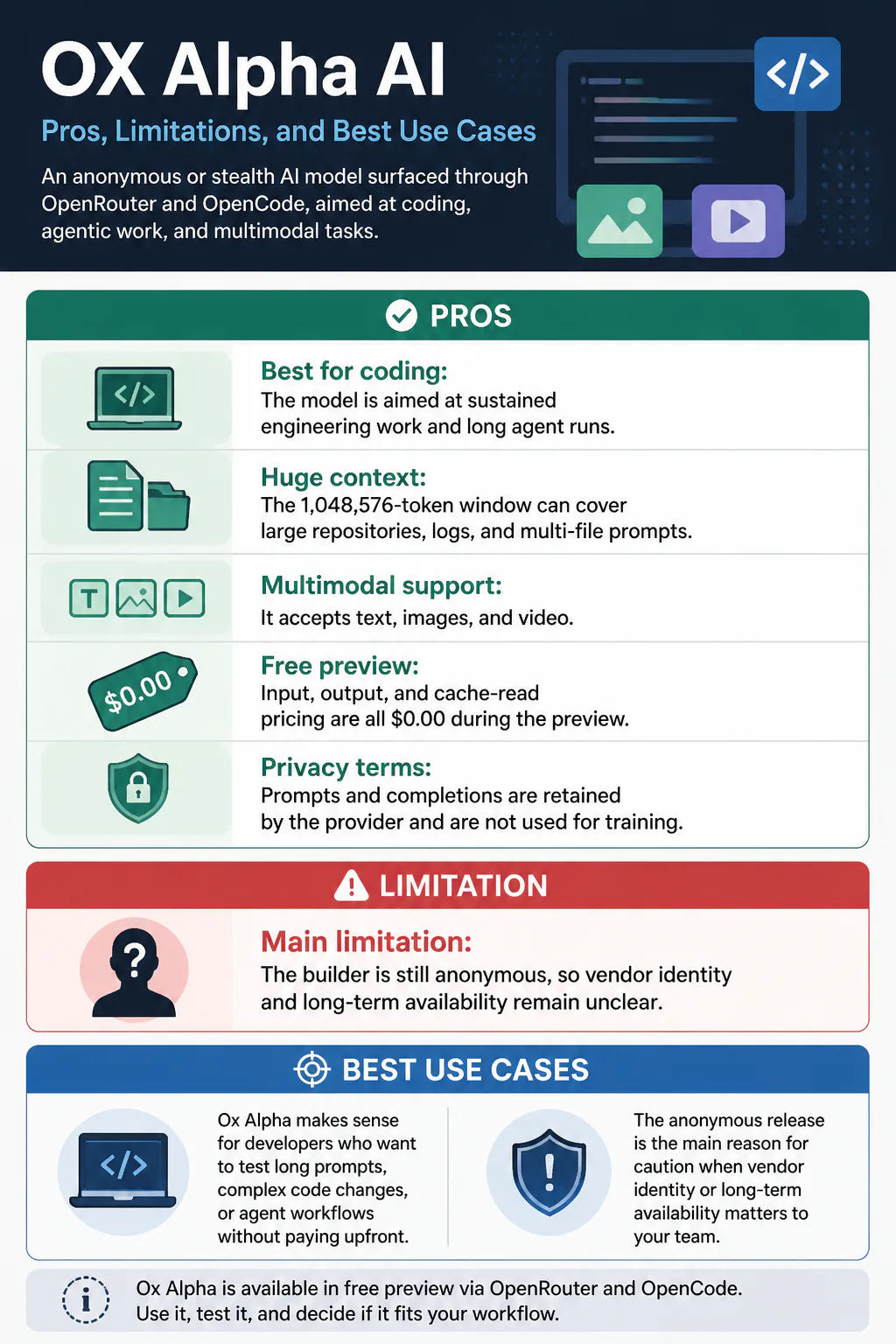
Best for coding: The model is aimed at sustained engineering work and long agent runs.
-
Huge context: The 1,048,576-token window can cover large repositories, logs, and multi-file prompts.
-
Multimodal support: It accepts text, images, and video.
-
Free preview: Input, output, and cache-read pricing are all $0.00 during the preview.
-
Privacy terms: Prompts and completions are retained by the provider and are not used for training.
-
Main limitation: The builder is still anonymous, so vendor identity and long-term availability remain unclear.
Ox Alpha makes sense for developers who want to test long prompts, complex code changes, or agent workflows without paying upfront. The anonymous release is the main reason for caution when vendor identity or long-term availability matters to your team.
Head-to-Head Comparison (Current Frontier Landscape, Aug 2026)
|
Aspect |
Ox Alpha |
Claude Fable 5 / Opus 5 |
GPT-5.6 (Sol etc.) |
Grok 4.6 |
GLM-5.3 (public) |
|---|---|---|---|---|---|
|
Context |
1M |
1M |
~1–1.05M |
500K |
Similar (1M-class) |
|
Multimodal |
Text + image + video |
Strong multimodal |
Strong multimodal |
Strong |
Public version more text-focused; Ox appears multimodal-enhanced |
|
Pricing |
Free (preview) |
Expensive ($5–10 / $25–50) |
$2–5 / $12–30 |
$2 / $6 |
Paid |
|
Coding/Agentic |
Strong early signals (outperformed in small DeepSWE tests) |
Usually tops or near-tops coding benchmarks |
Strong, especially agentic |
Competitive |
Very close to Ox (fingerprint match) |
|
Speed |
Moderate (~23–29 t/s) |
Varies (thinking adds latency) |
Competitive |
Often faster |
Similar |
|
Best for |
Free long-context coding agents, multimodal agent workflows right now |
Highest reliability on hardest coding/reasoning when cost is secondary |
Balanced capability + ecosystem |
Cost-efficient real-time / knowledge work |
Chinese-lab ecosystem, GLM users |
Ox Alpha coding benchmarks
Ox Alpha has no official coding or agentic benchmarks published as of August 22, 2026. OpenRouter lists none, and independent trackers like Artificial Analysis do not include it. All available numbers are community-run, small-sample evaluations that should be treated as preliminary signals rather than definitive rankings.
Reported Community Coding Results
1. DeepSWE 10-task subset (most cited)
DeepSWE is a strong, contamination-resistant long-horizon software-engineering benchmark (113 original tasks across 91 repositories and 5 languages). Community tester Ben Davis (and others) ran a deterministic 10-task subset:
|
Model |
Pass rate (approx.) |
Notes |
|---|---|---|
|
Ox Alpha |
~80% (8/10) |
Near-misses on the 2 failures; one task (Marriott) solved in a single shot where others scored 0 |
|
Claude Fable 5 |
~65% |
— |
|
GLM-5.3 |
~62% |
— |
|
Grok 4.6 |
~62% |
— |
|
GPT-5.6-sol |
~52% |
— |
This is a small subset (not the full 113-task suite). Full public DeepSWE leaderboards (mid-to-late 2026 snapshots) show frontier models in the ~70% range under full evaluation with the mini-swe-agent harness (e.g., Claude Opus 5 / GPT-5.6 Sol variants around 70–73% at max effort). The 10-task gap is therefore meaningful but carries high variance—literally a handful of tasks separate 80% from 65%.
2. Kingbench (community custom suite)
One evaluator’s private “Kingbench” (80-point scale covering coding, reasoning, multimodal, and specialized tasks):
-
Ox Alpha: 87.5% (70/80)
-
GLM-5.3: 91.25%
-
Claude Fable 5: ~82.5%
-
Qwen 3.8 Max: ~81.25%
-
Claude Opus 4.8: ~80%
Ox Alpha placed second overall and scored perfect or near-perfect on several coding/multimodal items (e.g., 3JS contact lens case, Panda SVG, Gemma fine-tuning task).
Other scattered signals
-
Early Terminal-Bench-style or agent-step counts mentioned in fingerprint analyses show Ox Alpha taking a high number of agent steps (similar to GLM-5.3 profiles).
-
Real-world usage on OpenRouter is heavily skewed toward coding agents (Claude Code, Hermes Agent, etc.), with hundreds of billions of tokens processed in the first 1–2 days—suggesting developers find it useful for sustained software-engineering workflows.
Context Against Established Coding Benchmarks (August 2026)
For reference, current public leaderboards (not including Ox Alpha) show:
-
SWE-bench Verified: Claude family (Opus 5 / Fable 5 / Mythos 5) dominates at 95–96%. Lower tiers sit in the high 80s.
-
Terminal-Bench 2.0 / 2.1: GPT-5.6 Sol leads (~90–92%), followed closely by Claude variants and Grok.
-
Full DeepSWE: Top models cluster around 70–73% at high/max effort.
Ox Alpha’s community subset scores place it competitively or ahead on the specific tasks tested, but without a full-suite run under a standardized harness it is impossible to rank it precisely against these numbers.
Analysis & Caveats
Positive signals
-
Strong performance on long-horizon, multi-file, agentic coding tasks in the tested subset.
-
One-shot success on a difficult task that defeated several frontier models.
-
High real-world adoption by production coding agents.
-
Matches the expected profile of a strong GLM-family model (tokenizer, style, step count, multimodal video handling).
Limitations
-
Sample size is tiny (10 tasks). Statistical noise is large.
-
Different harnesses, effort settings, and number of attempts (Ox Alpha often 1-shot vs. others 4 attempts) make direct comparison imperfect.
-
No public results on the full DeepSWE, SWE-bench Verified, Terminal-Bench, LiveCodeBench, or other standard suites.
-
Mandatory high-effort reasoning may inflate latency/cost once the free period ends, even if quality is high.
-
Some community voices have noted underperformance on simpler or non-agentic coding tasks relative to the hype, raising the usual “benchmaxxing vs. real-world” caution.
FAQ
Is OX Alpha AI free?
Yes. During the preview period, input, output, and cache reads cost $0.00.
How long is the free preview?
The free preview lasts one week.
Is OX Alpha AI used for training?
Prompts and completions are retained by the provider but are not used for training.
Who built OX Alpha AI?
Ox Alpha is a stealth model, and OpenRouter is the access layer.
How do I access OX Alpha?
Use stealth/ox-alpha in OpenRouter or OpenCode.
Bottom line: OX Alpha AI combines a huge context window with free preview access and strong early coding results. Try it through OpenRouter or OpenCode to evaluate long-context coding and agent workflows now.



The DeepSWE result (80% vs. 65% for Opus 5) is impressive, especially for a model with an anonymous builder. At APIVALE, we’ve seen teams want to test long-horizon agent workflows without vendor lock-in, but the retention policy (prompts kept, not used for training) still raises governance questions. For anyone evaluating this for production, how does the team recommend mitigating the risk of relying on a stealth provider for sustained engineering tasks?
Risk Mitigation for Stealth AI Providers (APIVALE/DeepSWE)
1. Assume zero trust. Sandbox all code, strip prompts of proprietary data, and require multi-model consensus for critical tasks.
2. Externalize state. Use the “Ralph pattern” (fresh agent loops + git/memory files) so work survives if the provider vanishes.
3. Contract with APIVALE, not the upstream Demand data retention warranties, breach notification, and jurisdictional guarantees.
4. Detect silent drift. Run a private daily benchmark and monitor for tokenizer/behavior changes.
5. Tier task exposure. Allow stealth models for refactoring/tests; prohibit them from security, auth, and infrastructure code.
6. Abstract and exit. Route through an internal gateway with model-agnostic prompts, and keep a pre-qualified fallback (e.g., Opus 5, GPT-5.6 Sol) qualified on your tasks.
Core principle: Route through it for performance; do not rely on it for trust.