
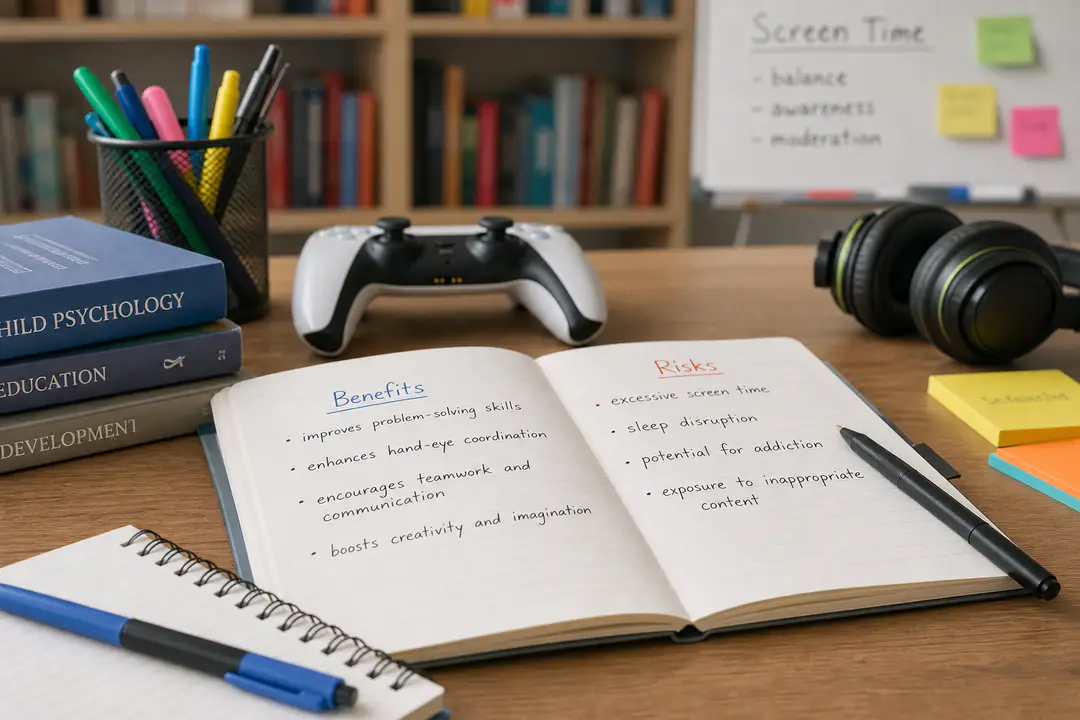
Gaming Affects on Children: Benefits and Risks
Gaming affects children in both positive and negative ways. Video games can strengthen cognitive skills such as attention, memory, problem-solving, and spatial and visual attentional faculties, yet they can also contribute to reduced school performance, sleep disorders, eye strain, obesity, aggressive behavior, and gaming addiction when play becomes disruptive. The real question is not whether games are good or bad in isolation, but how they fit into a child’s life. School performance, physical health, behavior, sleep, and social relationships all shift depending on game content, timing, supervision, and whether screen time pushes out exercise, homework, family time, and rest.
1. What Gaming Does to a Child
The strongest evidence points to a simple pattern: outcomes depend less on raw play time than on the quality of play. A child who spends limited time on age-appropriate, social, well-structured games and still sleeps well, moves enough, and keeps up with school often looks very different from a child whose gaming habits crowd out homework, physical activity, and face-to-face relationships.
When parents hear broad claims about screen time, they should check whether the concern is moderate play or problematic gaming, because those patterns are linked with very different school outcomes. A large cross-country study covering 145,953 students found that moderate gaming lined up with better academic outcomes than excessive gaming, while problematic gaming tracked with poorer school performance. Another long-running cohort of Canadian children found that each extra hour of total screen time was tied to 9% to 10% lower odds of reaching a higher academic level in grade 3 reading and math and grade 6 math. Video game use also showed a specific association with lower grade 3 reading achievement.
Gaming also reaches into mood and daily routine. Douglas Gentile of Iowa State University has spent years separating ordinary enthusiasm from harmful use patterns, and that distinction is crucial for parents. A child can love video games without having problematic gaming, just as a child can spend many hours gaming during a school break without showing the loss of control seen in gaming addiction.
2. Positive Effects of Video Games
Video games are not just passive entertainment. Many require children to track moving targets, remember rules, switch strategies quickly, cooperate with teammates, and recover after failure. Those demands explain why some benefits show up consistently in the research.
Cognitive gains
- Improved attention in fast-paced tasks that require sustained focus.
- Stronger spatial and visual attentional faculties, especially in games built around navigation, pattern recognition, and quick visual processing.
- Better problem-solving and decision-making when games reward planning rather than repetition.
- Practice with working memory through objectives, resource management, and multi-step tasks.
Adam Gazzaley at Neuroscape, University of California, San Francisco, has focused much of his work on how interactive digital experiences can train attention and cognitive control. That does not mean every commercial game improves learning, but it does help explain why certain well-designed games can sharpen attention and emotional regulation rather than simply consume time.
Social and emotional benefits
Game content changes the social outcome. Cooperative games often reward communication, shared goals, and mutual support. Prosocial titles and team-based play can increase empathy, helpful/cooperative behavior, and self-esteem, especially when children play with friends, siblings, or parents and talk about what happened during play.
Nick Ballou of the Oxford Internet Institute has emphasized a point parents often miss: the social quality of gaming can matter more than the amount. For some children, especially those who struggle in offline group settings, games offer structured interaction that feels less intimidating and can support social relationships instead of weakening them.
- Co-op play can build turn-taking and communication.
- Shared goals can support empathy and patience.
- Success in manageable challenges can improve self-esteem.
- Online multiplayer can maintain friendships when paired with strong online safety rules.
That social upside has limits. It is strongest when children still have offline friendships, supervised online play, and clear boundaries around strangers, chat functions, privacy risks, and cyberbullying. Parents who want a broader look at game formats often compare popular titles such as Mobile Legends gameplay with other competitive online games, because game design strongly affects whether play pushes cooperation or conflict.
3. Negative Effects of Excessive Gaming
The risks become clearer when gaming shifts from a hobby to a routine that displaces sleep, movement, schoolwork, and family life. Problematic gaming is not just “playing a lot.” It involves loss of control, persistent overuse, and real damage to daily functioning. That is the pattern linked most strongly with school problems, health complaints, and behavioral issues.
| Area | Potential benefit | Potential harm |
|---|---|---|
| School | Practice with attention and problem-solving | Reduced school performance, especially when gaming displaces homework or happens before school |
| Physical health | Active games can add movement | Obesity, eye strain, fatigue, repetitive stress injuries, poor nutrition |
| Sleep | None when play is too close to bedtime | Sleep disorders, later bedtimes, daytime tiredness |
| Behavior | Cooperative games can support empathy | Aggressive thoughts and aggressive behavior in some children, especially with violent content |
| Social life | Friendship and teamwork | Conflict at home, withdrawal, cyberbullying, privacy risks |
School and attention problems
Academic difficulties often show up before parents identify gaming as the cause. Homework gets rushed. Reading falls off. Morning focus drops. One recurring finding is that before-school gaming is associated with lower school performance, which fits what teachers report: children arrive overstimulated, distracted, or mentally preoccupied with the game they just left.
The long-term concern is not one bad grade but a pattern of reduced school performance. If a child’s gaming regularly replaces reading, practice, revision, and sleep, lower achievement stops being surprising. Valerie Herber of Southwest Health Behavioral Services has pointed out that families often notice the emotional fallout first, but school performance is where the disruption becomes measurable.
Physical health effects
Physical health risks from heavy gaming are easy to underestimate because they build slowly. Long sedentary periods raise obesity risk, especially when gaming is paired with snacking and reduced outdoor activity. Repetitive hand motions can lead to repetitive stress injuries, while poor posture contributes to neck, shoulder, and back pain.
Eye strain and fatigue are common, particularly after long sessions without breaks. Rare but serious problems also belong in the conversation, including video-induced seizures in children with specific vulnerabilities. Parents do not need alarmist language here, but they do need to recognize that gaming is not physically neutral when it dominates a child’s routine.
- Eye strain often shows up as headaches, dry eyes, or blurred vision after long sessions.
- Sleep loss compounds fatigue and weakens attention the next day.
- Low activity and high snacking push obesity risk higher.
- Hand, wrist, and shoulder pain can signal repetitive stress injuries.
Behavior and mental health concerns
Behavioral effects vary by child and by game content. Violent content has been linked with aggressive thoughts and, in some children, more aggressive behavior. That does not mean every child who plays a combat game becomes more hostile, but content and temperament interact. A child who is already impulsive, easily frustrated, or struggling with emotional regulation needs closer supervision than a child who can play, stop, and move on calmly.
Mental health concerns also rise when gaming becomes a coping tool used to avoid stress, loneliness, or school pressure. In the short term, games can relieve stress. If they become the only reliable coping mechanism, the pattern starts to resemble problematic gaming and can overlap with anxiety, low mood, or behavioral disorders.
Children who spend a lot of time in online spaces also face risks unrelated to gameplay itself: cyberbullying, exposure to hostile chat, pressure from in-game social status, and privacy risks tied to voice chat, usernames, and direct messaging. Parents following hardware and platform changes, including devices such as the Steam Deck OLED models, should remember that easier access often means less visible supervision.
4. Healthy Gaming vs Problematic Gaming
Parents often ask where normal enthusiasm ends and gaming addiction begins. The cleanest dividing line is function. Healthy gaming fits inside a child’s life. Problematic gaming takes control of it.
How the two patterns differ
A child with healthy gaming habits can enjoy games intensely and still stop when asked, shift to homework, sleep on time, and keep stable social relationships. Frustration after losing is brief. Mood does not depend entirely on access to a console or phone. Gaming stays one part of a larger routine.
A child with problematic gaming shows persistent loss of control. Arguments over stopping become constant. School performance drops. Sleep shortens. Meals get skipped or rushed. Other interests fade. The child keeps playing despite obvious harm, which is much closer to the pattern described in gaming addiction and gaming disorder.
| Healthy gaming | Problematic gaming |
|---|---|
| Stops without major conflict | Cannot stop without severe distress or repeated conflict |
| Schoolwork and sleep stay intact | Reduced school performance and chronic sleep loss |
| Balanced with exercise and offline play | Displaces physical activity, hobbies, and family time |
| Social play supports friendships | Online play replaces most offline social relationships |
| Mood remains stable outside gaming | Irritability, withdrawal, or distress when not gaming |
Research increasingly supports another useful distinction: high use is not identical to harmful use. Some children spend many hours gaming on weekends and remain healthy, active, and academically steady. Others play fewer hours but in the worst slots, such as before school, late at night, or during every homework break, and show more disruption. Quality, timing, and context carry more weight than a single screen time number.
5. Warning Signs Parents Should Watch
Problems usually appear as clusters, not isolated moments. One late bedtime after a special event is not the issue. A month of sleep loss, missing assignments, and rising irritability is.
- Frequent arguments about stopping or cutting back.
- Reduced school performance, unfinished homework, or falling reading scores.
- Sleep disorders, late-night play, or exhaustion in the morning.
- Loss of interest in sports, clubs, outdoor play, or time with friends.
- Irritability, anger, or sadness when gaming is unavailable.
- Physical complaints such as eye strain, headaches, wrist pain, or fatigue.
- Secretive behavior around devices, spending, chat features, or online contacts.
One consumer signal also explains why gaming takes such a central role in many families: nearly 72% of children ask for an electronic game-related present. That level of demand means gaming is woven into birthdays, holidays, peer culture, and advertising. Parents are not managing a niche hobby. They are managing a mainstream part of childhood.
Because of that, supervision has to extend beyond time limits. A child who plays a family-friendly puzzle game for an hour after homework presents a different risk profile than a child who spends the same hour in an unmoderated competitive chat space. Reviews of current online titles, such as this PlayMyWorld review, can help parents understand what kinds of systems, rewards, and social features their children are using.
6. Parent Guidance
The most effective rules are concrete and tied to daily function. “Play less” is vague. “No gaming before school, no gaming during homework breaks, and devices off one hour before bed” is clear and easier to enforce. Children respond better when limits are predictable rather than negotiated every night.
Start with the pressure points that most often cause harm: sleep, academics, movement, and online behavior. If those four areas remain stable, gaming usually stays manageable. If one slips, adjust the routine before conflict hardens into a pattern.
What works at home
- Keep gaming out of the hour before bedtime to reduce sleep disruption.
- Ban before-school gaming if mornings, mood, or school performance are slipping.
- Require homework, meals, and physical activity before recreational play.
- Check game ratings, chat settings, friend lists, and privacy controls.
- Favor games that encourage cooperation, creativity, or problem-solving over constant aggression.
- Play together sometimes so children know adults understand the appeal and the risks.
Parents should also watch for children using games as their only emotional refuge. If a child turns to gaming after every disappointment, social conflict, or stressful school day, the goal is not just reducing screen time. The child needs broader coping tools, better emotional regulation, and, in some cases, support from a mental health professional.
That is where family tone matters. Punishment alone often drives gaming underground. Calm structure works better: fixed windows, visible devices, shared expectations, and clear consequences linked to sleep, grades, and conduct. When children understand that gaming continues as long as life outside the screen remains healthy, the rule feels fair and easier to follow.
Final Thoughts
Gaming is healthiest when it adds to a child’s life instead of replacing key parts of it. As games become more social, portable, and immersive, the smartest approach for parents is not blanket approval or blanket fear, but active oversight shaped by sleep, learning, behavior, and the kind of play a child is actually having.




Tôi đã giới thiệu flixfox download apk cho bạn bè vì tốc độ tải nhanh và hệ thống hoạt động khá ổn định. TONY10-19