
Thomson Reuters Launches Thomson AI Model for Legal Work
Thomson Reuters has introduced its own large language model for legal and professional work. The move affects cost, quality control, and how AI is deployed across Thomson Reuters products. It also reflects a broader enterprise shift toward owning more of the stack behind high-volume workflows.
Thomson Launch Facts
|
Attribute |
Details |
|---|---|
|
Model |
Thomson |
|
Company |
Thomson Reuters |
|
Launch date |
August 24, 2026 |
|
Type |
Proprietary large language model |
|
Training budget |
$40 million |
|
Built from |
Strong open-source foundation |
|
Reported lineage |
Snowdon |
|
Open-source link |
Alibaba Qwen |
|
First deployment |
Tabular Analysis in CoCounsel Legal |
|
Initial use case |
High-volume, structured document review |
|
Ownership |
Fully owned and controlled |
|
Training data sources |
Westlaw, Practical Law, Checkpoint, Reuters |
|
Open release |
Small version on Hugging Face |

Thomson Reuters launches Thomson
Thomson Reuters launched Thomson on Monday, August 24, 2026, as its first proprietary large language model. The clearest immediate use is inside CoCounsel Legal, where the model is being introduced as part of the company’s legal and professional AI stack. The bigger move is ownership: it now has a model it controls outright for its highest-value workflows.
The economics matter here too. Thomson Reuters says Thomson was trained at a fraction of the cost of comparable frontier models and is built to cut heavy inference spending. This is not a general consumer chatbot. It is a controlled model tuned for dense legal and tax content, where reliability and document handling matter more than broad consumer reach.
How Thomson was built
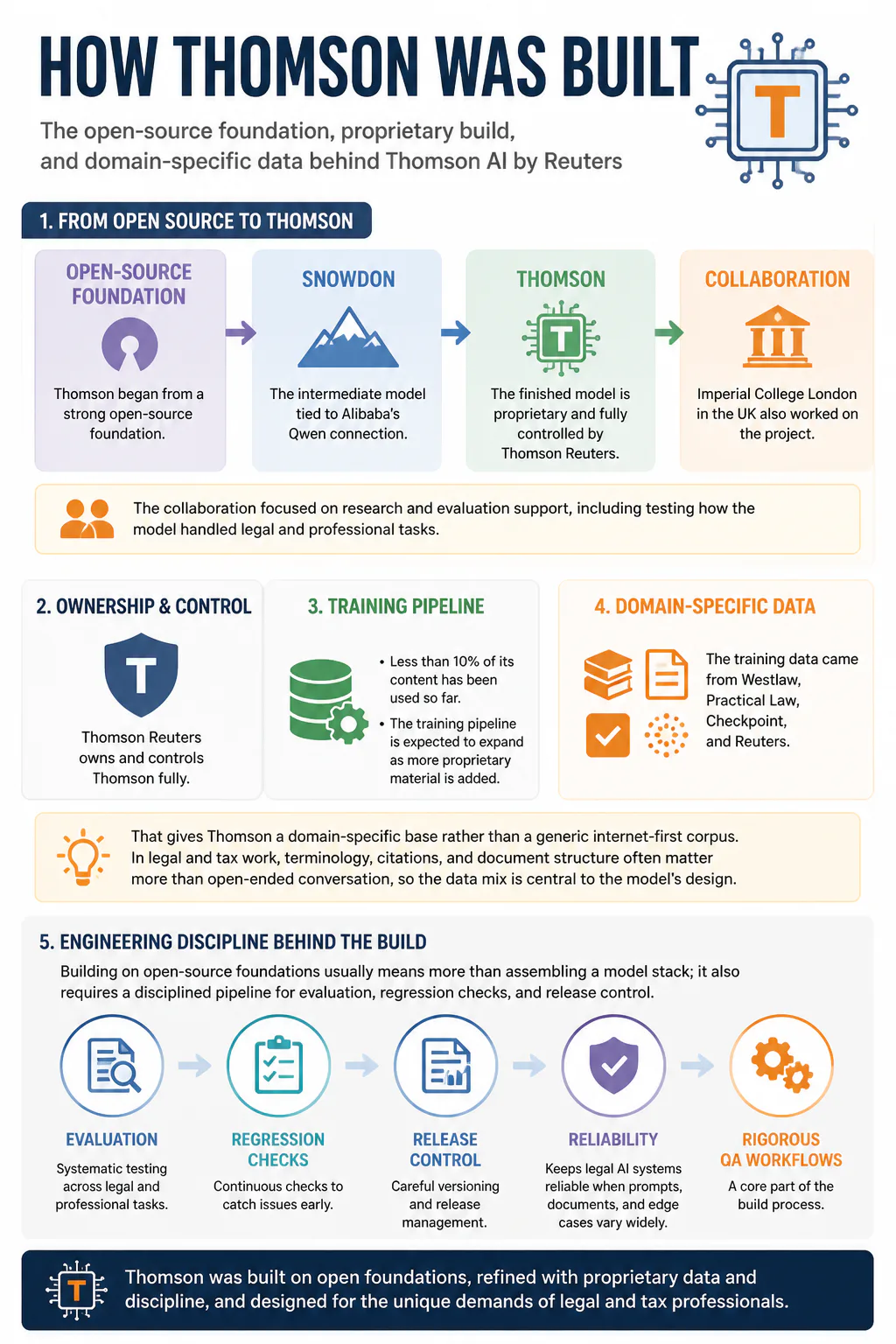
Thomson began from a strong open-source foundation. Its reported lineage points to Snowdon, the intermediate model tied to Alibaba’s Qwen connection. The finished model is proprietary and fully controlled by Thomson Reuters.
Imperial College London in the UK also worked on the project. The collaboration focused on research and evaluation support, including testing how the model handled legal and professional tasks.

Thomson Reuters owns and controls Thomson fully. The practical value is in how the company reworked, trained, and deployed the model for its own products. Less than 10% of its content has been used so far, and the training pipeline is expected to expand as more proprietary material is added.
The training data came from Westlaw, Practical Law, Checkpoint, and Reuters. That gives Thomson a domain-specific base rather than a generic internet-first corpus. In legal and tax work, terminology, citations, and document structure often matter more than open-ended conversation, so the data mix is central to the model’s design.
Building on open-source foundations usually means more than assembling a model stack; it also requires a disciplined pipeline for evaluation, regression checks, and release control. That same engineering mindset is what keeps legal AI systems reliable when prompts, documents, and edge cases vary widely, making rigorous QA workflows a core part of the build process.
What Thomson will power first
Thomson’s first deployment is Tabular Analysis inside CoCounsel Legal, where it will handle high-volume, structured document review. Tabular and document-heavy work depends on consistent extraction, comparison, and classification, which lines up with a system trained on professional content.
CoCounsel Legal remains multi-model by design, so Thomson is joining the stack rather than replacing every existing system. Thomson Reuters can route some tasks to its own model and keep others on external systems when that makes more sense. The first deployment also gives the company a controlled setting to measure quality before a broader rollout across its legal and tax portfolio.
The first uses for Thomson are likely to center on drafting, research, and review tasks where time savings compound quickly across large teams. Those are the same kinds of service workflows that are being reshaped as organizations embed AI into daily client work, turning routine knowledge tasks into faster, more scalable operations.

Why Thomson Reuters built it in-house
Cost and control are the main reasons. Thomson runs at a fraction of the cost of comparable frontier models and avoids the heavy inference costs that usually come with them. It also cuts dependence on outside providers such as Anthropic, whose Claude models have powered much of CoCounsel.
That matters in legal AI because performance alone is not enough. A product can work well and still become expensive to run at scale, especially in high-volume enterprise settings. Owning the model gives Thomson Reuters more room to tune performance, manage latency, and decide where external models still fit.
CoCounsel Legal remains multi-model while Thomson is tested across real workflows. An in-house model gives Thomson Reuters a way to reduce vendor dependence without losing flexibility when another model is stronger or cheaper for a specific task.
How Thomson was evaluated
-
Instruction following: Thomson showed a meaningful uplift over the base model.
-
Dense legal content: It performed better on dense, domain-specific material.
-
Frontier-model parity: Early evaluations placed Thomson on par with latest frontier models across a range of tasks.
-
Academic review: Legal and AI academics participated in evaluations.
-
Jonathan H. Choi: The Washington University School of Law academic preferred Thomson’s responses overall.
-
Usability signal: Links to treatises made responses more transparent and useful for legal work.
-
Professor Samuel Dahan: The Queen’s Conflict Analytics Lab and Cornell Legal AI Lab scholar said citation quality was generally competitive with leading frontier models.
Those results point to the area Thomson Reuters cares about most: structured, citation-heavy professional content. That is a narrower target than general-purpose chat performance, but it is the one that matters for legal workflows and enterprise adoption.
Evaluating a legal model is rarely just a matter of accuracy on one task; it usually involves comparing reasoning quality, consistency, and how well the system handles complex instructions. That broader perspective mirrors the way model benchmarks are used to separate incremental improvements from real capability jumps in advanced AI systems.
What comes next for Thomson
Thomson Reuters plans to expand Thomson across its legal and tax portfolio, turning it from a single deployment into a shared layer across multiple products. The company is also releasing a small version on Hugging Face for academic and non-commercial use, which opens the door to outside testing and closer scrutiny.
The strategy is split in two: keep the production model controlled while giving researchers a smaller version to inspect. Customer data is not used to train the model without explicit consent, an important point for legal and enterprise customers. The next phase will show whether Thomson can turn a strong launch into a lasting product advantage.
FAQs
Is Thomson open-weight for public use?
Thomson Reuters is releasing a small version on Hugging Face for academic and non-commercial use. The production model remains fully owned and controlled by the company.
Will the Hugging Face release allow independent benchmarking?
The small release gives outside researchers a way to test Thomson’s behavior and compare it with other models under controlled conditions. The open version is the main benchmarking window.
How does Thomson differ from Claude in CoCounsel Legal?
Claude has powered much of CoCounsel, while Thomson is Thomson Reuters’ in-house model for selected workloads. CoCounsel Legal remains multi-model, so Thomson adds another option.
Conclusion
Thomson gives Thomson Reuters a core AI capability built for legal and tax work, with enterprise economics and a live product workflow from the start.