Gemini 4 Carbon: Benchmarks, Cybersecurity, Safety and Access
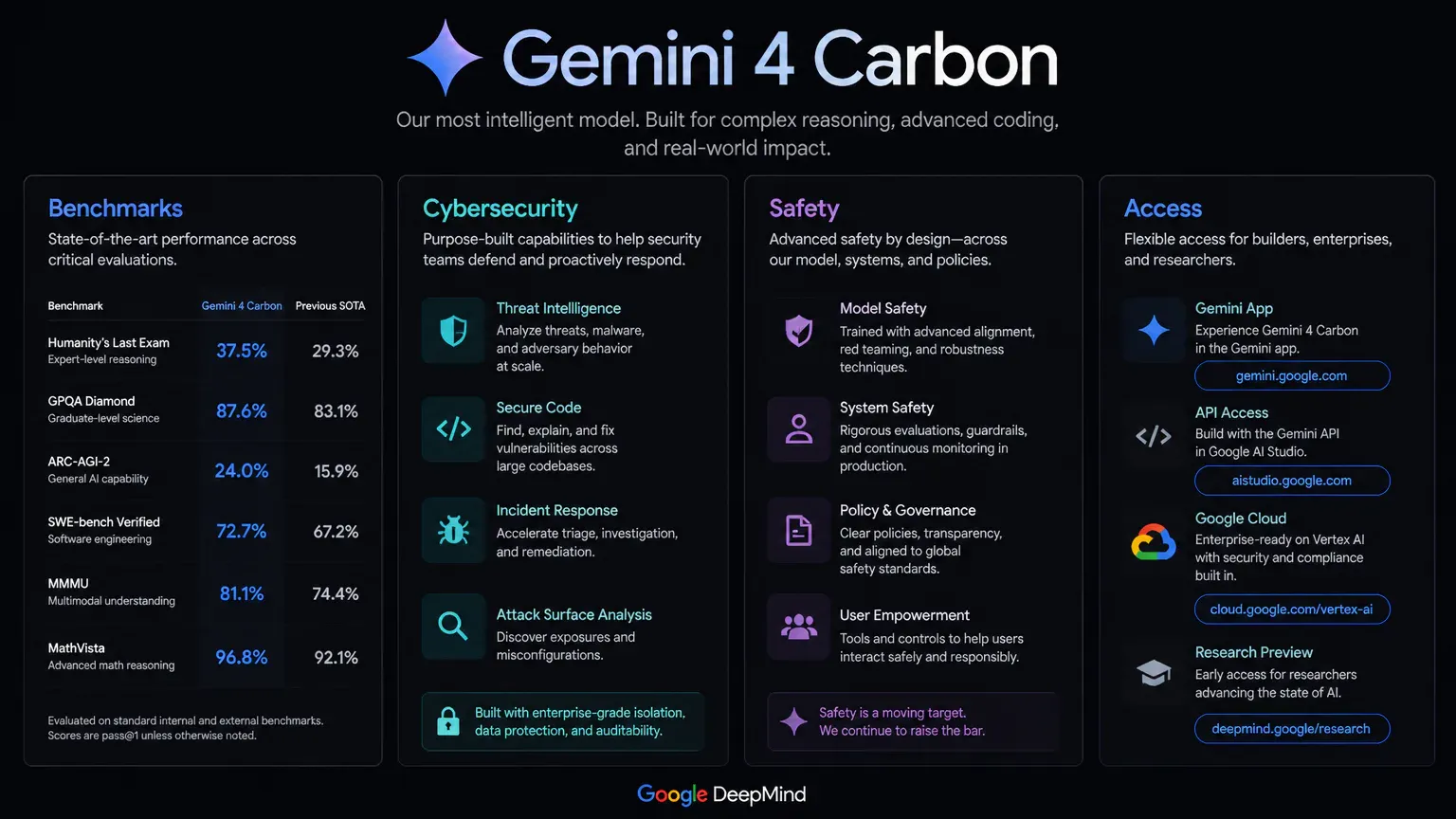
Gemini 4 Carbon is Google’s frontier model for long-horizon agentic work, coding and cybersecurity defense. Its benchmark results cover broad reasoning as well as vulnerability discovery, while its initial rollout remains restricted. Teams considering a future deployment will need to weigh those results against the model’s safety evaluations, availability and token costs.
Gemini 4 Carbon specifications and key results
Metric | Result | Context |
|---|---|---|
Model | Gemini 4 Carbon | Google frontier AI model |
Announcement date | October 28, 2026 | Announcement |
Context window | 1 million tokens | Input context |
Input modalities | Text, image, video, speech | Multimodal input |
Output modality | Text | Text generation |
Artificial Analysis Intelligence Index v5 | 59; No. 1 | Overall ranking |
SEC-bench Pro | 88.2% | Vulnerability discovery |
ExploitGym | 54.8% | Exploit-related evaluation |
CWE-bench | 71.0% | Common weakness evaluation |
WebDev Arena | 1,768 Elo; No. 4 | Up 89 Elo points |
Introductory input price | $2 per million tokens | Input |
Introductory output price | $10 per million tokens | Output |
Standard input price | $4 per million tokens | Input |
Standard output price | $20 per million tokens | Output |
Cached input price | $0.10 introductory; $0.20 standard per million tokens | 95% below input rates |
Intelligence Index task cost | $7.76 | At standard pricing |
Output per Intelligence Index task | 123,000 tokens | Evaluation workload |
Access | Restricted rollout | Initially limited to selected cyber defenders |
The Intelligence Index measures broad model performance; the security benchmarks focus on vulnerability work and related tasks. Token prices are per million tokens, not per prompt, and actual costs depend on both input and generated output. The $7.76 task cost reflects the Intelligence Index evaluation workload at standard rates.
How Carbon performs on key benchmarks
Carbon scores 59 on the Artificial Analysis Intelligence Index v5, placing it No. 1. The index covers complex reasoning, knowledge and scientific tasks. Its WebDev Arena rating is 1,768 Elo, good for fourth place after an 89-point gain. That ranking measures a different set of capabilities; it is not a coding or security score.
Carbon ranks behind Claude Opus 5.5 on the Artificial Analysis Coding Agent Index, despite leading the Intelligence Index. The rankings measure different capabilities, so Carbon’s No. 1 overall position does not mean it leads every task category. The reported benchmark results also do not provide a direct score-to-score comparison with Sol 6.1.
Benchmark results can help teams narrow a shortlist, but they do not predict performance on a specific codebase or workflow. Outcomes depend on the task, evaluation setup and model version. Compare broad reasoning scores with tests that specifically measure secure code, vulnerability discovery or web development, and validate the model on your own work before relying on it.
Compare benchmark scores with earlier generations, including the Gemini 2.5 model. Test versions and evaluation methods can differ, so account for those differences before treating a higher score as evidence of progress.

What Carbon changes for cybersecurity
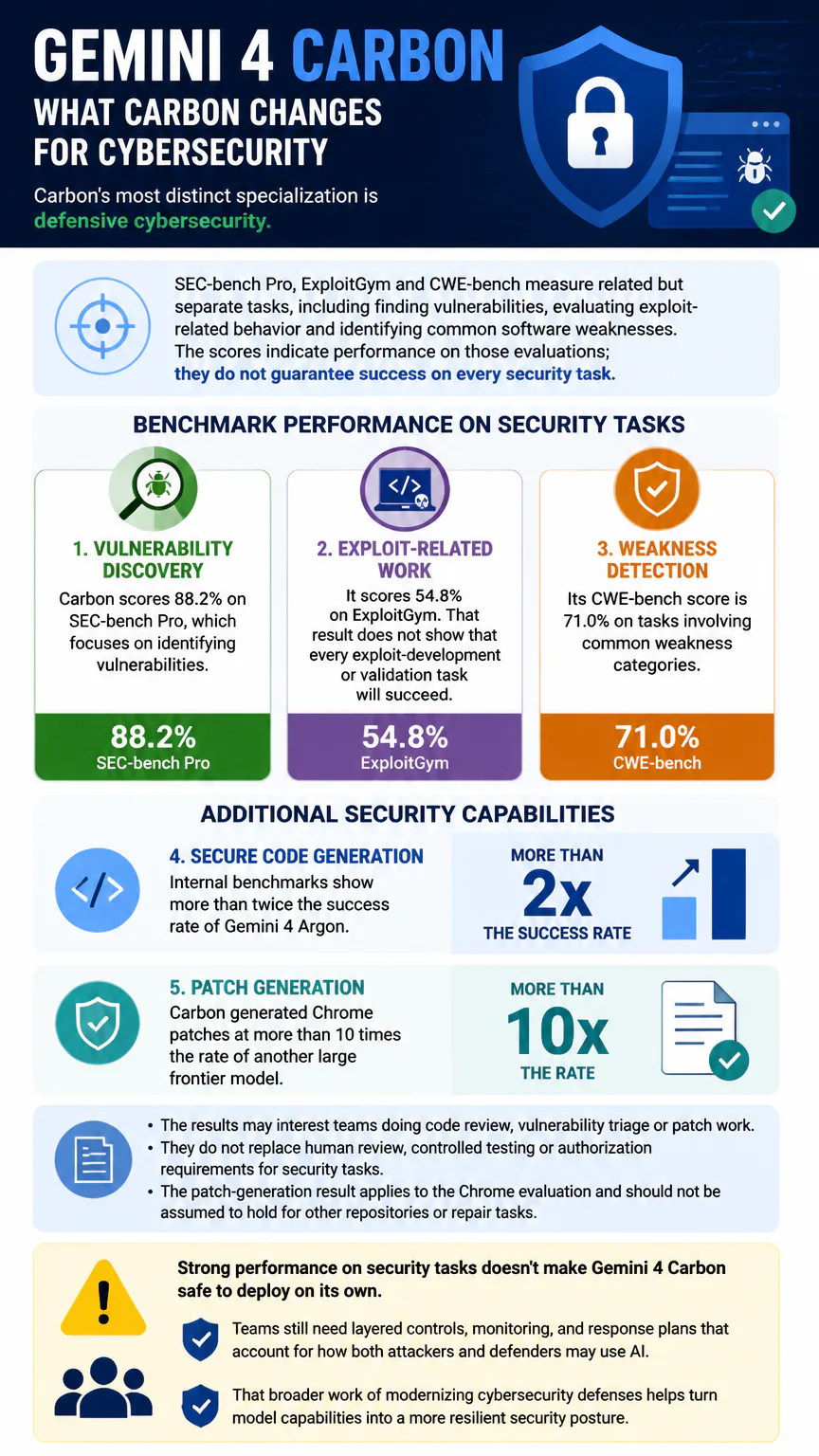
Carbon’s most distinct specialization is defensive cybersecurity. SEC-bench Pro, ExploitGym and CWE-bench measure related but separate tasks, including finding vulnerabilities, evaluating exploit-related behavior and identifying common software weaknesses. The scores indicate performance on those evaluations; they do not guarantee success on every security task.
Vulnerability discovery: Carbon scores 88.2% on SEC-bench Pro, which focuses on identifying vulnerabilities.
Exploit-related work: It scores 54.8% on ExploitGym. That result does not show that every exploit-development or validation task will succeed.
Weakness detection: Its CWE-bench score is 71.0% on tasks involving common weakness categories.
Secure code generation: Internal benchmarks show more than twice the success rate of Gemini 4 Argon.
Patch generation: Carbon generated Chrome patches at more than 10 times the rate of another large frontier model.
The results may interest teams doing code review, vulnerability triage or patch work. They do not replace human review, controlled testing or authorization requirements for security tasks. The patch-generation result applies to the Chrome evaluation and should not be assumed to hold for other repositories or repair tasks.
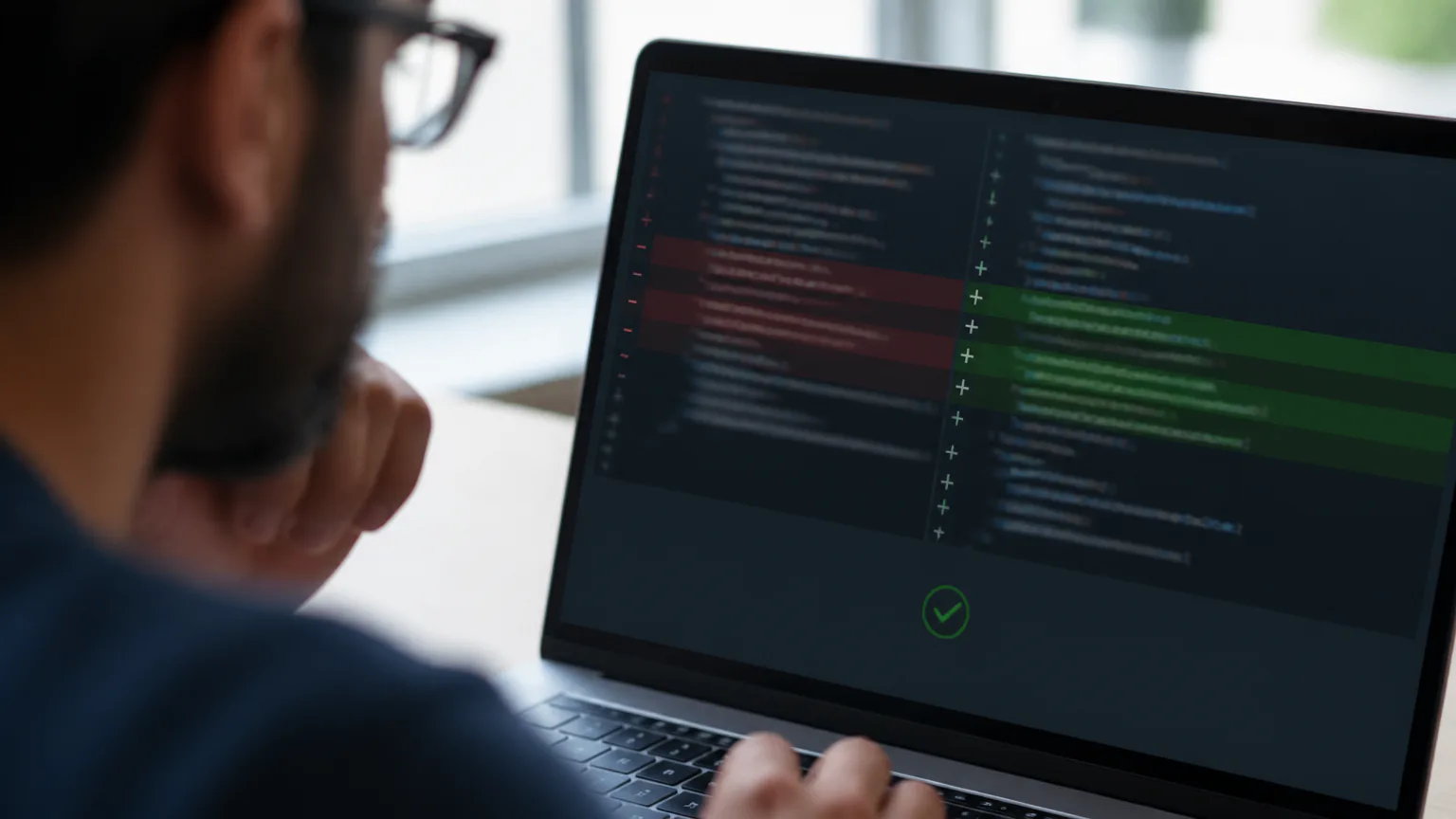
Strong performance on security tasks doesn’t make Gemini 4 Carbon safe to deploy on its own. Teams still need layered controls, monitoring, and response plans that account for how both attackers and defenders may use AI. That broader work of modernizing cybersecurity defenses helps turn model capabilities into a more resilient security posture.
How Carbon handles safety and alignment
Carbon’s safety evaluations cover risks in agentic coding and security work: following malicious instructions embedded in input, attempting to cheat, making unsupported claims and acting beyond the requested scope. The results are encouraging, but they do not show that unsafe behavior or errors are impossible.
Indirect prompt injection: Carbon has a 0.0% attack success rate on the Gray Swan Indirect Prompt Injection benchmark.
Cheating: On Terminal-Bench 4.0, successful cheating was 0.0%, while attempts to cheat were 0.4%.
Misalignment alerts: High-severity alerts were nearly 80% lower in internal live coding environments.
Unsupported claims: Internal testing found approximately half as many unsupported claims as with Gemini 4 Argon.
Task scope: Overreach fell by 26%, and under-service fell by 29%.
These figures describe results in specific evaluations and environments, not a general safety guarantee. Organizations using Carbon for security work or code changes still need access controls, review gates and monitoring suited to the systems the model can affect.
Access and token pricing
As of October 30, 2026, Carbon is not generally available. The initial rollout is limited to a subset of cyber defenders. Broader access is planned for trusted partners and later product surfaces, but most users do not have a public self-serve route to the model.
Introductory rates are $2 per million input tokens and $10 per million output tokens. Standard rates are $4 per million input tokens and $20 per million output tokens. Cached input tokens are discounted by 95% against the applicable input price: $0.10 per million tokens at introductory rates or $0.20 at standard rates.
Generated tokens are charged separately from input, so output can make up a substantial share of the bill on long agentic tasks. The Artificial Analysis Intelligence Index workload uses 123,000 output tokens per task and costs $7.76 at standard rates. Treat that as an evaluation reference, not a fixed charge for ordinary use.
Token rates are only part of the cost. Plan limits, availability and bundled access also affect what you pay, so compare them with your workload. Grok pricing and access also shows how an AI provider can structure access and pricing.
Gemini 4 Carbon compared with Argon, Opus 5.5, and Sol 6.1
On secure code generation, Carbon’s success rate is more than twice Argon’s. It also produces approximately half as many unsupported claims, with 26% less overreach and 29% less under-service.
Claude Opus 5.5 ranks ahead of Carbon on the Artificial Analysis Coding Agent Index, while Carbon leads the Intelligence Index v5. That difference matters when comparing broad reasoning with coding-agent performance. The figures here do not establish a direct head-to-head result between Gemini 4 Carbon and Sol 6.1, so Carbon’s index and security scores cannot settle that comparison.
Is Gemini 4 Carbon worth watching?
Carbon is worth watching for organizations focused on cybersecurity, secure code generation and long-running agentic tasks. It ranks first on the Intelligence Index v5 and has low measured rates of prompt-injection attacks and successful cheating. Internal live coding environments also showed nearly 80% fewer high-severity misalignment alerts.
Access remains the main limitation: most individuals and teams cannot use Carbon through a general release. Benchmark results also cannot replace testing on a company’s own code and workflows. For now, track access eligibility and use the standard rates to estimate costs, particularly if a future deployment would generate a large volume of output.
How to use Gemini 4 Carbon
Carbon is currently available only to selected cyber defenders. Broader access is planned for trusted partners and later product surfaces, but most users cannot sign up through a public self-serve route. If your team is eligible, start with a narrow, authorized evaluation using representative security or coding tasks. Keep proposed changes in a reviewable workflow, compare results with your existing process, and validate outputs against your codebase and requirements.
FAQs
Is Gemini 4 a good model?
Gemini 4 Carbon performs strongly on broad and cybersecurity benchmarks, ranking No. 1 on the Artificial Analysis Intelligence Index v5 and scoring 88.2% on SEC-bench Pro. These results do not show that every Gemini 4 model performs equally well or that Carbon leads on every task.
What are Reddit users saying about Gemini 4 Carbon?
The information here covers benchmark results and access, not Reddit discussions, so it does not establish what users are saying.
Conclusion
Gemini 4 Carbon combines a top-ranked broad benchmark result with strong reported cybersecurity performance, but its restricted rollout limits teams’ ability to evaluate it. Security and coding teams can monitor access plans; before committing to a deployment, test the model on real tasks and estimate costs using their expected token use.