
How to Mitigate Security and Compliance Risks from Stealth AI Providers
Stealth AI providers can introduce more risk than their convenience suggests, especially when the service is hard to audit, stores data in an opaque jurisdiction, or weakens guardrails to move faster. For teams evaluating APIVALE and DeepSWE, the real question is not just whether the model works. You also need to prove where data goes, how outputs are controlled, and what happens if the provider behaves unpredictably.
That matters even more in 2026 because AI risk is now a governance issue as well as a security one. Hidden deployment paths, prompt-injection exposure, and compliance obligations under the EU AI Act all affect whether adoption is acceptable, restricted, or blocked.
Stealth AI Provider Risk Snapshot
|
Risk area |
What to check |
Why it matters |
|---|---|---|
|
Provenance |
Ownership, operator, model lineage |
Determines accountability |
|
Data handling |
Storage location, retention, access scope |
Controls sovereignty and leakage risk |
|
Jurisdiction |
Contract law, governing law, regulatory reach |
Defines legal exposure and recourse |
|
Model integrity |
Versioning, update control, tamper resistance |
Prevents silent behavior changes |
|
Prompt injection resistance |
Input filtering, tool isolation, output checks |
Reduces malicious instruction following |
|
Safety guardrails |
Harmful content blocking, policy enforcement |
Limits abuse and unsafe outputs |
|
Governance |
Approval process, logging, ownership, review cadence |
Makes use auditable and defensible |
|
Compliance |
AI Act readiness, privacy duties, internal policies |
Prevents regulatory breach |
|
Operational monitoring |
Usage tracking, anomaly detection, response playbooks |
Detects misuse early |
|
Exit strategy |
Offboarding, data deletion, model swap plan |
Reduces lock-in and lingering exposure |

What makes these providers risky
With stealth AI providers, the hardest questions are often the ones that matter most. Mainstream services usually publish more about training lineage, hosting boundaries, logging behavior, and administrative controls. When that information is missing or incomplete, uncertainty lands exactly where enterprise risk tends to concentrate.
-
Hidden infrastructure: traffic may pass through regions, processors, or subprocessors you cannot readily validate.
-
Unclear data handling: prompts, files, and outputs may be retained or reused in ways that are not obvious from a marketing page.
-
Weak safety guardrails: some models block fewer harmful prompts and are easier to jailbreak.
-
Difficult-to-audit behavior: output quality, policy adherence, and version changes may shift without clear notice.
-
Compliance ambiguity: a tool may be technically usable while still failing privacy, records, or governance requirements.
DeepSeek shows why these risks matter. Its R1 model saw heavy adoption after its release on January 20, 2025, but security testing and traffic observations raised serious concerns. At one point, traffic spiked 1,800%. During a monitored period, the chat block rate was 26%, and R1 posted a prompt-injection success rate of 77%. Any provider that cannot clearly show stronger controls deserves the same level of scrutiny.
How to assess provider trust
Start with provenance, then move to controls you can verify and enforce. Popularity, low cost, or fast output does not make a provider trustworthy. What matters is whether you can confirm who operates it, what data it touches, how it is governed, and whether its security posture fits the sensitivity of your use case.
-
Confirm the operator, legal entity, and governing jurisdiction.
-
Identify where prompts, files, embeddings, logs, and outputs are stored.
-
Review retention, deletion, and administrator access rules.
-
Check whether the provider supports version pinning, audit logs, and policy controls.
-
Test resistance to prompt injection, jailbreaks, and malicious tool calls.
-
Map the service to your internal control framework, including approval and review ownership.
-
Verify whether its use is compatible with privacy and AI regulatory obligations.
OpenAI, Anthropic, and Google Gemini make useful security and safety benchmarks because their behavior is easier to compare. DeepSeek-R1’s 77% prompt-injection success rate is far above OpenAI o1-preview at 27%, and it also compares poorly with Google Gemini on harmful prompt blocking.
Controls that reduce exposure
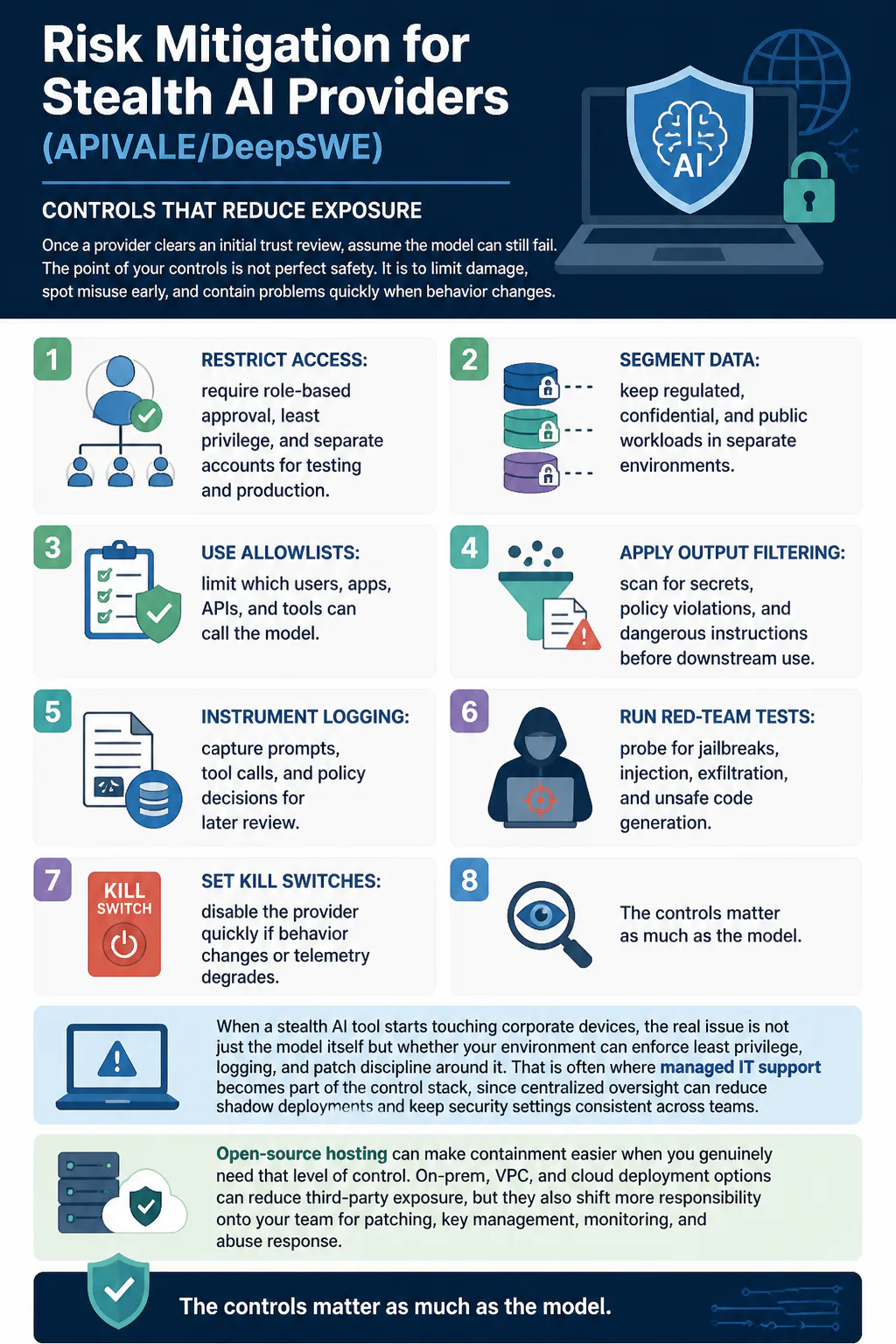
Once a provider clears an initial trust review, assume the model can still fail. The point of your controls is not perfect safety. It is to limit damage, spot misuse early, and contain problems quickly when behavior changes.
-
Restrict access: require role-based approval, least privilege, and separate accounts for testing and production.
-
Segment data: keep regulated, confidential, and public workloads in separate environments.
-
Use allowlists: limit which users, apps, APIs, and tools can call the model.
-
Apply output filtering: scan for secrets, policy violations, and dangerous instructions before downstream use.
-
Instrument logging: capture prompts, tool calls, and policy decisions for later review.
-
Run red-team tests: probe for jailbreaks, injection, exfiltration, and unsafe code generation.
-
Set kill switches: disable the provider quickly if behavior changes or telemetry degrades.
When a stealth AI tool starts touching corporate devices, the real issue is not just the model itself but whether your environment can enforce least privilege, logging, and patch discipline around it. That is often where managed IT support becomes part of the control stack, since centralized oversight can reduce shadow deployments and keep security settings consistent across teams.

Open-source hosting can make containment easier when you genuinely need that level of control. On-prem, VPC, and cloud deployment options can reduce third-party exposure, but they also shift more responsibility onto your team for patching, key management, monitoring, and abuse response. The controls matter as much as the model.
Governance and compliance requirements
Governance turns AI use from an ad hoc experiment into a managed service. Teams need a repeatable way to approve, monitor, and retire risky systems, with a clear record of who owns the decision and which controls must remain in place.
-
NIST AI RMF: use the Govern, Map, Measure, and Manage functions to structure risk work.
-
EU AI Act: treat it as a live compliance requirement, with risk-based obligations fully applicable on August 2, 2026.
-
Data protection rules: define what personal, confidential, or regulated data may never enter the model.
-
Vendor review: require security, privacy, legal, and procurement sign-off before adoption.
-
Documentation: keep model purpose, owners, controls, testing, and incident procedures in writing.
-
Accountability: assign a business owner, a security owner, and an escalation path.
DeepSeek raises a separate governance issue because its terms of service are governed by the laws of the People’s Republic of China in the mainland, and its privacy policy states that user data is stored in the PRC and governed by PRC law. That combination may conflict with data sovereignty expectations, cross-border restrictions, or internal policy requirements.
Compliance gets harder when employees are working across locations and using tools outside the normal procurement path, because records, approvals, and data handling can fragment quickly. The same governance challenge shows up in remote-access workflows, where remote mailbox services illustrate how organizations try to keep communications centralized while still supporting flexible work.
Monitoring and response practices
Focus monitoring on what changes after deployment, not only on the initial approval decision. Stealth AI risk often appears later: users find ways to push a model into unsafe output, traffic patterns shift, or teams start using the tool outside approved channels.
-
Track who uses the model, what data classes are submitted, and which applications consume the outputs.
-
Watch for spikes in prompt volume, unusual tool calls, and repeated policy violations.
-
Record jailbreak attempts, injection patterns, and blocked responses as security signals.
-
Review model version changes and retrain or retest after each meaningful update.
-
Set alert thresholds for secret exposure, unsafe code generation, and abnormal geographic access.
-
Practice incident response with a clear path to suspend access, preserve logs, and notify stakeholders.
AI-generated code needs extra care. Open-source malware is growing 73% year over year, and AI code review still produces 80% to 90% false positives in many findings. You need human triage and targeted verification. Too many alerts create noise; too few checks leave risky code unreviewed.
Once an AI provider is approved, the practical question becomes whether you can spot unusual prompts, data flows, or spending patterns before they turn into an incident. That is where analytics-driven oversight matters, because the same habit of turning activity into actionable signals can help security teams detect misuse and containment gaps early.

When to block or limit use
Block a provider when it cannot meet your minimum standard for auditability, data handling, or jurisdictional clarity. Limit it when the tool has value, but only inside a narrow, monitored workflow with sensitive data excluded.
-
Block the provider if you cannot verify where data is stored or which law governs it.
-
Block it if prompt-injection resistance and harmful-content blocking are materially weaker than acceptable benchmarks.
-
Limit it if the model is useful for low-risk drafting but not for confidential, regulated, or production workflows.
-
Limit it if outputs require heavy human review before any external or operational use.
-
Allow it only under guardrails when logging, role control, and offboarding are already in place.
DeepSeek’s security profile shows why hard limits matter. Cisco assessments found that it failed to block a single harmful prompt in security tests, while Palo Alto Networks observed a chat block rate of 26% in early 2025.
Risk Mitigation for Stealth AI Providers (APIVALE/DeepSWE)
APIVALE does route to stealth/ox-alpha (0xAlpha), an anonymous frontier coding model with no disclosed builder, which technical fingerprinting suggests may share architecture with GLM-5.3. For production teams, “anonymous builder + high performance” is not a feature; it is a compound risk. Here is how I would recommend mitigating it.
1. Treat the Model as Untrusted Infrastructure
Because you cannot verify the builder’s training data, alignment process, or safety filters, you must assume the model is a black box that could exhibit emergent behaviors, training data regurgitation, or subtle backdoors.
Practical controls:
-
Sandbox all generated code. Never let the agent commit directly to production branches. Run every output through isolated CI/CD with fuzzing, static analysis, and dependency scanning before human review.
-
Strip prompts before sending. Remove proprietary identifiers, internal hostnames, hardcoded secrets, and employee names. If the provider retains prompts, you are leaking reconnaissance data to an unknown entity.
-
Require multi-model consensus for critical paths. Run the same long-horizon task through both the stealth model and a known frontier model (e.g., Claude Opus 5 or GPT-5.6 Sol). Flag divergences for human review. This turns the stealth model’s strength into a detection signal rather than a single point of failure.
2. Externalize State and Avoid Context Lock-In
Long-horizon agents fail when they accumulate stale assumptions or lose track of requirements
. With a stealth provider, you have an additional risk: the model could change without notice, or the service could vanish mid-task.
Practical controls:
-
Use the “Ralph pattern”: Fresh agent instances in a loop, with memory externalized into git history, progress files, and task state
. If the provider disappears, you can resume with another model using the same checkpoint files.
-
Commit every meaningful step. The agent should write progress logs, test results, and partial patches to disk—not hold them in context. This prevents total work loss if the API goes dark.
-
Pin agent configurations. If APIVALE allows model versioning (e.g.,
stealth/ox-alphavs. a dated snapshot), pin to a specific version and test new versions in a staging environment before promoting them.
3. Contractual and Legal Risk Transfer
You cannot audit a stealth provider directly, so push liability to the visible counterparty.
Practical controls:
-
Negotiate terms with APIVALE, not the upstream. Your MSAs, data processing agreements, and liability caps should sit with APIVALE as the gateway operator. Require APIVALE to warrant that the upstream does not train on your data, does not retain logs beyond a defined period, and is subject to the same jurisdictional constraints as APIVALE itself.
-
Demand breach notification. If the upstream provider is acquired, shut down, or suffers a security incident, APIVALE should be contractually obligated to notify you within 24–48 hours.
-
Set data residency requirements. If the stealth model routes through unknown jurisdictions, your governance team may have compliance exposure (GDPR, ITAR, etc.). APIVALE should guarantee regional routing or provide transparency into where prompts are processed.
4. Operationalize Drift Detection
Anonymous models do not publish changelogs. A silent update could degrade performance, alter tool-calling behavior, or introduce new failure modes.
Practical controls:
-
Run a continuous evaluation harness. Maintain a private benchmark of 20–30 representative internal tasks drawn from your actual codebase (not public benchmarks). Score the stealth model daily against this harness. If pass rates drift by more than a confidence interval, trigger an alert and pause automatic routing.
-
Monitor token-level fingerprints. If the model’s tokenizer, error schema, or tool-calling format changes suddenly, that may indicate an architecture swap (e.g., the stealth provider switching from a GLM-5.3 backend to something else). APIVALE’s gateway should surface these signals.
5. Graduated Exposure by Task Criticality
Do not let benchmark scores drive production adoption directly. DeepSWE measures long-horizon engineering capability, but it does not measure trustworthiness
.
Practical controls:
-
Tier 1 (Allowed): Refactoring, documentation generation, test scaffolding, and internal tooling where the output is mechanically verified.
-
Tier 2 (Restricted): Feature implementation in non-critical services, with mandatory human code review and secondary model consensus.
-
Tier 3 (Prohibited): Security-sensitive code, infrastructure as code, auth systems, and anything touching production secrets. No stealth model should touch these, regardless of benchmark score.
6. Maintain an Exit Strategy
The ultimate mitigation for vendor lock-in is the ability to switch providers without rewriting your agent scaffolding.
Practical controls:
-
Abstract model access behind an internal gateway. Your codebase should call
internal-ai-gateway.company.com, notapi.apivale.com/v1directly. This lets you swap APIVALE for another provider, or route to known models, without changing agent logic. -
Keep prompts model-agnostic. Avoid prompt engineering that depends on the stealth model’s specific quirks (e.g., its tendency to use certain tool formats or its 1M context window). If you optimize too heavily for Ox Alpha’s behavior, you create a hidden dependency.
-
Benchmark alternatives continuously. Know what Opus 5, GPT-5.6 Sol, or GLM-5.3 would cost and score on your internal tasks. If the stealth model becomes unavailable, you should have a pre-qualified fallback with known pricing and performance
FAQs
What is the main risk of stealth AI providers?
The main risk is limited visibility into data handling, safety controls, and model changes over time. That makes compliance harder to prove and makes it easier for harmful or sensitive data to slip out of control.
Why is data sovereignty important here?
Data sovereignty determines which laws, courts, and regulators can reach your prompts, files, logs, and outputs. If a provider stores or processes data in a restrictive jurisdiction, your legal and operational exposure changes immediately.
How does the EU AI Act affect adoption?
The EU AI Act creates risk-based obligations that are fully applicable as of August 2, 2026. You need documented governance, clear accountability, and controls that match the model’s use case rather than treating AI as an unregulated utility.
Should open-source models automatically be treated as safer?
No. Open-source hosting can improve control and auditability, but it does not remove prompt-injection risk, harmful output risk, or operational burden. In some cases, it increases the security and monitoring work your team has to do.
What is the best framework for managing AI risk?
The NIST AI RMF is a practical starting point because it organizes work into Govern, Map, Measure, and Manage. It is voluntary, but it gives teams a clear structure for ownership, testing, and ongoing control.
Conclusion
Stealth AI providers are not automatically unusable, but they need more scrutiny than visible, well-documented services. If you cannot verify provenance, sovereignty, guardrails, and monitoring, the safer choice is to restrict the tool or block it until those gaps are closed.