
Catturd Twitter: Clear Explainer of Catturd Twitter Identity
Online political accounts can shape arguments far beyond their own feeds, which is why names like Catturd draw so much attention. For many readers, the challenge is separating the meme-like branding from the account’s real influence on political conversation. Questions about identity, reach, and platform treatment make this topic especially relevant in discussions about social media and public debate.
Key Takeaways
- Catturd is Phillip Buchanan, a right-wing political commentator who uses the account as a pseudonymous social media persona.
- The X/Twitter handle is @catturd2, the display name is Catturd ™, and the account has more than 3.9 million followers.
- The account is known for political commentary, conspiracy theories, and repeated involvement in Twitter controversies over moderation, visibility, and misinformation allegations.
Who Is Catturd on Twitter?
Identity and Personal Background
- Catturd is the online identity of Phillip Buchanan.
- He was born on September 18, 1964, and is 61 years old.
- Buchanan is associated with Wewahitchka, Florida.
- He has become best known not through conventional media work but through a highly visible, pseudonymous account that mixes humor, provocation, and hard-edged political commentary.
His public image rests on a contrast: the name and avatar suggest trolling, but the account operates as a serious node in right-wing online politics. That mix has helped him stand out in American conservatism, where internet-native voices often gain traction by sounding less formal than party officials, candidates, or television pundits.
Twitter Handle and Account Details
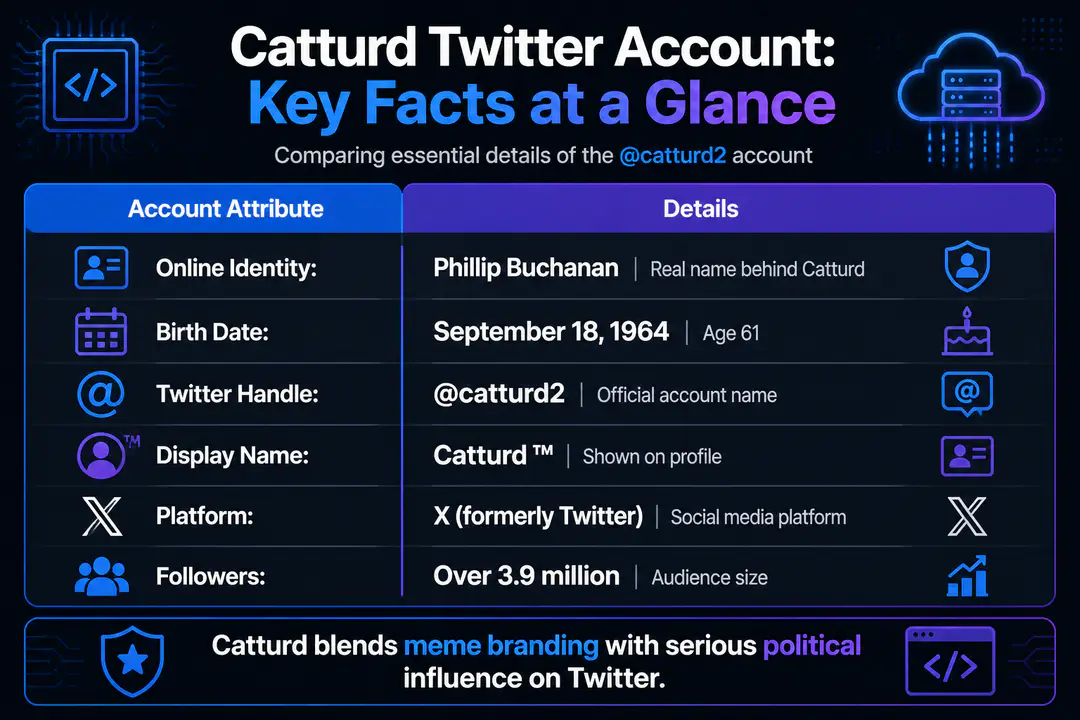
The account’s handle is @catturd2, and the display name is Catturd ™. It has been active since 2018 and built a following that grew into the millions, passing 3.9 million followers. Its scale is a key part of why the account gets covered in discussions about political influence online.
Basic account facts are easier to scan in a side-by-side format:
| Fact | Details |
|---|---|
| Online identity | Phillip Buchanan |
| Birth date | September 18, 1964 |
| Age | 61 |
| Handle | @catturd2 |
| Display name | Catturd ™ |
| Platform | X, formerly Twitter |
| Followers | Over 3.9 million |
| Political alignment | Right-wing, pro-Trump commentary |
| Known controversies | Conspiracy theories, misinformation allegations, moderation disputes |
A few account details explain why it became so visible:
- It posts at very high volume, often reacting in real time to breaking political news.
- It relies heavily on short replies, jokes, polls, and blunt framing that travel well on the platform.
- It developed a loyal audience that treats the account as both commentary and community signal.
As debates about engagement intensified, many users also looked for ways to interpret sudden spikes or drops in visibility. That wider interest in losing Twitter followers helps explain why accounts like this became part of bigger arguments about reach and platform treatment.
Political Views and Content
Catturd is widely identified with right-wing politics, especially the pro-Trump wing of the Republican base. The account regularly comments on Donald Trump, Ron DeSantis, the Republican presidential primary, media coverage, immigration, culture-war issues, and disputes inside conservative politics. Its tone is often mocking and combative, which helps posts spread quickly through replies and reposts.
The account’s content usually falls into a few repeating categories:
- Supportive commentary about Trump and attacks on his critics
- Criticism of Democrats, mainstream media, and federal institutions
- Posts about election integrity, censorship, and alleged bias against conservatives
- Polls and prompts designed to drive engagement around hot-button topics
Catturd also became significant because larger political actors engaged with the account. It has been treated at times as a mood barometer for online conservative audiences, and its posts have intersected with discussions tied to MAGA Inc., Trump-affiliated messaging, and hypothetical primary fights within the Republican coalition.
Controversies and Platform Issues
The account’s notoriety is tied not only to its size but also to recurring controversy. Catturd has been criticized for sharing conspiracy theories and for amplifying claims that opponents describe as misinformation. Some posts and reposts have circulated misleading political narratives, including misrepresented statements from public officials, which is one reason the account remains a frequent reference point in debates about online accuracy.
Moderation fights are central to the account’s story. Catturd repeatedly complained about being shadowbanned, meaning a user believes the platform is limiting visibility without a formal suspension. Those complaints became especially prominent during the transition from Twitter to X and after Elon Musk took over, because Musk openly interacted with the account and elevated broader claims about conservative suppression.
That relationship with Musk mattered politically and culturally. Musk replied to or referenced the account, and Catturd became part of the atmosphere around major platform moments, including changes to recommendation systems, verification, and high-profile political events on Twitter spaces. As X added more AI tools and automated discovery features, debates over platform amplification also overlapped with interest in Grok on Twitter, since users increasingly connected visibility, replies, and algorithmic exposure.
Catturd’s Influence on Twitter
Catturd’s influence comes less from formal authority and more from repetition, timing, and audience trust inside a specific political lane. The account can help push phrasing, jokes, or accusations into mainstream circulation because large follower counts turn ordinary posts into talking points. In online political discourse, that matters even when a post does not introduce new facts.
Its influence shows up in several ways:
- Posts can shape the tone of conservative reactions to breaking news.
- Replies from the account often pull smaller right-wing creators into a shared message cycle.
- Mentions by politicians, campaign figures, or platform owners increase its visibility beyond its core base.
That does not mean the account controls events, but it does help frame them for a sizable audience. In practical terms, Catturd operates as a high-engagement amplifier in American politics, where online personas can affect what trends, what gets repeated on other platforms, and what narratives supporters rally around.
Background on Twitter Platform Changes
Catturd’s rise cannot be separated from how Twitter changed over time. The platform rewarded fast, provocative posting long before Elon Musk bought it, but the post-acquisition period made questions about visibility, account treatment, and editorial discretion even more central. Verification shifts, recommendation changes, and a looser approach to some moderation disputes all affected how political accounts were perceived.
Two platform dynamics are especially relevant here:
- Twitter rewarded engagement-heavy posts, which benefited blunt political accounts that posted constantly.
- The Musk era turned internal policy fights into public drama, giving already prominent users a larger role in shaping the platform narrative.
That helps explain why Catturd became more than a meme account. The feed sits at the intersection of politics, platform design, and audience identity, much like other cases where users study image search techniques or posting patterns to verify what is spreading and why it gains traction.
FAQs
Is Catturd a real person?
Yes. Catturd is the online identity used by Phillip Buchanan.
What is Catturd’s Twitter handle?
The handle is @catturd2, and the display name is Catturd ™.
Why is Catturd controversial?
The account is controversial because it has been linked to conspiracy theories, misinformation allegations, and repeated disputes over moderation and visibility on X.
Why does Catturd matter in politics?
The account matters because it has a very large following, strong engagement in right-wing circles, and a record of influencing online political conversation during major news cycles.
Conclusion
Understanding Catturd requires looking at both the person behind the pseudonym and the platform dynamics that amplified the account. Its prominence offers a useful example of how identity, audience, and influence interact in political discourse on social media.