Virtual Medical Receptionists: How They Work and Why Practices Use Them
A virtual medical receptionist handles front-desk communication without sitting on site. In healthcare, that can mean a remote human receptionist, an AI medical receptionist, or a hybrid model that combines automation with human-in-the-loop support. The best setups reduce missed calls, improve appointment scheduling, support patient intake and insurance verification, and keep routine work from overwhelming in-office staff.
The need is clear. Across 22 medical practices and 7,000 calls, 42% of incoming calls went unanswered during business hours. In a 10-provider practice, front desk teams often manage 300 to 500 calls a day, while eligibility and benefits checks plus prior authorization consume 45% of phone time and scheduling adds another 31%.
What it does
A virtual medical receptionist covers the repetitive but operationally critical tasks that drive patient access. It answers inbound calls, handles call routing, books and reschedules visits, sends appointment reminders, manages after-hours support, and captures patient communication that would otherwise end up in voicemail overflow.
Many systems also support patient intake, refills, eligibility checks, insurance verification, no-show follow-up, waitlist management, payment questions, and warm handoff to billing, nursing, or clinical staff when the request needs escalation.
Answer and route calls
Manage appointment scheduling and rescheduling
Send appointment reminders
Collect patient intake details
Perform insurance verification
Support refills and prior authorization workflows
Handle after-hours support
Reduce missed calls and call abandonment rate
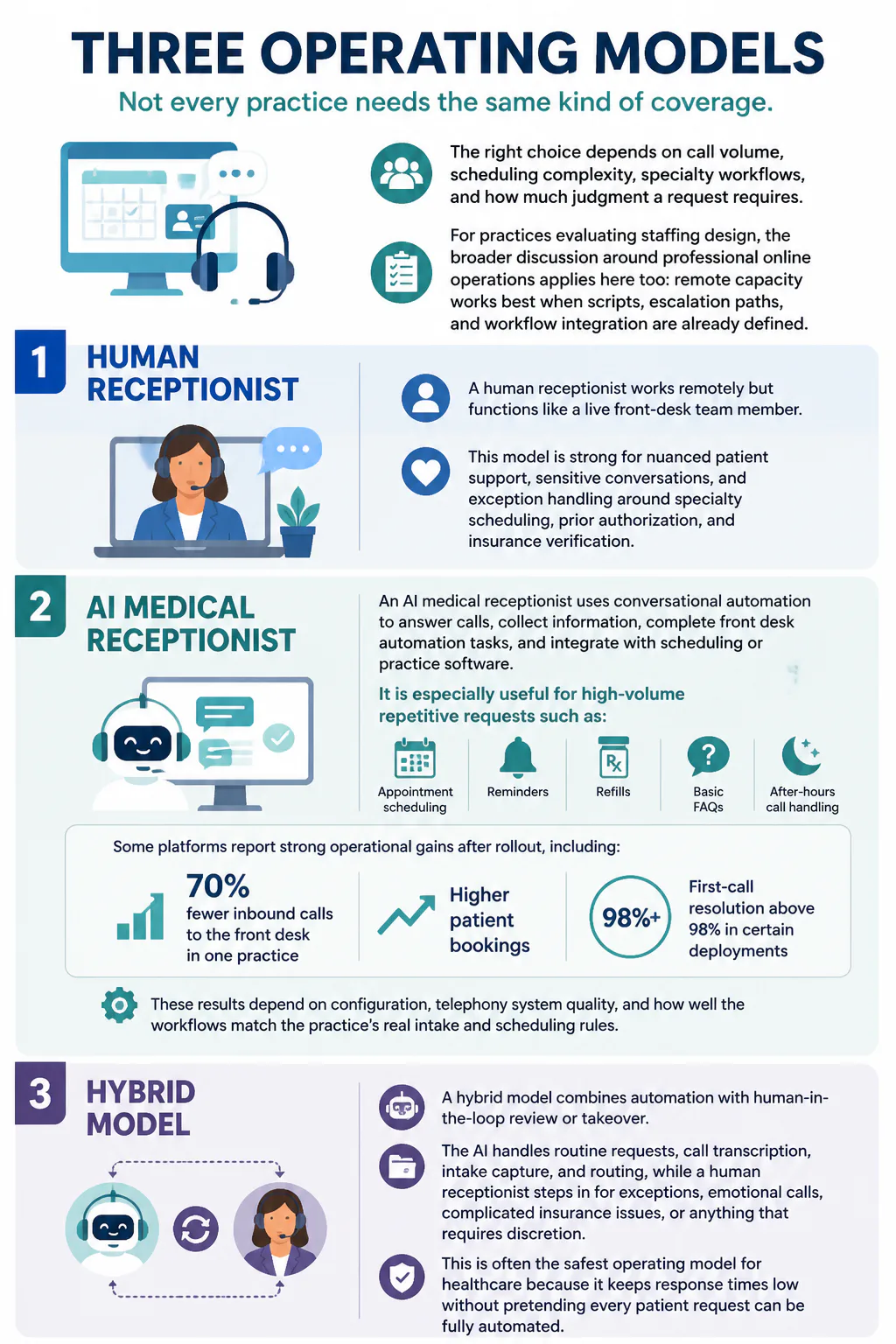
Three operating models
Not every practice needs the same kind of coverage. The right choice depends on call volume, scheduling complexity, specialty workflows, and how much judgment a request requires.
Human receptionist
A human receptionist works remotely but functions like a live front-desk team member. This model is strong for nuanced patient support, sensitive conversations, and exception handling around specialty scheduling, prior authorization, and insurance verification.
For practices evaluating staffing design, the broader discussion around professional online operations applies here too: remote capacity works best when scripts, escalation paths, and workflow integration are already defined.
AI medical receptionist
An AI medical receptionist uses conversational automation to answer calls, collect information, complete front desk automation tasks, and integrate with scheduling or practice software. It is especially useful for high-volume repetitive requests such as appointment scheduling, reminders, refills, basic FAQs, and after-hours call handling.
Some platforms report strong operational gains after rollout, including 70% fewer inbound calls to the front desk in one practice, higher patient bookings, and first-call resolution above 98% in certain deployments. These results depend on configuration, telephony system quality, and how well the workflows match the practice’s real intake and scheduling rules.
Hybrid model
A hybrid model combines automation with human-in-the-loop review or takeover. The AI handles routine requests, call transcription, intake capture, and routing, while a human receptionist steps in for exceptions, emotional calls, complicated insurance issues, or anything that requires discretion.
This is often the safest operating model for healthcare because it keeps response times low without pretending every patient request can be fully automated.
Top 10 Virtual Medical Receptionists companies in the world
(rather than individual receptionists), these are among the most reputable providers globally based on healthcare specialization, reputation, HIPAA compliance, features, and market presence.
| Rank | Company | Best For | Key Features |
|---|---|---|---|
| 1 | Hello Rache | Dedicated medical virtual assistants | HIPAA-trained staff, appointment scheduling, insurance verification, EHR support |
| 2 | Smith.ai | AI + human receptionist | 24/7 call answering, lead qualification, appointment booking, live agents |
| 3 | Moneypenny | Large healthcare practices | 24/7 receptionists, multilingual support, overflow call handling |
| 4 | Nexa | Medical offices needing after-hours coverage | Appointment scheduling, bilingual receptionists, HIPAA-compliant workflows |
| 5 | Ruby | Small private practices | Friendly live receptionists, call routing, mobile app integration |
| 6 | VoiceNation | High-volume clinics | Live answering, message taking, appointment scheduling, HIPAA compliance |
| 7 | MAP Communications | Established medical practices | 24/7 live operators, secure messaging, customized scripts |
| 8 | Remote Leverage | Hiring dedicated full-time medical receptionists | Dedicated staff from Latin America/Philippines, EHR experience, lower long-term cost |
| 9 | Prialto | Administrative + receptionist support | Executive assistants, scheduling, customer service, healthcare support |
| 10 | Global Medical Virtual Assistants (GMVA) | Growing healthcare organizations | Medical virtual assistants, front-desk support, insurance verification, patient coordination |
Services offered by the above companies
- Answering patient phone calls
- Appointment scheduling and rescheduling
- Insurance verification
- Patient intake
- EHR/EMR updates
- Prescription refill requests
- Referral coordination
- Billing inquiries
- After-hours call coverage
- HIPAA-compliant communication
Why practices adopt it
The business case is not just labor savings. It is access, continuity, and revenue protection. Unanswered calls create care delays, lower patient satisfaction, and increase the chance that patients book elsewhere.
Missed appointments cost the U.S. healthcare system more than $150 billion annually, and each missed appointment slot represents about $200 in lost revenue. Better reminder workflows, waitlist management, and faster rescheduling directly affect that number.
Fewer missed calls during peak hours
Lower voicemail overflow
Better patient experience with faster response times
Less administrative burden on front-desk staff
More consistent after-hours support
Stronger no-show recovery through reminders and follow-up
Better staff focus on in-office patient interactions
Where the savings come from
Most front-desk inefficiency comes from interruption-heavy tasks, not isolated long calls. Scheduling, eligibility and benefits checks, insurance verification, refill requests, and prior authorization questions repeatedly pull staff away from patients standing at the desk.
That pattern is similar to why teams follow software updates discipline in other operational systems: small process failures compound quickly when call flow, records, and task ownership are not synchronized.
Reported outcomes vary, but documented implementations include a 40% reduction in voicemails within the first weeks in one case and an increase in call pickup rate from 63% to 89% in another. Some services also position virtual receptionist support as a path to significant overhead reduction when call handling replaces or supplements full-time onsite coverage.
Integration requirements
A virtual medical receptionist becomes useful only when it connects cleanly to the systems your staff already use. The minimum requirement is workflow integration across telephony, scheduling, and documentation.
Telephony system with intelligent call routing
EHR integration for patient lookup and scheduling context
Practice management system access for insurance and billing workflows
Appointment reminders tied to confirmed schedule data
Audit logging for every action
Role-based access controls
Secure call transcription where used
Warm handoff rules for urgent or clinical calls
EHR integration
EHR integration matters because appointment scheduling without real schedule data creates double work. A disconnected receptionist service can still answer calls, but staff then have to re-enter information, correct errors, and chase confirmations.
Insurance workflows
Insurance verification should extend beyond capturing an insurance card. Effective systems support eligibility and benefits checks, plan confirmation, and routing of prior authorization issues to the correct queue before the patient arrives.
Security and HIPAA
A virtual medical receptionist must be HIPAA-compliant. That means more than saying the word HIPAA in marketing copy. Practices should expect a business associate agreement, encryption in transit and at rest, audit trails, role-based access, and clear policies for storing recordings, transcripts, and intake data.
Patient communication channels also matter. If the service sends reminders, collects intake information, or handles refills through voice, text, or portal workflows, each step needs documented access controls and auditable activity records.
Signed business associate agreement
Encrypted communication
Encryption in transit and at rest
Audit logging and audit trails
Role-based access controls
Policies for recordings and transcripts
Defined retention and deletion practices
Choosing the right model
The decision is less about trend and more about task fit. High-volume primary care, multispecialty groups, and practices with heavy after-hours traffic often benefit from more automation. Complex specialty clinics often need stronger human receptionist coverage or a hybrid model.
|
Model |
Best for |
Strengths |
Limits |
|---|---|---|---|
|
Human receptionist |
Complex scheduling, nuanced patient support, specialty workflows |
Empathy, judgment, flexible problem-solving, better handling of exceptions |
Higher labor cost, harder to scale 24/7, variable throughput |
|
AI medical receptionist |
Routine call volume, after-hours support, repetitive front desk automation |
Always available, consistent responses, fast handling of common requests |
Needs strong configuration, weaker on edge cases and emotionally complex calls |
|
Hybrid model |
Practices needing both scale and oversight |
Balances speed with human-in-the-loop escalation, better patient safety posture |
Requires careful workflow design and handoff rules |
Questions to ask vendors
A good evaluation process focuses on workflow detail, not sales language. Ask how the service handles the exact calls your front desk gets every day.
How does appointment scheduling work for new versus established patients?
What happens when the schedule is full?
Can it manage waitlist management automatically?
How are insurance verification and eligibility checks performed?
What is the process for prior authorization questions?
How are refills routed to clinical staff?
What telephony system integrations are supported?
How does the service document calls in the EHR or practice management system?
Is there a business associate agreement?
What audit logging is available?
How are urgent calls escalated through warm handoff?
How are call abandonment rate and missed calls measured after go-live?
Implementation pitfalls
Most failures happen because practices buy call coverage before defining workflow ownership. If the system can answer calls but cannot complete the next step correctly, staff still inherit the same workload with added cleanup.
The same caution appears in any software review worth reading: automation succeeds only when setup matches the real process, permissions are tight, and reporting shows where exceptions pile up.
Poor call routing design
No clear escalation path for clinical concerns
Weak EHR integration
Incomplete scheduling rules
Unclear ownership for prior authorization and refills
No review of transcripts, logs, or error patterns after launch
Choosing full automation for workflows that need human judgment
Best virtual medical receptionist services
The best virtual medical receptionist services do more than answer phones. They reduce missed calls, improve appointment scheduling, support patient intake and insurance verification, and connect cleanly with the front desk, telephony system, and EHR workflow already in place.
That matters because demand is high and capacity is limited. In 22 medical practices covering 7,000 calls, 42% of incoming calls went unanswered during business hours, and a 10-provider practice often handles 300 to 500 calls a day.
Strong options usually fall into three groups: a remote human receptionist, an AI medical receptionist, or a hybrid model with human-in-the-loop escalation. The right choice depends on specialty complexity, after-hours support needs, and how often requests require warm handoff to staff.
Virtual medical receptionist jobs center on handling front desk work from off site for healthcare practices. In 2026, these roles usually fall into three models: remote human receptionist, AI medical receptionist operations support, and a hybrid model with human-in-the-loop escalation.
Most openings focus on live patient communication and workflow execution rather than simple answering service tasks. Day-to-day work often includes appointment scheduling, patient intake, insurance verification, eligibility and benefits checks, refills, call routing, appointment reminders, and warm handoff to billing or clinical teams.
Because a 10-provider practice can receive 300 to 500 calls per day, employers look for people who can reduce missed calls, manage voicemail overflow, and protect the patient experience under pressure. Healthcare-specific roles also require comfort with EHR integration, practice management system workflows, and HIPAA-compliant communication standards such as role-based access, audit logging, and encryption in transit and at rest.
Virtual medical receptionist scheduling
Scheduling is one of the highest-volume front desk tasks in ambulatory care, accounting for 31% of phone time in many practices. A virtual medical receptionist reduces that load by handling appointment scheduling and rescheduling across voice, after-hours support, and callback workflows.
An effective setup does more than book open slots. It applies scheduling rules, captures patient intake details, confirms visit type, supports waitlist management, and sends appointment reminders that reduce no-shows and call abandonment rate.
The strongest results come from workflow integration. When scheduling connects to the practice management system, telephony system, and EHR integration layer, the receptionist can update calendars in real time, trigger follow-up messages, and route exceptions through a warm handoff to staff.
In healthcare, telephone triage also has compliance and workflow requirements. A HIPAA-compliant setup needs EHR integration or documented workflow integration, encrypted communication, audit logging, role-based access, and a business associate agreement so patient communication, call transcription, and follow-up are handled securely.
Virtual medical receptionist job description
A virtual medical receptionist manages front desk communication for a healthcare practice without being physically on site. The role can be filled by a remote human receptionist, an AI medical receptionist, or a hybrid model with human-in-the-loop escalation for requests that need judgment.
Core duties include answering inbound calls, call routing, appointment scheduling, rescheduling, appointment reminders, patient intake, and insurance verification. Many practices also assign after-hours support, refill requests, eligibility and benefits checks, prior authorization intake, no-show follow-up, and warm handoff to billing or clinical staff.
In daily operations, this role is tied to front desk automation and workflow integration with the telephony system, practice management system, and EHR integration. Because healthcare data is involved, the position must operate in a HIPAA-compliant environment with a business associate agreement, role-based access, audit logging, and encryption in transit and at rest.
Virtual medical receptionist in Florida
A virtual medical receptionist in Florida helps practices manage high call volume, after-hours support, patient intake, and appointment scheduling without adding more on-site front desk staff. That matters in busy primary care, specialty, dental, and multi-location groups where missed calls quickly turn into lost bookings and weaker patient experience.
The core options are the same in Florida as elsewhere: a remote human receptionist, an AI medical receptionist, or a hybrid model with human-in-the-loop escalation. The right fit depends on scheduling complexity, insurance verification needs, language coverage, and how often the practice needs warm handoff to billing, nursing, or referral staff.
Operational discipline matters more than geography alone. A Florida practice should look for HIPAA-compliant workflows, EHR integration, secure call routing, appointment reminders, eligibility and benefits checks, and clear audit logging so front desk automation improves access without creating compliance risk.
Best virtual medical receptionist in Australia
A virtual medical receptionist in Australia serves the same core role as elsewhere: handling front-desk communication, appointment scheduling, patient intake, insurance verification, and after-hours support without requiring every interaction to be managed on site. The practical difference is local workflow fit, including time zones, clinic hours, and how the service connects to the practice’s telephony system and practice management system.
For Australian practices, the best setups are less about geography than execution. A HIPAA-compliant approach remains a strong benchmark for privacy controls, including encrypted communication, audit logging, role-based access, and clear workflow integration with EHR integration, call routing, and appointment reminders.
The business case is straightforward. High call volumes, missed calls, and voicemail overflow create administrative burden and weaken patient experience, while better front desk automation can reduce call abandonment rate, support eligibility and benefits checks, and free staff to focus on in-person patient support and exception handling.
Strongest virtual medical receptionist services
The strongest virtual medical receptionist services solve the same front-desk problems first: missed calls, voicemail overflow, appointment scheduling delays, and rising administrative burden. In healthcare, the best fit depends less on hype and more on call volume, specialty workflows, HIPAA-compliant handling, and EHR integration.
That matters because 42% of incoming calls in one 7,000-call sample across 22 medical practices went unanswered during business hours. In a 10-provider practice handling 300 to 500 calls a day, better call routing, appointment reminders, patient intake, and insurance verification can directly improve patient experience and reduce call abandonment rate.
If you are comparing options in 2026, group them into three practical models: human receptionist, AI medical receptionist, and hybrid model. The right choice is the one that answers routine requests fast, escalates exceptions with a warm handoff, and fits your telephony system, practice management system, and security requirements.
FAQ
Can a virtual medical receptionist replace in-office staff?
No responsible healthcare operation should assume full replacement. A virtual medical receptionist works best as support, overflow handling, after-hours access, or a structured front desk automation layer. Many practices still need onsite staff for check-in, payments, scanning, and in-person patient support.
Is an AI medical receptionist safe for healthcare?
It can be, if the system is HIPAA-compliant and the workflow includes role-based access, encryption in transit and at rest, audit trails, and clear escalation rules. Safety depends on configuration and governance, not on the label alone.
What tasks should stay with humans?
Complex triage-adjacent calls, emotionally sensitive conversations, exceptions in specialty scheduling, disputed insurance issues, and any request that needs judgment should stay with human staff or move through a hybrid model.
How quickly can results show up?
Some practices report early gains within weeks, including reduced voicemail volume and better pickup rates. The fastest improvements usually appear in missed calls, voicemail overflow, and after-hours response coverage.
What metrics matter most after launch?
Track missed calls, call abandonment rate, pickup rate, first-call resolution, voicemail overflow, no-show rate, appointment reminders delivered, scheduling conversion, and staff time shifted away from repetitive phone work.
Conclusion
A virtual medical receptionist is most valuable when it solves a specific front-desk bottleneck: unanswered calls, scheduling overload, after-hours gaps, or insurance verification drag. If your practice handles high call volume and routine patient communication is pulling staff away from care, start with a hybrid model, insist on HIPAA-compliant controls, and evaluate success with call pickup, no-show reduction, and staff workload data within the first 30 to 60 days.