
Star Citizen Developer Stream Goes Off the Rails During Siege of Orison Showcase
The Star Citizen Developer Stream was supposed to prove that the troubled Siege of Orison mission works as intended on an internal build. Instead, the live stream turned into a public display of bugs, awkward developer exchanges, and a failed mission demo that reinforced long-running concerns about Star Citizen, its early access state, and the gap between intended design and what players actually experience.
For fans, the moment mattered because Cloud Imperium Games, or CIG, used the broadcast to answer complaints about the mission’s state on the Public Test Universe. Rather than restoring confidence, the VOD gave viewers a clearer look at the same technical issues that have fueled community backlash for years.
What the stream tried to show
The August 5 broadcast was an official Star Citizen Live session built around a simple idea: show Siege of Orison on an internal build and demonstrate the intended mission flow. The developers explained that the version on the Public Test Universe, effectively the game’s public test server, was dealing with major instancing problems and performance issues.
That setup was important because it framed the stream as a corrective. CIG was not showing a polished trailer or a scripted vertical slice. It was presenting local server gameplay from an internal build to argue that the mission’s public version was not representative of the intended experience.
That distinction between an internal build and a public test server is common in game development, especially in large online games. The problem here was that the mission demo still looked unstable even under conditions meant to be more controlled, which made the justification much harder for viewers to accept.
How the demo unraveled
The mission chosen for the stream was Siege of Orison, and the team quickly ran into the same kinds of failures players have complained about. The session showed weapons malfunction, weapon swapping problems, inventory issues, combat interruptions, trouble using medical equipment, and failed attempts to revive teammates.
What made the stream especially damaging was not one dramatic crash, but the accumulation of small failures. The buggy mess kept interrupting basic actions that should support the mission’s core loop, so the team struggled to move cleanly from one objective to the next.
Viewers also saw the limits of the build in real time. A mission meant to demonstrate intended design instead highlighted how fragile the experience still is, even before adding the extra stress of the Public Test Universe and wider player concurrency.
-
Weapons would not behave reliably during firefights.
-
Weapon swapping became inconsistent.
-
Inventory access created friction during mission progress.
-
Medical equipment did not support smooth recovery flow.
-
Attempts to revive teammates became another point of failure.
-
General technical issues kept disrupting combat and coordination.
Anyone who follows unstable online games will recognize the pattern from other live-service headaches, including anti-cheat and client-side update friction seen in pieces like Vanguard update security coverage, where technical design choices can dominate player reaction more than the content itself.
Awkward moments on-air
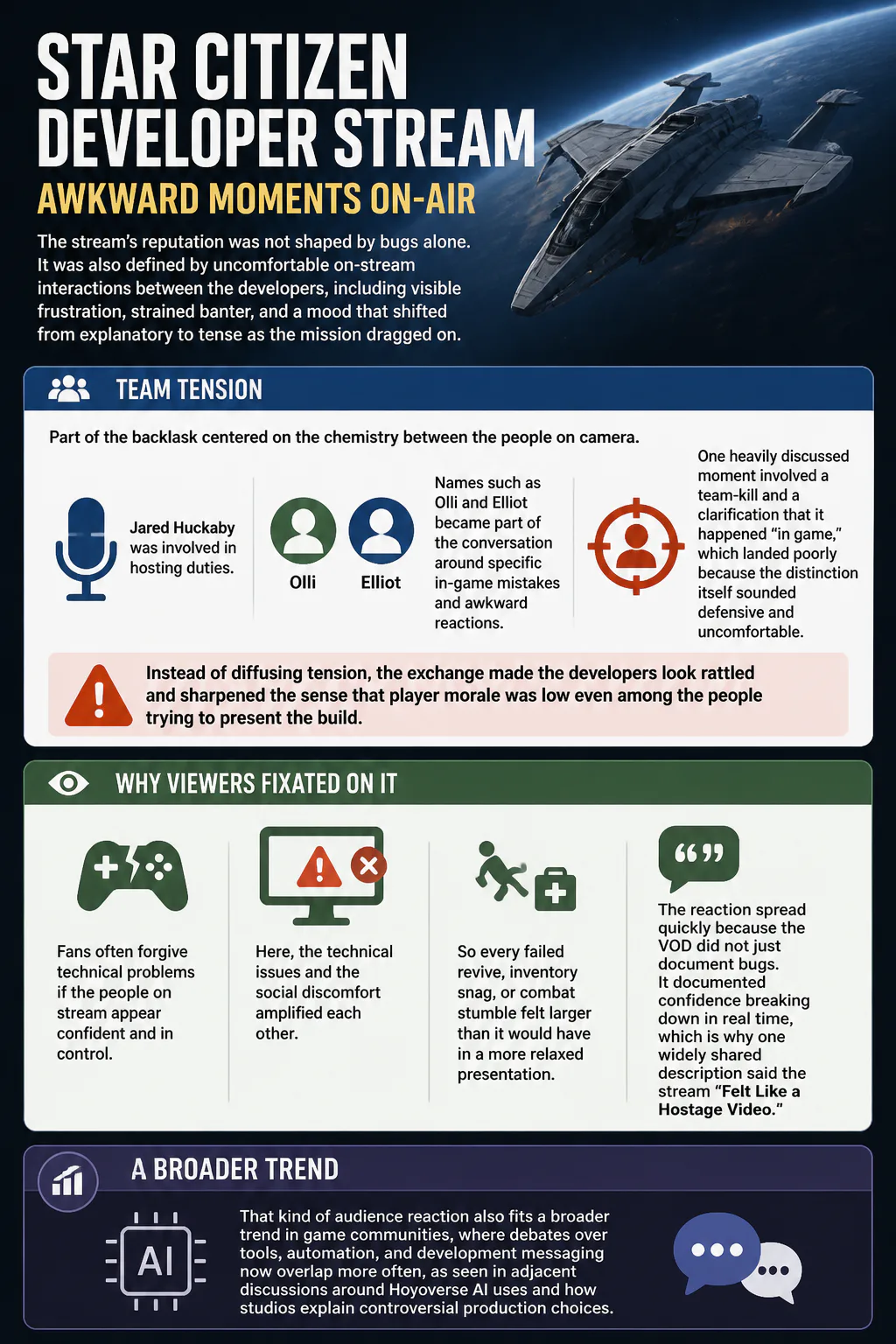
The stream’s reputation was not shaped by bugs alone. It was also defined by uncomfortable on-stream interactions between the developers, including visible frustration, strained banter, and a mood that shifted from explanatory to tense as the mission dragged on.
Team tension
Part of the backlash centered on the chemistry between the people on camera. Jared Huckaby was involved in hosting duties, while names such as Olli and Elliot became part of the conversation around specific in-game mistakes and awkward reactions.
One heavily discussed moment involved a team-kill and a clarification that it happened “in game,” which landed poorly because the distinction itself sounded defensive and uncomfortable. Instead of diffusing tension, the exchange made the developers look rattled and sharpened the sense that player morale was low even among the people trying to present the build.
Why viewers fixated on it
Fans often forgive technical problems if the people on stream appear confident and in control. Here, the technical issues and the social discomfort amplified each other, so every failed revive, inventory snag, or combat stumble felt larger than it would have in a more relaxed presentation.
The reaction spread quickly because the VOD did not just document bugs. It documented confidence breaking down in real time, which is why one widely shared description said the stream “Felt Like a Hostage Video.”
Why the ending hit badly
The stream reportedly ran for about an hour and a half before the attempt effectively collapsed. Rather than reaching a satisfying conclusion, the team was told they were out of time and needed to wrap up, which made the session feel less like a completed demonstration and more like a failed exercise that had to be cut short.
That ending mattered because the entire point of the broadcast was to show that Siege of Orison could work properly on an internal build. When the mission demo ended without delivering that proof, the stream’s central argument failed with it.
The abrupt sign-off also left little room for recovery. A postmortem, a clear explanation of what broke, or a structured comparison with the Public Test Universe could have softened the blow, but the close instead reinforced the impression of lost control.
Why players reacted so strongly
The backlash was bigger than one bad live stream because Star Citizen carries unusual baggage. The project has been in development for about 15 years, has raised more than $1 billion through crowdfunding, and has been in early access since 2017.
Under those conditions, a failed mission demo does not look like a minor stumble. It becomes a symbol of the wider complaint that the game remains unable to consistently deliver basic reliability despite years of development and a massive funding total.
Trust and crowdfunding
Crowdfunding changes the relationship between studio and audience. Players do not just buy a finished product; they fund the promise of progress, which makes every public showcase a test of credibility as much as a test of technology.
That is why this stream drew such intense scrutiny. CIG was effectively asking players to trust that the public experience was worse than the intended one, and then the internal build itself exposed serious technical issues in front of them.
Early access fatigue
Many games use early access as a buffer for instability, but long timelines change audience patience. By 2026, players are less likely to treat repeated breakdowns as normal development noise when the game has already spent years available in an unfinished state.
Squadron 42 context
The stream also landed against the backdrop of ongoing claims about Squadron 42. Chris Roberts has said the single-player game is playable start to finish and on track for a 2026 release.
That context cuts both ways for CIG. On one hand, it gives supporters a reason to believe major progress is still happening. On the other, a visibly unstable Star Citizen mission demo makes it harder for skeptics to accept optimistic messaging without stronger proof.
What it means now
The Star Citizen developer stream mattered because it was meant to settle a specific dispute over intended gameplay and instead deepened distrust. It showed that even in a controlled internal build, Siege of Orison could still devolve into technical issues, stalled progress, and visible developer frustration.
If players wanted clarity on why the stream caused backlash, the answer is simple: CIG tried to demonstrate confidence, and the live stream documented the opposite. Until the public test server and the live game can reliably deliver the mission without the same failures, this VOD will remain a reference point in the argument over whether Star Citizen’s long development is still earning the community’s trust.