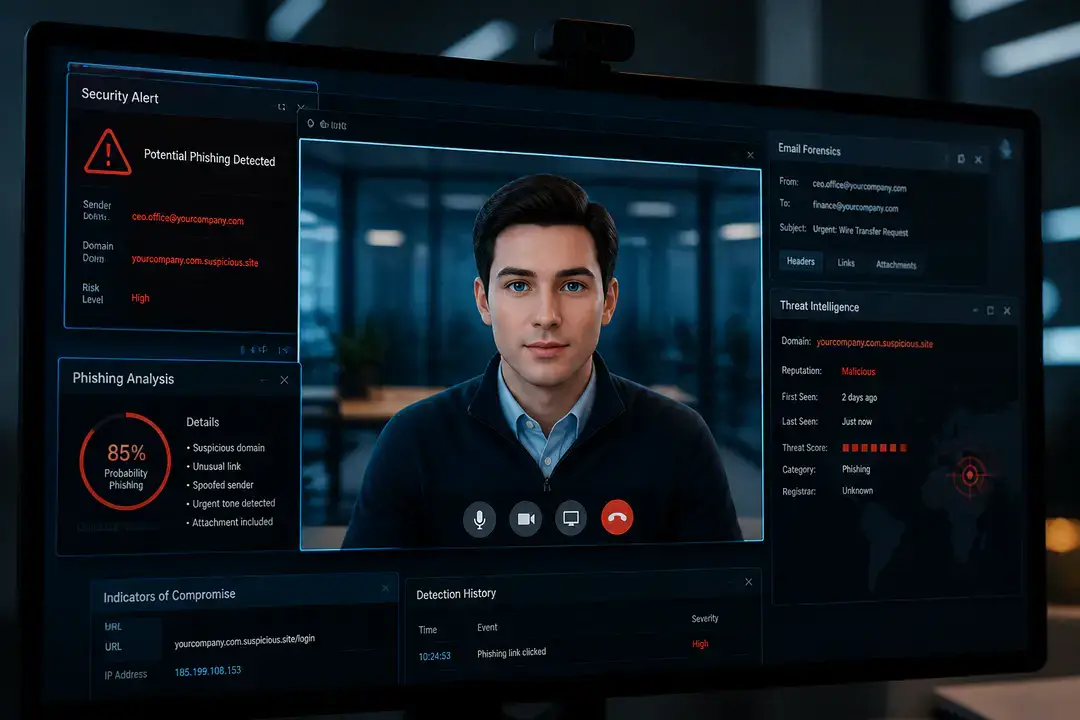
Spotting AI-Generated Video in Phishing and Brand Impersonation Attacks
Phishing and brand impersonation attempts using AI-synthesized videos can be identified by observing the unnatural mouth and eye movements, misaligned lighting or audio sync, and the context which usually leverages you to act quickly. Yes, the most trustworthy indication is hardly ever the video itself, it is the accompanying request: an immediate money transfer, a request for credentials, or a link that doesn’t correspond to the brand’s genuine domain. Consider any video that urges you to act promptly as questionable, regardless of how friendly the person on the screen looks.
It is important since the technical level of synthetic video has risen so fast that relying on the old piece of advice (search for errors) doesn’t work anymore alone. Attackers nowadays come up with deepfake CEO, fake spokesperson videos, and cloned brand commercials that even after a quick look seem real. Security departments indicate that the best protective measure is a procedural one rather than a visual, i.e. verification practices and confirmation via a different channel are more important than any single sign. Though, being aware of the visual and contextual hints gives you the opportunity to slow down and verify.
What AI-generated video looks like in a phishing attempt
Most fake videos created with malicious intent match a few patterns. The worst kind is a deepfake video call or a recorded message impersonating a known executive, which is used in business email compromise schemes to authorize wire transfers or changes to vendors. Then, there is brand impersonation, where cybercriminals clone a company’s spokesperson or the style of their advertisement to lure online users into fake giveaways, scams, or phishing pages for stealing passwords, etc. Low-effort ones just merge a real public video with a cloned voiceover, which is cheaper to make and has become increasingly common.
The supply side most likely explains the sudden increase. Creating a simple synthetic video which previously was the domain of specialists can now be done by the average consumer with the help of software and in a matter of minutes, a fact that has led to a sharp increase in the number of such attacks per the security threat reports of the industry. The attackers do not need a perfect video. They only require a clip good enough to hold the target’s attention for the few seconds that they are looking at the video before clicking, and that standard is lower than most people think.
The visual tells that still give synthetic video away
The face is still the source of the failures. The first step is to look at the eyes, since irregular or unnatural blinking is a common source, as well as an unnatural gaze (glassy or frozen and not following naturally). Next look for the mouth, where the text tends to run behind or ahead of the audio, and the teeth or tongue tend to be blurry or flash across frames. Edges and lighting are revealing also. Pay special attention to the boundaries between skin and hair, ears and neck as with synthetic composites they often tend to exhibit a mild softness or flickering distortion at the fine edges.
Uneven lighting between the face and background, or strangely cast shadows are a dead giveaway that the object is composite or cut&paste. Hands and ears are known trouble spots, as both are difficult objects to model accurately and are often noticeably distorted with the wrong number of fingers, or strange shapes. These indicators are weakening over time; don’t use these as your only guides!
An already-visible indicator of a VC can be added to, or a good VC can have a very odd set of compression artifacts that closely resemble visual indicators. The visual layer is intended as a tiebreaker, not a final arbitrator; the more heavily compressed the clip is for social media, the more difficult these indicators are to interpret.
Why context catches what your eyes miss
The telltale signs of the fake video are usually present outside the main video, not within it. In fact, nearly every deepfake-video scam comes with a desperate demand that tries to exploit your trust and makes you want to ignore your usual verification steps: sending the payment immediately, confirming your login by clicking this link, completing this transaction before the end of the day, etc. In reality, legitimate companies seldom use a single, unidentified video for communicating highly-sensitive matters. Also, any video that features a well-known face issuing an urgent request for a large amount of money should raise questions by just looking at the situation, without even considering the technical aspects of the video.
Check the delivery channel and the destination. A spokesperson video pushing a deal will sit on a lookalike domain, a freshly created social account, or a link whose URL doesn’t match the brand’s real one. Hover before clicking, inspect the sender, and confirm the account’s age and verification. The same scam logic that fuels fake-spokesperson ads is why platforms that exist for legitimately generating social media video ads put authenticity and brand-account verification at the center of their products, since the format itself is so easily abused by impersonators operating outside those guardrails.
Verification out-of-band is the tactic that really prevents the attack from happening. If a video looks like it is from your CEO, your bank, or a vendor, get in touch with them through a known and reliable way that you have used before, rather than the number or link in the message. This one little habit can stop most of these scams, no matter how good the video is, which is the reason why security training is nowadays focusing on it instead of on spotting pixels.
How the risk differs across organizations and individuals
The appearance of the threat changes given who you are. Finance and executive teams at mid-to-large companies have exposure to the highest-value version, the targeted deepfake fraud authorizing a transfer, where a single successful attempt may result in six or seven figure losses. Such attacks are not only researched but also highly personalized, sometimes referring to real projects. That means, the procedural defenses (dual approval on payments, verification thresholds) become A lot more important than the visual inspections. Consumers and small businesses are unluckily exposed to the high-volume version. The fake celebrity or brand endorsement videos promoting cryptocurrencies, fake stores, or account-recovery scams are mass-produced, not very customized, and That means, visual signs of deception are often quite careless and the contextual red flags are very obvious (too-good-to-be-true offers, off-brand domains).
The public-facing brands are exposed to a third risk, impersonation of their own brand ambassadors, which leads to loss of customer trust even when the company itself is not directly affected, and which calls for active monitoring of the brand’s appearance. It is also shaped by regional and platform factors. Attacks mostly utilize local payment systems and languages, and the platforms that have weaker user verification are more prone to impersonation. What works for a corporate finance team as a defense (strict payment controls) hardly helps a brand that is trying to protect its public image and it is those that need takedown processes and monitoring.
Further Reading