How Gaming Affects the Brain, ScookieGeek
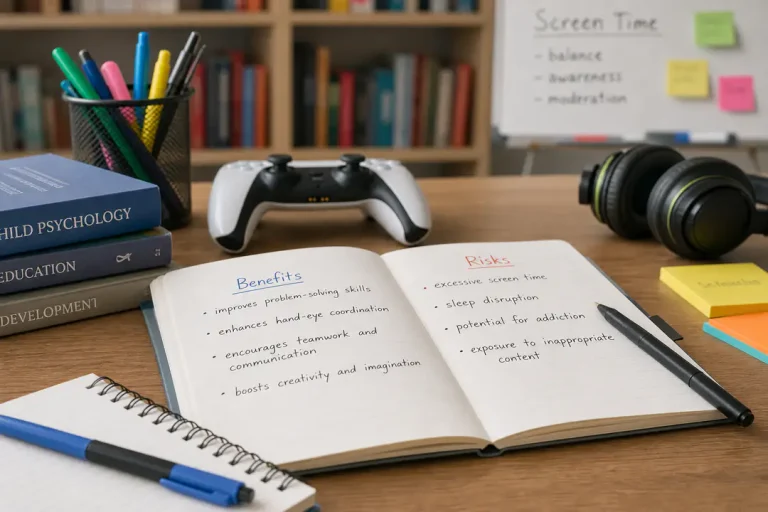
Gaming can both help and harm the brain. That is the short answer, and the science backs both sides: video games can strengthen cognition, visual attention, reaction time, hand-eye coordination, and some forms of learning, while excessive play can disrupt sleep, amplify reward-driven habits, and in some people contribute to gaming disorder. The most useful way to read the evidence is not as a verdict on games as a whole, but as a question of dose, genre, and context. On ScookieGeek, where gaming culture often gets reduced to either hype or panic, the better view is balanced: the brain changes linked to play involve the prefrontal cortex, hippocampus, amygdala, dopamine signaling, and the neural pathways shaped by neuroplasticity.
What the Brain Does During Play
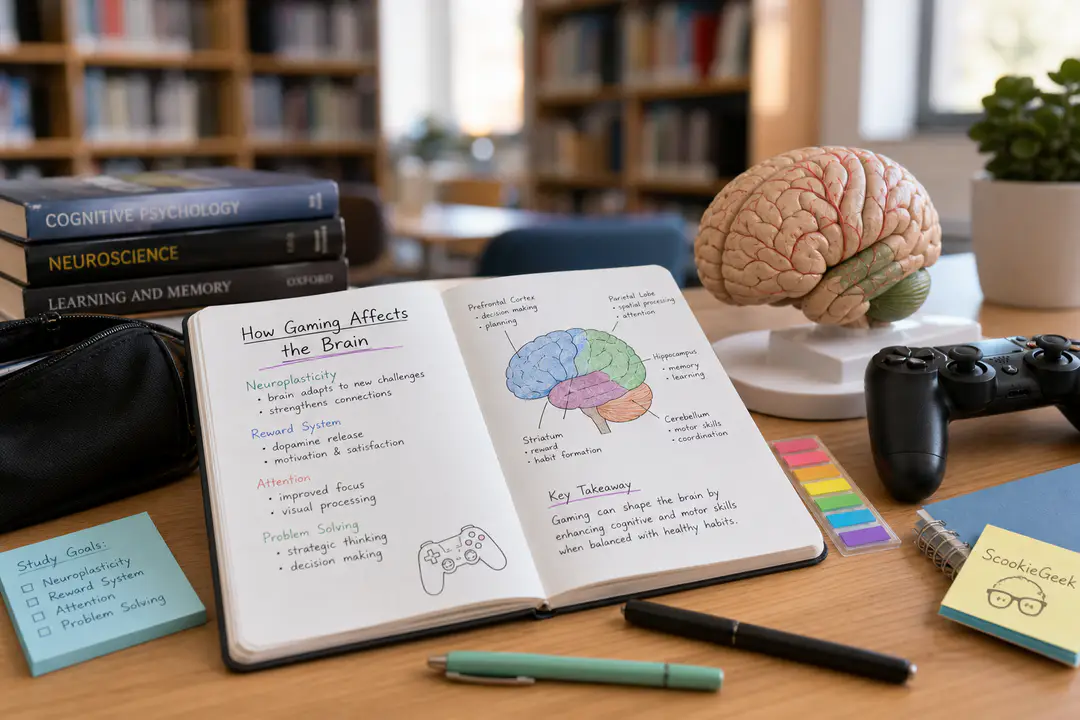
A fast game session is not one mental process. It is a stack of processes happening at once: visual processing tracks enemies or objects, motor responses convert perception into movement, working memory holds short-term goals, and decision-making updates every second as the game state changes. That is why neuroimaging studies, including MRI work, keep returning to multiple brain regions instead of one single “gaming center.”
The prefrontal cortex is central when a game asks for planning, inhibition, and focus. Strategy titles, puzzle games, and difficult action games all push this system, especially when players must ignore distractions and switch between objectives. The hippocampus becomes more relevant when navigation, map learning, and long-term memory matter. In 3D adventure games, that spatial load is not incidental; it is one of the main reasons those games are often discussed in relation to neuroplasticity and brain function.
The amygdala has a different role. It helps process emotional engagement, threat, stress, and salience. In a competitive FPS match, the brain is not only tracking aim and reaction time; it is also tagging moments as urgent, rewarding, frustrating, or risky. Dopamine then reinforces patterns that feel rewarding, which can support learning and persistence, but also feed compulsive repetition when play becomes excessive.
Cognitive Gains
Attention and speed
Action-heavy games are consistently associated with stronger visual attention and faster reaction time. That does not mean every player becomes broadly “smarter,” but it does mean repeated practice can sharpen the ability to detect relevant visual cues quickly and act on them. FPS games are the clearest example because they combine target selection, rapid motor responses, and constant attentional filtering.
- Visual attention improves when players monitor multiple moving elements at once.
- Reaction time benefits from repeated, high-speed perception-to-action cycles.
- Hand-eye coordination improves because successful play depends on precise timing.
- Focus can become more stable in tasks that reward selective attention and error correction.
Those skills do not transfer perfectly to every real-world task, but the underlying point is solid: repeated gameplay can reshape neural pathways tied to speeded visual processing and controlled responses.
Memory and learning
Games also recruit different memory systems in different ways. Working memory helps when a player tracks cooldowns, inventory, enemy positions, and immediate goals. Short-term memory supports temporary information retention, while long-term memory matters when players learn map layouts, enemy behavior, quest logic, or efficient routes through a level.
Puzzle and strategy games lean more heavily into memory-based learning than reflex-heavy action titles. That makes them useful examples when discussing cognition beyond speed. A player solving layered puzzle sequences is practicing information holding, rule updating, and problem-solving, while a strategy player is often rehearsing prediction and planning over longer time horizons.
That same pattern shows up in other skill domains too. Just as repeated practice shapes performance in physically demanding training programs such as high-performance BLS training, repeated game tasks can strengthen task-specific brain function through repetition and feedback.
Spatial cognition
3D navigation matters because the brain treats space as information, not background scenery. In games built around exploration, players continually encode routes, landmarks, and directional relationships. The hippocampus is heavily involved in this process, which is why 3D adventure titles are often discussed in relation to spatial learning and grey matter differences in neuroimaging research.
That does not make every open-world game a brain-training tool. It means the design of the game determines what the brain rehearses most often.
What Review-Level Research Shows
A useful snapshot of the evidence comes from a systematic review of randomized controlled trials published after 2000. It included 9 scientific articles, and the eligible studies were rated as fair quality under Delphi Criteria. The interventions were not tiny one-off exposures either. Training durations ranged from 16 to 90 hours, which gives the findings more weight than a single short lab session.
The game genres studied covered a meaningful spread of cognitive demands: 3D adventure, first-person shooting (FPS), puzzle, rhythm dance, and strategy. That matters because game genres recruit different combinations of attention, memory, motor control, timing, and emotional engagement. Treating “video games” as one uniform activity hides the actual mechanism.
| Genre | Primary brain demands | Likely cognitive emphasis |
|---|---|---|
| 3D adventure | Spatial navigation, exploration, memory | Hippocampus-linked spatial learning, long-term memory |
| FPS | Rapid visual scanning, motor speed, threat response | Visual attention, reaction time, hand-eye coordination |
| Puzzle | Rule tracking, sequencing, logic | Working memory, problem-solving, focus |
| Rhythm dance | Timing, synchrony, movement matching | Motor responses, coordination, attention |
| Strategy | Planning, resource control, inhibition | Decision-making, prefrontal control, learning |
Researchers and science writers discussing this area, including names such as Luke Grayson, often point readers toward databases like PubMed and Google Scholar for a reason: the strongest claims come from controlled studies and neuroimaging, not from blanket assumptions that all games are either harmful or beneficial. MRI and other neuroimaging methods can show associations in brain structure and brain function, including changes linked to grey matter, white matter, and activation patterns during tasks. Those findings are valuable, but they still need cautious interpretation. A brain difference on MRI is not automatically a life outcome.
Emotion, Reward, and Stress
The reward system is where gaming becomes psychologically powerful. Dopamine is central here, not as a simplistic “pleasure chemical,” but as part of a learning signal that helps the brain mark actions worth repeating. Leveling up, winning matches, unlocking loot, and hearing immediate feedback sounds are effective because they tighten the loop between action and reward.
That loop has upsides. It supports persistence, fast feedback-based learning, and stress relief for many players. After a difficult day, a structured game session can reduce mental overload by replacing scattered real-world demands with clear rules, visible progress, and controllable goals. Social games can also improve social behavior for some players by creating cooperation, role coordination, and shared achievement.
But emotional engagement cuts both ways. Frustration spikes, anger after losses, and reward chasing after near-misses can keep the brain in a heightened state longer than intended. The amygdala is relevant here because it helps tag emotionally intense moments, especially under competition or threat. If that pattern extends late into the evening, it can collide with recovery and sleep. Similar trade-offs show up in other forms of health behavior, where stimulation, fatigue, and performance interact over time, much like the broader balance discussed in daily step targets.
- Reward-rich games can support motivation and learning.
- Competitive games can increase emotional intensity and stress.
- Co-op play can reinforce social connection and teamwork.
- Long sessions close to bedtime can leave arousal too high for easy sleep onset.
Where the Risks Become Real
Gaming disorder
Most players do not have gaming disorder. The difference is that normal enthusiasm does not require sacrificing school, work, sleep, or relationships, while clinical impairment does. Gaming disorder is about loss of control, priority given to gaming over other activities, and continuation despite harm.
What pushes the risk upward is not just time spent playing. The stronger pattern is reward dependence plus impaired self-regulation, especially when the prefrontal cortex is losing the contest with immediate dopamine-driven reinforcement. In practical terms, a person keeps playing despite worsening school, work, sleep, or relationships.
Sleep disruption
Sleep disruption is one of the most common downsides of excessive gaming. Bright screens, emotional arousal, social pressure to stay online, and the unresolved “one more match” loop all make disengagement harder. Even when players enjoy gaming as stress relief, a late session can still leave the brain too activated to shift cleanly into sleep.
That matters because poor sleep weakens attention, mood regulation, learning, and memory the next day. In other words, one of the main systems gaming can sharpen in moderation, cognition, is one of the first systems sleep loss starts to erode.
Social isolation and displacement
Gaming is not inherently isolating. Multiplayer games can be highly social. The problem appears when gaming displaces offline responsibilities, exercise, schoolwork, or face-to-face relationships for long stretches.
- Skipped sleep and irregular schedules
- Reduced physical activity
- Irritability when unable to play
- Declining interest in non-gaming activities
- Persistent conflict over time spent gaming
Those signs do not prove addiction on their own, but they are useful markers that gaming is shifting from hobby to harmful habit.
Genres Matter More Than People Admit
One reason broad arguments about games go nowhere is that game genres are doing very different things to the brain. A rhythm dance game trains timing and coordinated movement. A puzzle game stresses rule maintenance and working memory. A strategy game leans harder on planning and delayed decision-making. An FPS taxes visual attention and rapid motor output. A 3D adventure title places more weight on spatial mapping and exploration.
If someone says gaming improved their focus, the follow-up question should be: what kind of gaming? If another person says gaming wrecked their sleep, the genre still matters, but the stronger variables are timing, duration, emotional intensity, and social pressure to keep playing.
That same genre logic also explains why some neuroimaging findings look inconsistent across studies. Brain structure and brain function adapt to what gets practiced. A player spending dozens of hours on strategic planning is not rehearsing the same circuitry as someone grinding twitch aim in an FPS. Neuroplasticity is specific. The brain changes in response to repeated demands, not to the label “video game.”
Portable play adds another wrinkle because access becomes constant. Devices designed as entertainment hubs and travel tools, including the kind of mobile-first convenience discussed in travel companion phones, make it easier to fill every idle moment with stimulation. That changes exposure patterns even when the games themselves stay the same.
Reading MRI Findings Carefully
MRI studies often attract the most attention because pictures of the brain feel definitive. They are useful, but they are not magical proof. An MRI can identify associations involving grey matter, white matter, and activation in regions tied to attention, memory, reward, or control. Neuroimaging can show that regular players differ from non-players in measurable ways. What it cannot do on its own is settle why those differences exist.
Some differences reflect training effects. Some reflect self-selection, where people with certain cognitive strengths or preferences are more drawn to certain game genres. The strongest evidence comes when behavioral change and neuroimaging findings line up after controlled training exposure, which is why randomized controlled trials matter more than casual before-and-after claims.
That is also why fair-quality studies under Delphi Criteria still require restraint in interpretation. Fair quality is useful evidence, not final certainty. Brain science on gaming has enough signal to reject simplistic myths, but not enough to support absolute claims that gaming always improves the brain or always damages it.
The Bottom Line
Gaming changes the brain because repeated experience changes the brain. The important question is what kind of experience gets repeated: fast attention training, spatial learning, social cooperation, reward chasing, sleep loss, or compulsive overuse. As games become more persistent, mobile, and socially continuous, the smartest response is not panic or celebration, but better matching of genre, schedule, and limits to the kind of brain effects you actually want.