How to Optimize Your Workspace for Better Welding Efficiency and Safety
The main cause of welding inefficiency is not the lack of skill of the workers but the way the workspace is organized. If a welder spends most of their time looking for materials, walking over cables, or waiting for smoke to dissipate, the real job – welding – is hardly being carried out. According to the standards of the sector, the percentage of productive welding time in a poorly optimized workshop would be between 20% and 30% of the workday (American Welding Society), meaning that up to 80% of the hours worked are dedicated to unnecessary tasks that could have been avoided or reduced with optimal design of the workspace.
To improve this ratio, it’s not necessary to build a new workshop, we just need to apply industrial design criteria that for decades has been standard for reducing waste in factories: Lean manufacturing.
Design Around A Linear Workflow
The biggest cause of unnecessary movement in a welding bay is having to shuffle material around with no purpose. Raw stock sitting next to finished parts. The grinder is clear on the other side of the shop from the bench. Work doubles back on itself.
A linear layout eliminates all that by matching the physical space to the sequence of work: storage of raw material, cutting and prep, the welding bay, and then grinding and inspection store. Work flows one way. You’re not doubling back on yourself. You’re not carrying stock past stations it doesn’t need to visit yet.
For a small shop or garage, the same idea still applies if it’s just one bench. One end is for prep, the other for finishing. The bench in the middle is for welding.
Organize The Work Envelope
A well-designed station is one where everything a welder needs during a job is located within arm’s reach without having to reposition. That means storing angle grinders, wire brushes, clamps, anti-spatter spray, and consumables at the bench – not on a shelf across the room.
Height-adjustable benches also play a role here. If you force a welder to stoop over a fixed-height surface for an entire shift, you’re going to build fatigue that impacts quality and raises the risk of injury. Ergonomic positioners – turntables or lift tables that rotate the workpiece – allow the welder to remain in a downhand position regardless of the joint orientation, which is faster and easier on the body.
When it comes to tooling up a station, there’s no shortage of options if you want to find a selection of welding equipment online — the key is making sure everything you bring in is matched to the specific processes you’re running, rather than simply buying whatever is most readily available.
Task lighting is also frequently underestimated. High-intensity adjustable LED lighting located at the weld area allows operators to see joint prep and weld pools clearly. This is especially important when welding with a hood on.
Build A Dedicated Hot Zone
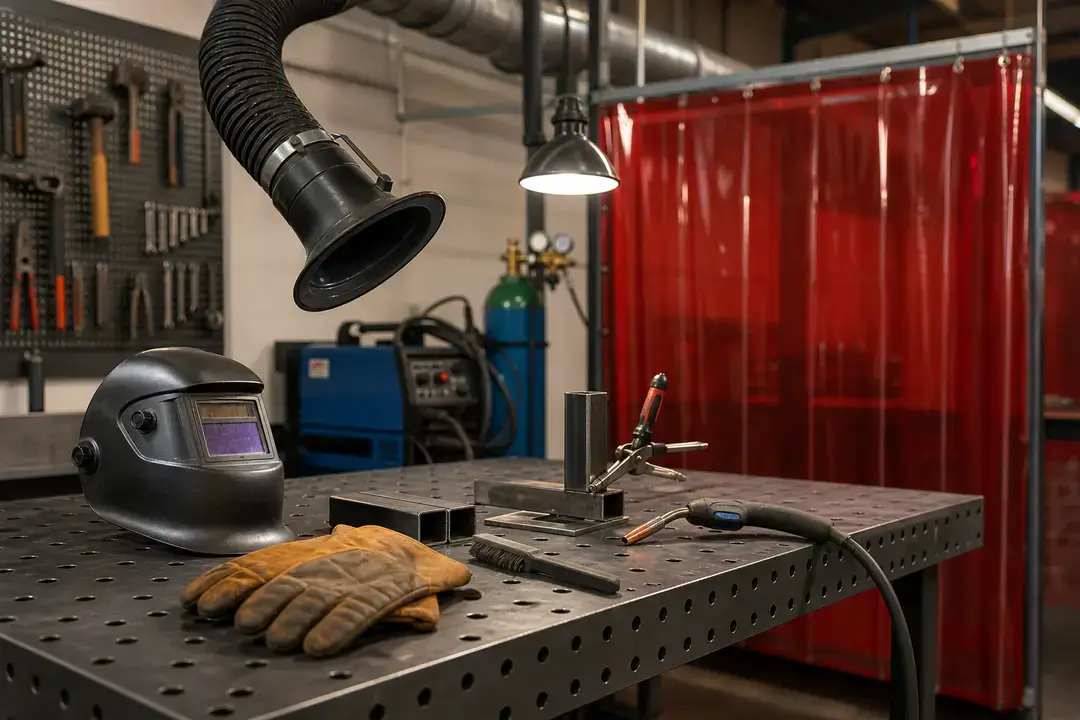
The welding arc gives off ultraviolet and infrared radiation that extends far outside the immediate work area. A welder looking at a joint won’t realize a coworker has entered the radiation field a few feet away. Welding curtains – PVC screens that are UV- and IR-rated – make a visible, physical boundary.
That “hot zone” isn’t just about protecting bystanders from arc eye. Isolating the welding bay also confines sparks away from flammable storage in other areas of the shop. Combined with sound gas cylinder practices – cylinders stored upright and chained, oxygen and fuel gases separated – an established hot zone goes a long way toward eliminating the most common fire and explosion hazards in a fab shop.
Clearly post and treat the boundaries as nonnegotiable.
Get Fumes and Cables Under Control
Ventilation in a shop will not protect the welder in the way they need to be protected from the metal fume. The hexavalent chromium, manganese, and other particulates that welding produces must be captured right where they’re produced – by local exhaust ventilation (LEV) hoods positioned within 6 to 12 inches of the weld pool. That’s so close because the hood is literally grabbing those particles before they’re released into the air and the welder’s breathing zone. The general airflow in the building doesn’t move fast enough or with enough precision to do that same job.
Then there’s cable management, probably even less glamorous but no less dangerous and crippling. Heavy welding leads, grounding cables, and gas hoses strewn across the floor are the #1 cause of trips and falls in welding environments. Articulating overhead booms or spring-loaded cable reels lift all of that off the floor, keep it out of the way during work, and remove one level of wear caused by cables being stepped on or dragged across the rough concrete floor.
Make The 5S Framework Stick
Organizing workplaces in 5 steps: sorting, setting in order, cleaning, standardizing, and sustaining – it’s not enough to tidy up once; habits and procedures also need to be put in place so that a tidy state becomes the new standard. A welding shop that functions well over time isn’t the one that was perfect the day the ribbon was cut. It’s the one where proper operation, maintenance, and good practices can sustain the improvements made in a grand reorganization.