Half-Life 1: The Game That Changed First-Person Shooters Forever
Few video games have influenced the first-person shooter genre as profoundly as the original Half-Life. Developed by Valve and released in 1998, Half-Life arrived at a time when most shooters were still built around straightforward level progression, key hunting, and large numbers of enemies. Valve took those familiar ingredients and combined them with environmental storytelling, scripted sequences, memorable characters, intelligent level design, and a continuous narrative that rarely removed control from the player. More than two decades later, Half-Life remains one of the most recognizable PC games ever created, and players who want to revisit the classic can download Half-Life and experience the adventure that helped redefine an entire genre.
For many people, the appeal of Half-Life is not simply nostalgia. The game still has a distinctive atmosphere that modern shooters often struggle to reproduce. Its environments feel isolated, mysterious, and surprisingly believable despite the limitations of late-1990s technology. Players looking for a classic Half Life download are returning to a game where exploration, combat, puzzles, and storytelling are woven together rather than presented as separate activities. Instead of watching long cinematic cutscenes, the player usually remains in Gordon Freeman’s perspective while events unfold around him.
The story begins at the Black Mesa Research Facility, a massive underground scientific complex located somewhere in the New Mexico desert. The player controls Gordon Freeman, a theoretical physicist who arrives for what initially seems like another normal day at work. The opening tram ride has become one of the most famous introductions in gaming history. Rather than throwing the player directly into combat, Half-Life allows time to establish its world. Scientists walk through laboratories, security guards patrol the facility, machinery operates in the background, and announcements echo through the corridors.
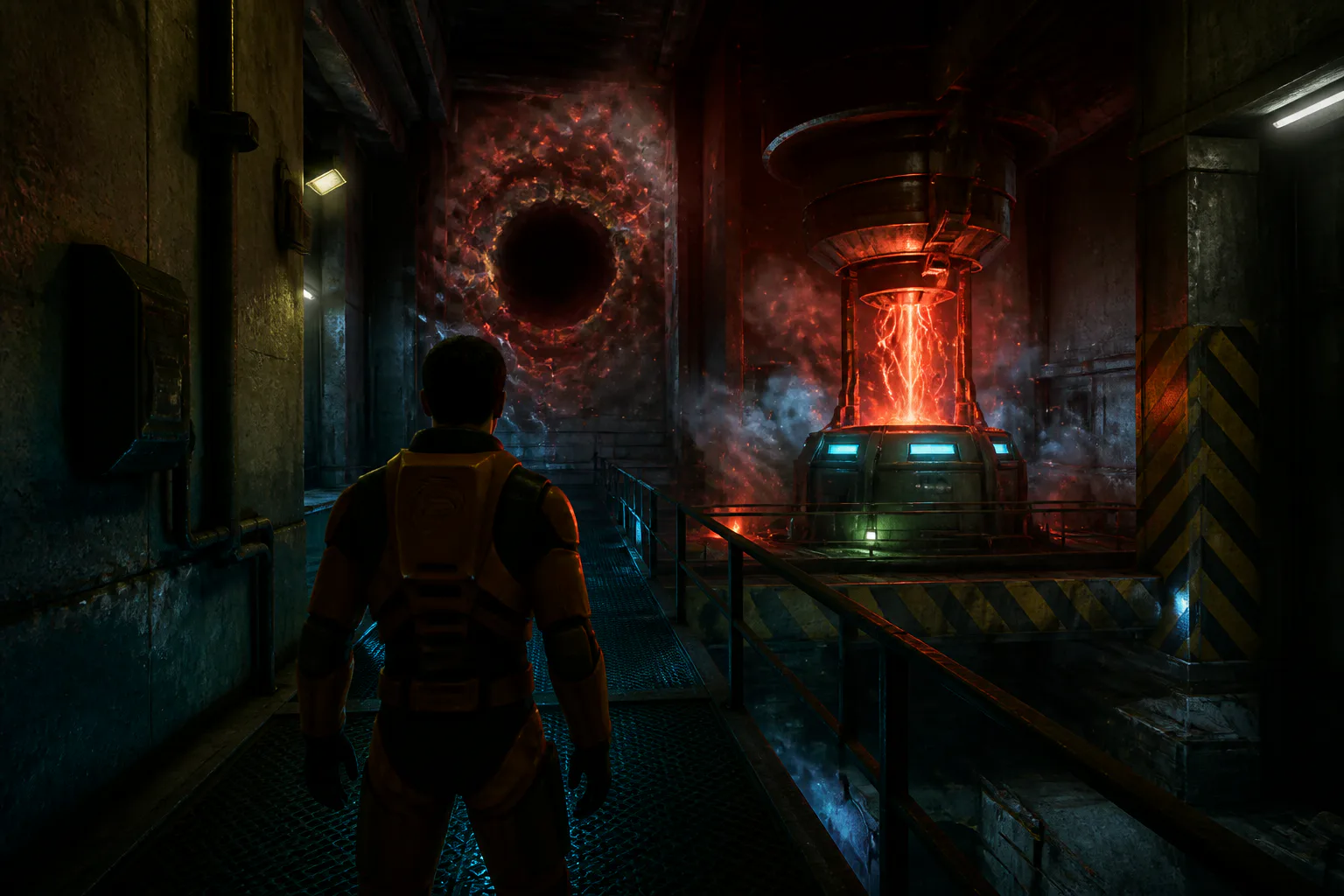
This slow introduction makes the disaster that follows considerably more effective. Gordon participates in an experiment involving an unusual crystal sample, but the procedure causes a catastrophic event known as the Resonance Cascade. Portals begin opening between Earth and an alien dimension called Xen. Strange creatures appear throughout Black Mesa, equipment malfunctions, sections of the facility collapse, and survivors desperately attempt to understand what has happened.
From that point forward, Gordon must make his way through the ruined research complex while fighting hostile alien creatures and attempting to reach safety. However, aliens are not the only threat. The United States military sends Hazardous Environment Combat Unit soldiers into Black Mesa, supposedly to contain the incident. It soon becomes clear that their mission also involves eliminating witnesses, including the surviving scientists and Gordon himself.
One of Half-Life’s greatest achievements is the way it tells this story without constantly interrupting gameplay. Important events usually happen while the player is still able to move around and observe the environment. Scientists speak to Gordon directly. Soldiers communicate with one another. Creatures attack unexpectedly. Explosions open new paths through previously inaccessible sections of the facility. The world appears to continue functioning even when Gordon is not standing in the center of a scripted cinematic.
This approach was particularly impressive in 1998. Many games of the period treated story as something that happened between levels. Half-Life instead attempted to make the story part of the level itself. A hallway, laboratory, ventilation shaft, railway system, warehouse, or underground tunnel could all communicate information about what had happened without requiring a narrator to explain it.
The structure of Black Mesa is another major reason the game remains memorable. Half-Life takes Gordon through laboratories, offices, industrial areas, storage facilities, underground tunnels, missile silos, military installations, sewers, and enormous experimental chambers. Because the game maintains the illusion that these areas belong to the same gigantic complex, the journey feels surprisingly cohesive.
Several chapters became particularly famous among players. “We’ve Got Hostiles” introduces the military threat more directly. “Blast Pit” features a gigantic tentacled creature that reacts to sound and forces the player to think differently about movement and combat. “Surface Tension” expands the scale dramatically, taking Gordon outside Black Mesa and placing him in the middle of battles involving soldiers, helicopters, tanks, alien creatures, and defensive installations.
Combat is another area where Half-Life distinguished itself from many competitors. Gordon gradually acquires a wide selection of weapons, beginning with the iconic crowbar. Pistols, shotguns, submachine guns, revolvers, explosives, experimental energy weapons, and alien equipment eventually become available. Different enemies encourage different approaches rather than allowing the player to rely on one weapon throughout the entire game.
The crowbar became one of the most recognizable weapons in gaming despite being extremely simple. Gordon uses it to break boxes, smash obstacles, defeat smaller enemies, and conserve ammunition. Over time, the crowbar became closely associated with Half-Life itself and eventually with Valve as a company.
Enemy design also contributes enormously to the game’s personality. Headcrabs may be the most famous creatures from Half-Life. These small alien parasites leap toward humans and can transform victims into zombie-like hosts. Other enemies include Vortigaunts, Bullsquids, Houndeyes, Barnacles, Alien Grunts, Ichthyosaurs, and several much larger creatures.
The game carefully introduces many of these enemies through the environment before asking the player to fight them directly. A player might first see a creature attacking another character, moving behind glass, or appearing briefly in the distance. This creates anticipation and helps make Black Mesa feel like a dangerous place instead of simply a sequence of rooms filled with enemies waiting to be shot.
Half-Life also made extensive use of environmental puzzles. Gordon is a scientist rather than a traditional action hero, and although most puzzles are relatively accessible, they reinforce the idea that observation matters. Players may need to activate machinery, restore electrical power, move objects, manipulate elevators, navigate ventilation systems, or determine how the environment itself can be used against a dangerous creature.
The artificial intelligence of the military soldiers was another frequently discussed feature when the game was released. Soldiers could communicate, take cover, throw grenades, reposition themselves, and attempt to pressure the player from different directions. Their behavior could create encounters that seemed less predictable than the simple enemy patterns commonly found in older shooters.
Sound design played an equally important role in creating tension. The mechanical ambience of Black Mesa, distant alarms, radio messages, creature noises, weapon sounds, and moments of near silence all help establish the game’s identity. Half-Life understood that horror and suspense often become more effective when the player hears danger before actually seeing it.
Visually, the original Half-Life is obviously a product of its era. Character models are angular, textures are relatively low resolution, and many environments are geometrically simple compared with modern games. Yet its art direction remains remarkably readable. Areas have strong visual identities, enemies are easy to recognize, and the industrial architecture of Black Mesa continues to communicate the oppressive scale of the facility.
Half-Life was built using GoldSrc, an engine derived heavily from id Software’s Quake technology and extensively modified by Valve. The technology allowed the developers to create scripted sequences, more interactive environments, skeletal character animation, improved artificial intelligence, and a much stronger sense of narrative continuity than players expected from shooters of the period.
The importance of GoldSrc extends beyond Half-Life itself. The engine became the foundation for an enormous modding community. Players and independent developers created modifications ranging from experimental single-player campaigns to entirely new multiplayer games. The most famous example is Counter-Strike, which began as a Half-Life modification before evolving into one of the most successful competitive multiplayer franchises in history.
Other notable Half-Life mods included Day of Defeat, Team Fortress Classic, Sven Co-op, Natural Selection, and countless smaller community p.