Meta Wonder Frontier AI Model
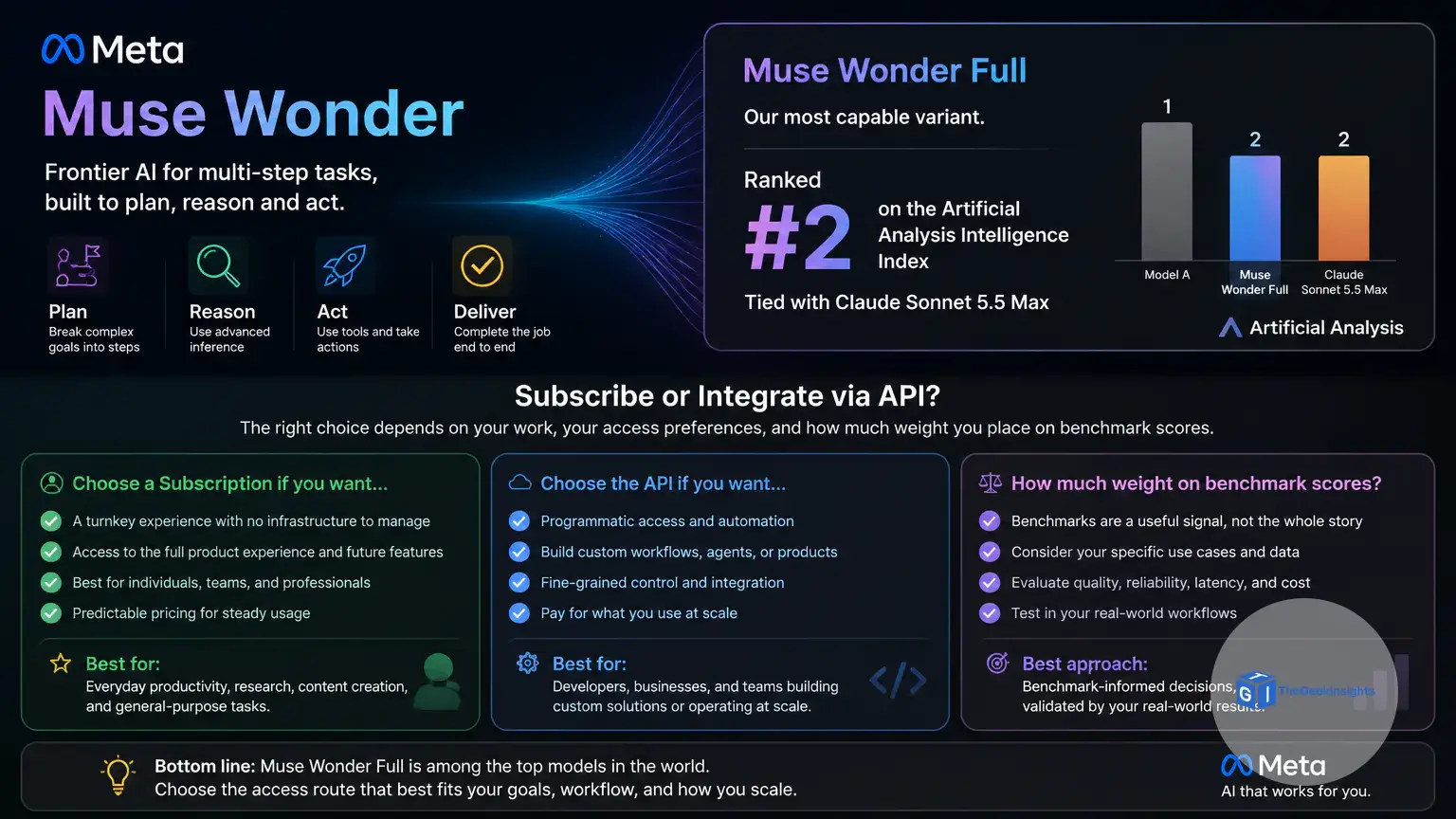
Meta Muse Wonder is a frontier AI model family for personal and professional tasks that require an agent to plan and act across multiple steps. Its more capable variant, Muse Wonder Full, ranked second on the Artificial Analysis Intelligence Index, tied with Claude Sonnet 5.5 Max. Whether to subscribe or integrate it through the API depends on the work you need done, the access route you prefer and how much weight you place on benchmark scores.
Muse Wonder Model Snapshot
Muse Wonder aspect | Muse Wonder snapshot |
|---|---|
Model family | Muse Wonder; Muse Wonder Full |
Primary focus | Personal and professional agentic tasks |
Core features | Active Memory; Active Focus |
Input: text | Supported |
Input: images | Supported |
Input: video | Supported |
Input: audio | Supported |
Input: PDF documents | Supported |
Context window | 1 million tokens |
API input rate | $4 per 1 million tokens |
API output rate | $20 per 1 million tokens |
Cached input rate | $0.20 per 1 million tokens |
Intelligence Index position | No. 2, tied with Claude Sonnet 5.5 Max |
Top-three evaluation results | Top three in 6 of 10 evaluations |
Highest-ranked competitor | Claude Opus 5.5 Max, No. 1 |
What Muse Wonder can do
Active Memory is intended to retain useful context, and Active Focus helps the model stay on task over time. Together, these features can support jobs such as organizing an insurance claim, reviewing a document or tracking details across a longer project. Muse Wonder also targets specialized work in law, finance and health, but its answers are not a substitute for qualified professional advice.
Muse Wonder can handle long-running coding assignments, including changes across multiple files, testing and revisions. It can also plan broader agent tasks, delegate subtasks, call tools in parallel and recover from errors. The model can operate browsers and desktop or mobile applications, so it can take on workflows that involve more than generating a single response.
The model accepts text, images, video, audio and PDF documents, with a 1-million-token context window. That gives it room to work with substantial material in a single task, but it does not guarantee that every detail will be interpreted correctly. Review important outputs, especially when a decision depends on a specific clause, figure or instruction.
A model’s value lies in more than the visuals it produces; it can also help creators test ideas and revise their work. AI image generators are changing digital art by speeding up concept exploration and opening new ways to create finished pieces.

What the benchmark results show
Muse Wonder Full ranked second on the Artificial Analysis Intelligence Index, tied with Claude Sonnet 5.5 Max. Claude Opus 5.5 Max ranked first. Muse Wonder Full placed in the top three on six of the index’s ten evaluations. The results put it near the top of the evaluated field, but they apply to the Full variant, not necessarily to every Muse Wonder product or access route.
Benchmarks measure performance on defined evaluations; they do not show whether an agent will reliably complete a particular company’s workflow. Claims that the models are state-of-the-art are separate from the Intelligence Index ranking. Strong scores indicate capability, but they do not guarantee accuracy, tool access or consistent task completion in everyday use.

Safety, privacy, and limitations
Muse Wonder includes safeguards against chemical, biological, radiological and nuclear misuse, as well as cyber misuse, and has defensive cybersecurity capabilities. Those protections do not establish how the model will behave in every high-risk scenario.
Active Memory may involve sensitive legal, financial or health information. Keep human review in place for consequential decisions; the model’s output is not a substitute for qualified professional advice or a security review.
The model’s limitations affect what you can safely do with it and what information you should share. They also raise questions about Muse features and safety controls, including who gets access.
How to access Muse Wonder
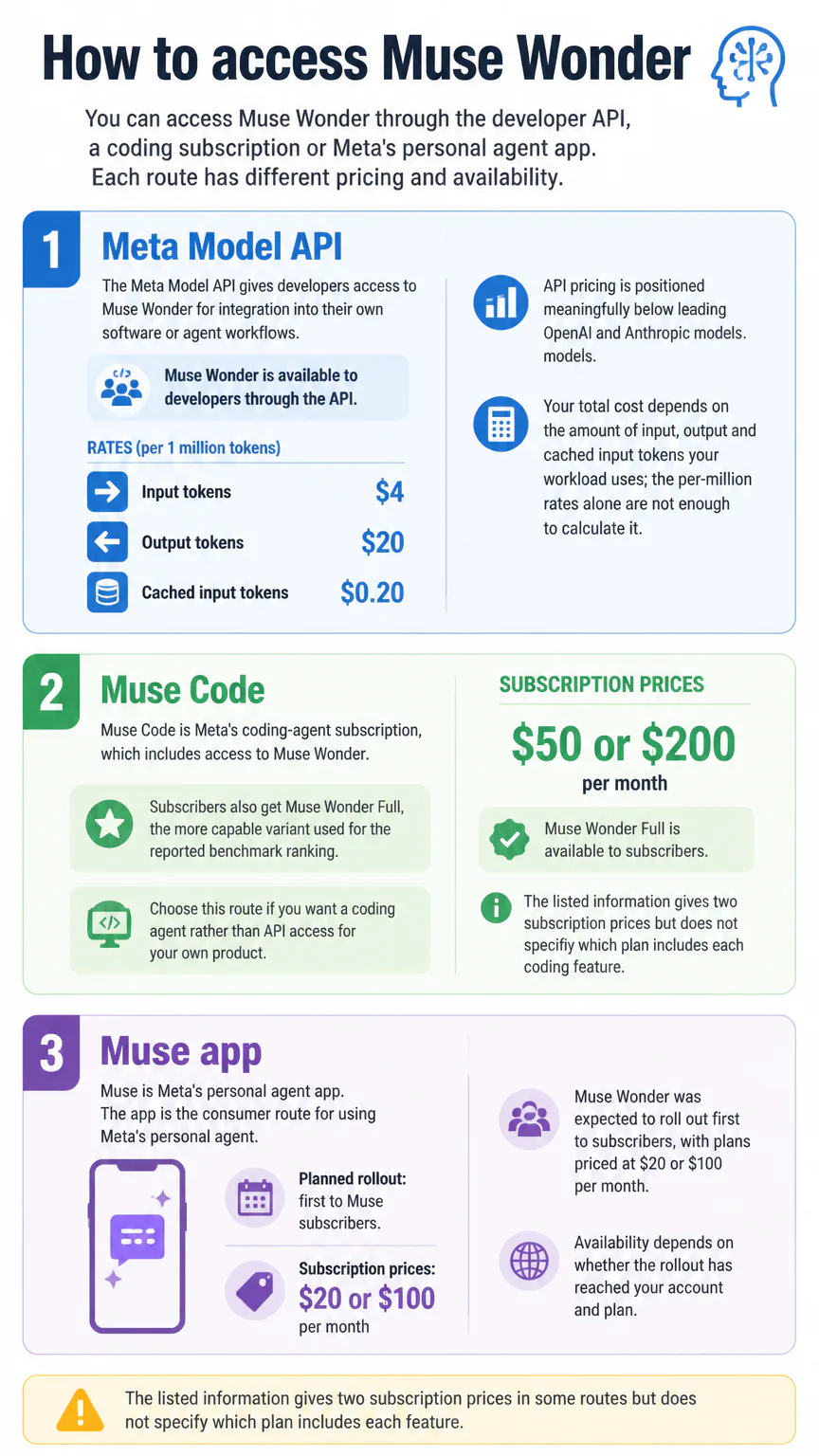
You can access Muse Wonder through the developer API, a coding subscription or Meta’s personal agent app. Each route has different pricing and availability.
Meta Model API
The Meta Model API gives developers access to Muse Wonder for integration into their own software or agent workflows.
Muse Wonder is available to developers through the API.
Rates are $4 per 1 million input tokens, $20 per 1 million output tokens and $0.20 per 1 million cached input tokens.
API pricing is positioned meaningfully below leading OpenAI and Anthropic models.
Your total cost depends on the amount of input, output and cached input tokens your workload uses; the per-million rates alone are not enough to calculate it.
Muse Code
Muse Code is Meta’s coding-agent subscription, which includes access to Muse Wonder. Subscribers also get Muse Wonder Full, the more capable variant used for the reported benchmark ranking.
Subscription prices: $50 or $200 per month.
Muse Wonder Full is available to subscribers.
Choose this route if you want a coding agent rather than API access for your own product. The listed information gives two subscription prices but does not specify which plan includes each coding feature.
Muse app
Muse is Meta’s personal agent app. Muse Wonder was expected to roll out first to subscribers, with plans priced at $20 or $100 per month.

Planned rollout: first to Muse subscribers.
Subscription prices: $20 or $100 per month.
The app is the consumer route for using Meta’s personal agent. Availability depends on whether the rollout has reached your account and plan.
Is Muse Wonder worth trying?
Muse Wonder is aimed at tasks that need sustained context and multiple actions, such as coding across files, coordinating research or working through a document-heavy process. Muse Wonder Full’s benchmark results place it among the leading models, but they do not show that it will outperform competitors on every task or fit every workflow.
Choose an access route based on what you plan to do: estimate API charges from token use, compare Muse Code’s $50 and $200 monthly plans, or compare Muse’s $20 and $100 monthly plans for personal-agent use. The subscription tiers have different prices.
Try representative tasks before committing. Check how well the model follows instructions, handles mistakes and produces verifiable results before trusting it with sensitive information or consequential actions.
Interactive environments ask more of a model than static prompts do: characters and systems must respond coherently as players change their actions. Knowing how AI in games is used today offers a point of comparison for what a model built for richer interactive experiences might eventually support.
Conclusion
Muse Wonder combines strong frontier-level benchmark results with features for sustained agent work. You can access it through an API, Muse Code or the planned Muse app rollout. Test it against a real workflow before subscribing or making it a production dependency; its benchmark rank alone is not enough to justify either choice.