
Nvidia’s DLSS 4: Nvidia’s Controversial Marketing and the Legitimate Value of DLSS in 2025
Nvidia has long been a dominant force in the GPU industry, but its reputation is far from spotless. Over the years, the company has faced criticism for misleading marketing, fake MSRP pricing, and other anti-consumer practices. These issues have resurfaced with the launch of the new 50 Series GPUs, where Nvidia’s performance claims—particularly on the desktop side—have been called into question. Now, similar concerns are arising with their laptop GPU marketing, further fueling skepticism among consumers.
Nvidia’s History of Misleading Practices
Nvidia’s marketing strategies have often blurred the line between innovation and deception. The company has a track record of:
- Misleading Performance Claims: Promising significant generational leaps that don’t always materialize in real-world, rasterized performance.
- Fake MSRPs: Advertising GPUs at a certain price point, only for third-party cards to launch at much higher prices due to “market conditions.”
- Overemphasis on DLSS in Marketing: Using AI upscaling as a crutch to inflate perceived performance gains, especially in scenarios where raw rasterization improvements are minimal.
This pattern has made Nvidia an easy target for criticism, and the 50 Series launch has only amplified frustrations.
The DLSS Debate: From Gimmick to Game-Changer
One of the most contentious aspects of Nvidia’s strategy has been its promotion of DLSS (Deep Learning Super Sampling). Initially introduced with the RTX 20 Series, DLSS was met with skepticism—and for good reason.
Early DLSS: A Flawed Technology
- DLSS 1.0 (2018-2020): Produced blurry images, had limited game support, and was often seen as a marketing gimmick rather than a real performance enhancer.
- DLSS 2.0 (2020-2022): Improved image quality but still faced criticism for being used to mask underwhelming generational GPU improvements.
- DLSS 3.0 (2022-2024): Introduced frame generation, but concerns remained about latency and artifacting.
Many reviewers, including myself, ignored or downplayed DLSS in early benchmarks because it simply wasn’t reliable enough to be a selling point.
DLSS 4 in 2025: A Legitimate Breakthrough
However, DLSS 4 marks a turning point. The technology has evolved to a point where:
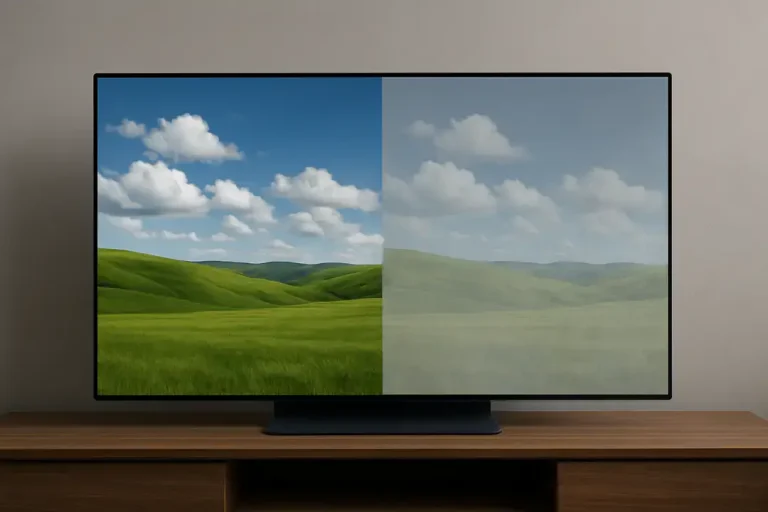
- Image quality is near-native, with minimal artifacts.
- Frame generation latency is drastically reduced, making it viable for competitive gaming.
- Game support is broader, with major titles integrating it effectively.
This is no longer just an Nvidia marketing tool—it’s a genuine performance multiplier, especially in laptops where power constraints limit raw performance gains.
Why DLSS is a Lifesaver for Laptops
The laptop GPU market faces a unique challenge: strict power limits. Unlike desktops, where wattage can be increased with bigger power supplies, laptops are constrained by:
- Thermal limits (cooling thin chassis is difficult).
- Battery life concerns (higher power draw kills portability).
- Physical size restrictions (no one wants a 4-inch-thick, dual-power-brick gaming laptop).
The Generational Performance Problem
Looking at raw rasterized performance from the 20 Series to the 50 Series, improvements have been incremental at best. Without architectural leaps or TSMC node shrinks, Nvidia can’t deliver massive performance jumps without increasing power consumption—which isn’t feasible in laptops.
DLSS as the Only Viable Solution
This is where DLSS 4 shines:
- It allows high resolutions (1440p, 4K) at playable framerates on a 175W GPU.
- Without DLSS, achieving similar performance would require unrealistic power increases (think 250W+ GPUs, dual power adapters).
- It bridges the gap between hardware limitations and user expectations.
The Bigger Issue: Nvidia’s Marketing vs. Reality
While DLSS is now a legitimate advantage, Nvidia’s history of misleading marketing still casts a shadow. The company has often:
- Overhyped DLSS gains while downplaying weak rasterized performance.
- Used AI-upscaled benchmarks to inflate generational comparisons.
- Pushed proprietary tech (DLSS) while ignoring open standards (FSR, XeSS).
This doesn’t mean DLSS is bad—it just means Nvidia’s messaging is often dishonest.
Conclusion: DLSS is Great, But Nvidia Needs Transparency
DLSS 4 is finally the technology it was always meant to be—a true game-changer, especially for laptops. However:
- Nvidia must stop using DLSS to obscure mediocre hardware improvements.
- Reviewers and consumers should demand transparency in performance claims.
- Competition (AMD FSR, Intel XeSS) is healthy—better upscaling benefits everyone.
At the end of the day, good technology shouldn’t be dismissed just because of bad marketing. DLSS 4 is worth praising, but Nvidia’s history means we should stay vigilant.