
How to Go Viral on Twitter Tips: Practical Tactics That Spread
On X, some posts disappear almost immediately while others spread through retweets, quotes, and replies. That makes visibility difficult for creators, professionals, and brands trying to reach the right audience. The challenge is not just writing something good, but writing something people notice and want to share. This guide breaks down practical ways to improve those odds.
Key Takeaways
- Start with a strong hook that creates curiosity, surprise, or emotional tension in the first line.
- Post content people instantly recognize as useful or relatable, because that is what drives retweets, quotes, and replies.
- Use timing, threads, and clear calls to action to help good tweets get early engagement and wider distribution.
- Add questions, light humor, and direct asks for retweets so readers feel invited to participate instead of just scroll past.
Steps to Go Viral on Twitter
A viral tweet earns rapid engagement through shares, retweets, quotes, likes, and replies. That early burst tells the platform your post is worth showing to more people. The goal is not clickbait. The goal is to create a post that stops the scroll, rewards attention, and makes someone want to pass it on.
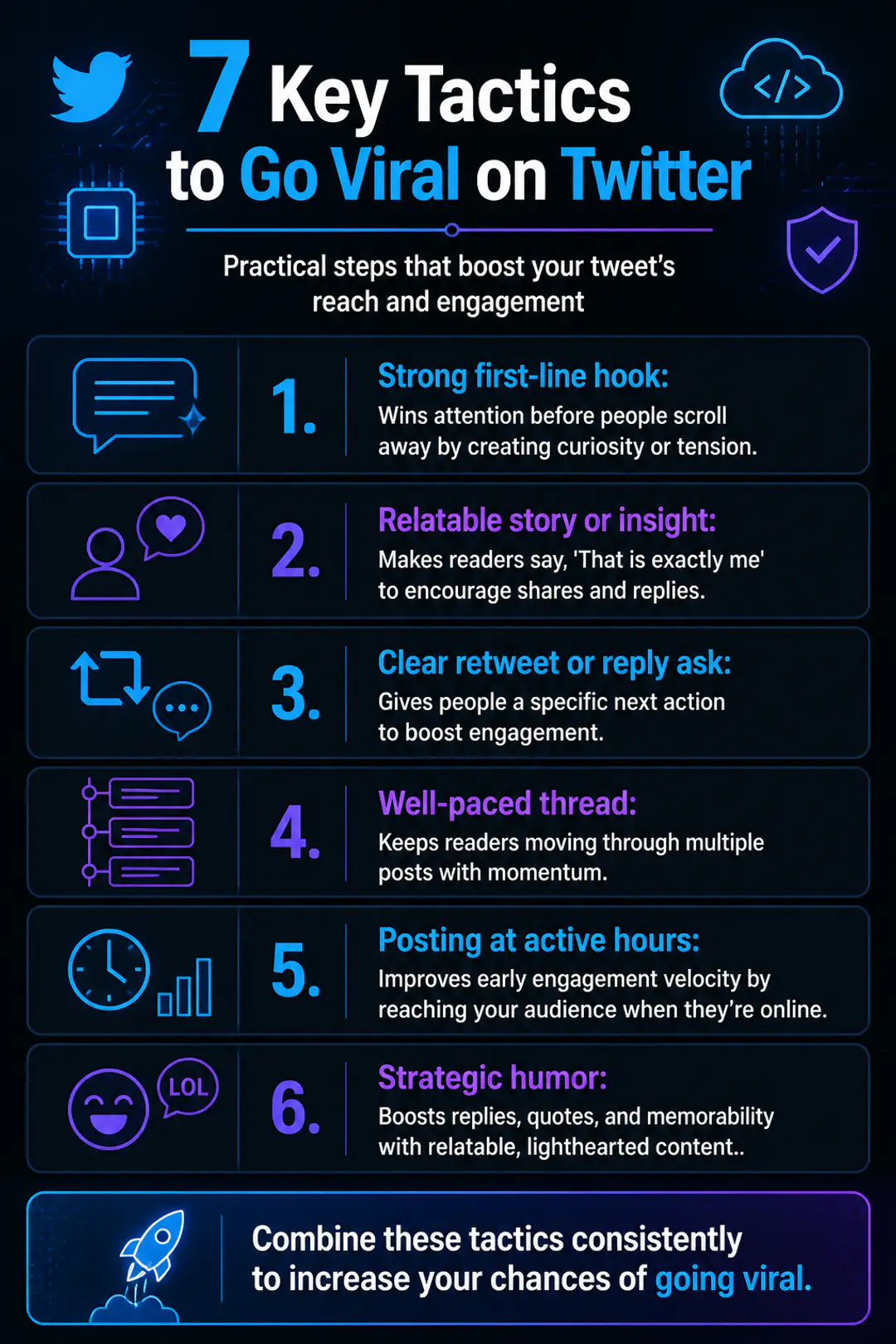
| Tactic | Impact | Ease | Why It Works |
|---|---|---|---|
| Strong first-line hook | High | Medium | Wins attention before people scroll away |
| Relatable story or insight | High | High | Makes readers say, “That is exactly me” |
| Clear retweet or reply ask | Medium | High | Gives people a specific next action |
| Well-paced thread | High | Medium | Keeps readers moving through multiple posts |
| Posting at active hours | Medium | High | Improves early engagement velocity |
| Strategic humor | Medium | Medium | Boosts replies, quotes, and memorability |
Create a Compelling Hook
Your first line decides whether the rest of the tweet gets read. A good hook opens a curiosity gap, which means readers feel they are missing something useful or surprising if they keep scrolling. Strong hooks often use contrast, tension, a bold observation, or a concrete promise.
Try formulas like these:
- A surprising attempt can lead to an unexpected result
- Most people get this wrong about Twitter threads
- This one change doubled reply rate
- A thread written in 55 minutes passed 2,000,000 impressions
That last example works because it is specific. A thread with over 2,000,000 impressions, 7,500 likes, and 1,500 retweets stands out because it combines a time constraint with a strong result. Numbers create credibility, but only when they are paired with a clear lesson.
- Avoid weak openings like “Here are my thoughts” or “A thread,” because they waste prime attention space.
- If your topic is educational, lead with the problem or outcome.
- If it is opinion-based, lead with the tension.
- If it is story-based, lead with the twist.
Use Relatable and Valuable Content
- Relatable frustrations: Posts about missed opportunities, bad advice, burnout, awkward client moments, or common creator mistakes often earn quote tweets because people add their own take.
- Useful frameworks: Checklists, swipeable templates, short lessons, and simple breakdowns get saved and shared because they solve a problem fast.
- Timely commentary: Reacting quickly to platform changes, news, or creator trends helps your post ride existing attention.
- Clear opinions: Strong but defensible takes invite replies. “Most threads are too long to finish” performs better than a vague statement about content quality.
- Resources people can pass along: If you include a practical example, list, or mini playbook, shareability rises because readers know exactly who else needs it.
Useful content spreads best when it is easy to repeat. Think in terms of “Would someone send this to a friend or teammate?” If the answer is yes, you are closer to viral potential. The same principle drives good marketing trends content, where fast takeaways and timely insight often outperform broad commentary.
One effective pattern is to pair relatability with instruction. For example, if tweets get likes but no retweets, the post may be interesting but not useful enough to share, so adding one concrete takeaway per tweet can make it more shareable. That works because it identifies the pain point and fixes it in the same breath.
Optimize Timing and Frequency
Good posts need early traction, so timing matters. Publish when your audience is active and able to engage quickly, especially on weekday mornings, lunch breaks, and early evenings in your main time zone. If you have analytics, use them. If not, test three time windows for two weeks and compare impressions, replies, and retweets rather than likes alone.
Frequency matters too. One great tweet every two weeks will not teach you much. A better cadence is to post consistently, test several hooks, and turn the winners into threads or follow-up posts. If your account is still growing, tweet enough to gather data but not so often that every post competes with the last one.
When you are building a professional audience, consistency in format and posting rhythm matters almost as much as creativity, much like planning your first professional online presence before you try to scale attention.
Leverage Twitter Threads Effectively
- Open with a lead-in tweet: The first tweet should work on its own. Make a promise, create tension, or show a surprising result.
- Use a strong frame: One proven thread framework began with 6 questions. Questions keep readers mentally involved before you give the answers.
- Keep cadence tight: Each tweet in the thread should move the story or lesson forward. Do not repeat the same point in slightly different words.
- Alternate value and tension: Give one takeaway, then raise the next question. That attention-keeping cadence helps readers continue instead of dropping off halfway.
- Make each tweet skimmable: Short paragraphs, line breaks, and clean phrasing improve completion rates.
- End with participation: Ask a question, invite a quote tweet, or tell readers to repost if they found it useful.
A simple thread structure looks like this:
- Hook: bold claim, result, or problem
- Context: why this matters now
- Questions: 3 to 6 curiosity-building prompts
- Main lessons: one clear point per tweet
- Examples: short proof, result, or scenario
- Closing CTA: ask for reply, repost, or quote
Think of your thread like a sequence, not a pile of posts. Readers should feel momentum. If tweet three could be removed without changing the thread, it probably should be removed.
Creators who already know how to package stories in other formats often adapt faster here, which is one reason lessons from unboxing videos carry over so well: the opening must earn attention, and each beat has to keep it.
Incorporate Calls to Action and Humor
People engage more when you make the next step obvious. A call to action can be as simple as “Reply with your best hook,” “Quote this with your take,” or “Retweet if this helped.” The key is to ask naturally and only after earning the ask with useful or entertaining content.
Humor also helps because it lowers friction. A dry observation, a self-aware line, or a clever contrast often earns replies and quote tweets faster than a purely instructional post. Strategic humor works best when it highlights a truth your audience already recognizes, not when it distracts from the point. Think relatable, not random.
- Use a sharp hook.
- Follow with a useful point.
- Add a light punchline.
- Finish with a direct ask.
For example, a post that says most people write tweets like emails and that is why nobody forwards them, then asks readers to retweet if they have ever overexplained a simple point, invites recognition and action at the same time.
Common Mistakes to Avoid
- Leading with a boring setup instead of the strongest line
- Using clickbait that creates curiosity but delivers no value
- Posting only for likes instead of shareability
- Writing threads that are too long and repetitive
- Ignoring replies after publishing, which slows momentum
- Asking for engagement before earning trust
- Posting at random times with no testing plan
- Trying to sound viral instead of sounding clear
Twitter Algorithm Basics
The X algorithm ranks tweets based on signals that show people find them worth interacting with. Early replies, retweets, quotes, dwell time, and follow-through actions all help a post travel further. That is why hooks, timing, and participation prompts matter so much: they help the platform see immediate interest. While paid reach and account authority affect visibility, organic growth still comes from posts that hold attention and trigger fast interaction.
FAQs
How long should a viral tweet be?
There is no perfect length, but shorter tweets often work better for punchy opinions and humor, while longer tweets work for useful context. The best test is whether every word earns its place.
Should I ask people to retweet?
Yes, if the ask feels natural and comes after value. A simple repost request at the end of a strong post often improves distribution without sounding forced.
Are threads better than single tweets?
Threads are better when you need pacing, story, or multiple lessons. Single tweets are better when your idea is sharp enough to land in one screen.
Can small accounts go viral?
Yes. Small accounts can break out when a post earns fast engagement and quote sharing from the right audience. Strong framing often matters more than follower count.
Conclusion
Virality cannot be guaranteed, but these tactics can significantly improve the odds. Apply the steps consistently, track what earns replies, retweets, and quotes fastest, and keep refining one variable at a time. Experiment with your own style so your posts become recognizable, useful, and easier to share.


