
What Gets You Found in AI Search Now: Key Visibility Factors
Getting found in AI search depends on whether an answer system can access your pages, understand what your business or content covers, and trust the information enough to use it. Traditional search visibility still matters: roughly 76.1% of URLs cited in Google’s AI Overviews also rank in Google’s top 10 organic results. Clear answers, original evidence, and consistent details across the web make your pages more likely to be retrieved and cited.
AI Search Visibility Factors
Useful content: Answer the reader’s specific question clearly and accurately.
Query coverage: Address related questions an answer engine may search while exploring a prompt.
Entity clarity: Describe your brand, services, audience, and expertise consistently.
Credible validation: Build trustworthy corroboration beyond your own website.
Technical accessibility: Make important pages crawlable and available as indexable text.
Extractable structure: Organize pages so systems can identify answers and supporting details.
Original evidence: Include firsthand experience, proprietary data, case studies, or original research.
AI answers haven’t made ordinary search visibility irrelevant. Well-ranked pages can still attract visits, earn references and give AI systems clear information about a brand. The familiar work involved in get on Google’s first page can strengthen that foundation, but strong rankings alone don’t guarantee an AI citation.
How AI Search Finds and Cites Pages
AI search tools retrieve information from web indexes and other available sources, then use selected material to compose a response. Some answers cite or link to the pages used. A citation is different from a conventional search ranking: a page may rank well without appearing in an AI answer, and the pages selected can vary by query.
Google AI Overviews show an AI-generated snapshot with links for further exploration. Google AI Mode supports conversational follow-up and deeper searches. Both rely closely on Google’s core index, so organic visibility remains an important foundation. Google shows AI Overviews when its systems determine that a generative answer could be especially helpful, not for every search.
ChatGPT and Perplexity can retrieve current web information and cite sources. Claude and Gemini can synthesize context from multiple sources, making broad subject authority and trustworthy external references relevant. Bing also matters: its index and Microsoft Copilot’s retrieval systems can supply web results for AI answers.
These systems do not share a single ranking formula, and a mention is not the same as a citation. AI Overviews can also contain inaccurate or offensive information, so their answers are not guaranteed to be accurate.
Create Content for Query Fan-Out
Query fan-out happens when an answer engine turns a prompt into several targeted searches before assembling a response. A page that addresses only the exact wording of a broad query may leave useful follow-up questions unanswered. Cover the reader’s full task, and put a direct answer near the beginning of each relevant section.
Identify the main question. State the clearest answer near the top of the page or section.
Map likely follow-ups. Include relevant questions about requirements, comparisons, costs, limitations, or next steps.
Answer each point directly. Give specific details and define unfamiliar terms when they first appear.
Support claims with evidence. Add original data, examples, case studies, or firsthand expertise that generic summaries cannot provide.
Keep information current. Review facts that change over time and update the relevant page content.
Avoid thin FAQ blocks that simply repeat the same keyword. Each section should answer a real question and include enough detail to stand on its own.
Make Your Brand Easy to Verify
AI systems need to connect a name with the right organization, subject, and claims. Use consistent descriptions of your business, services, audience, locations, and expertise across your website and public profiles. Conflicting details across pages can make it harder for a system to identify which description is reliable.
Give important people and organizations clear names, roles, and descriptions.
Include author information that reflects relevant experience or subject expertise.
Keep service descriptions and business details consistent across your website and external profiles.
Earn independent coverage and references from credible organizations in your field.
Contribute useful, accurate information to relevant communities instead of posting repetitive promotions.
Independent references can corroborate a brand’s expertise and accurate information. Contribute useful, accurate information to relevant communities rather than focusing on accumulating mentions.
AI systems have more confidence in a brand when its name, location, website and services match across its own pages and trusted profiles. Consistent details also help people confirm which business is behind the brand when they verify a business in ChatGPT.
Check Technical Access and Structure
Important information needs to be accessible to crawlers and present in indexable page content. Search systems may struggle to interpret pages that rely on inaccessible scripts, block crawling, or hide key answers in images. Check that priority pages load, can be indexed, and present their main content as readable text.
Allow relevant search crawlers to access pages you want included in search.
Check indexation and fix accidental blocking or canonicalization problems.
Use descriptive headings and a logical structure to separate topics.
Add structured data that accurately describes the page, organization, or offering.
Make pages usable on mobile devices and address serious loading problems.
Structured data can clarify entities and offerings, but it does not guarantee an AI citation. Markup should match visible page content; it cannot replace useful information, indexability, or credibility.
Measure Mentions, Citations, and Accuracy
A single conventional ranking cannot capture AI visibility. Check whether systems mention your brand, cite your pages, and describe your products or expertise accurately. Test realistic questions prospective customers might ask, including follow-ups that could change the answer.
Choose relevant prompts, including category questions and specific questions your pages address.
Check results across Google AI Overviews, Google AI Mode, ChatGPT, Perplexity, Claude, and Gemini.
Record brand mentions, page citations, and competing brands that appear in the results.
Check descriptions for errors, missing context, or outdated details.
Compare results over time and revise pages where answers reveal a clear information gap.
Results can vary by prompt and search experience, so treat each response as a snapshot, not a stable ranking. Correct factual errors on your own pages first, then strengthen the evidence and consistent descriptions available elsewhere.
Start with the Highest-Impact Fixes
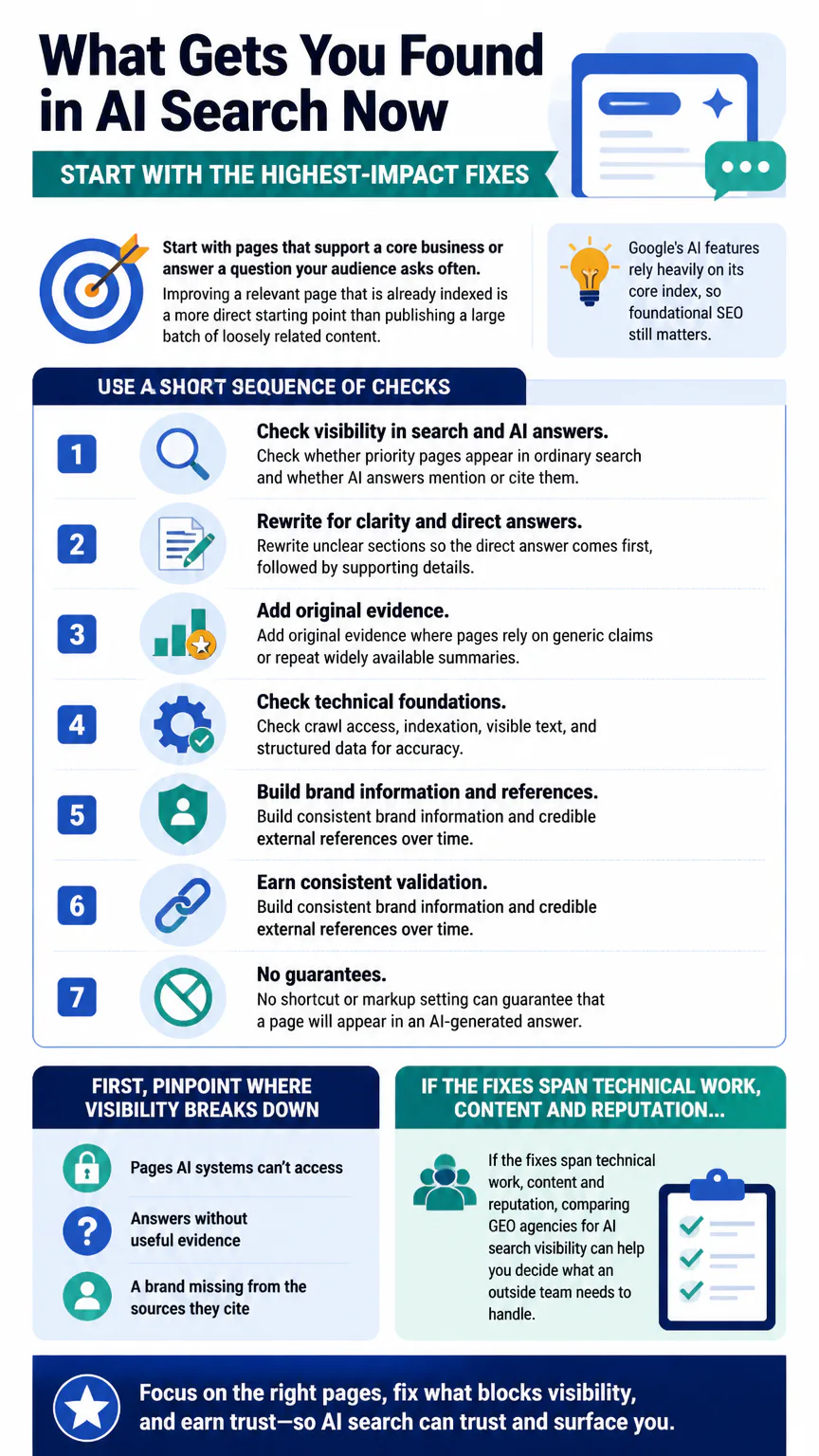
Start with pages that support a core business or answer a question your audience asks often. Improving a relevant page that is already indexed is a more direct starting point than publishing a large batch of loosely related content. Use a short sequence of checks so editorial and technical work focus on the same priority pages.
Check whether priority pages appear in ordinary search and whether AI answers mention or cite them.
Rewrite unclear sections so the direct answer comes first, followed by supporting details.
Add original evidence where pages rely on generic claims or repeat widely available summaries.
Check crawl access, indexation, visible text, and structured data for accuracy.
Build consistent brand information and credible external references over time.
Google’s AI features rely heavily on its core index, so foundational SEO still matters. No shortcut or markup setting can guarantee that a page will appear in an AI-generated answer.
First, pinpoint where visibility breaks down: pages AI systems can’t access, answers without useful evidence, or a brand missing from the sources they cite. If the fixes span technical work, content and reputation, comparing GEO agencies for AI search visibility can help you decide what an outside team needs to handle.
FAQs
What is the most popular AI search?
Google Search is the broadest mainstream search destination, with AI Overviews and AI Mode as part of its AI search experience. ChatGPT and Perplexity are also widely used for conversational or citation-focused web searches.
Are all Google searches AI now?
No. Google Search still includes conventional results, and AI Overviews appear only when Google’s systems determine that a generative answer would be useful for the query.
Why did my AI Overview disappear?
AI Overviews are selective and can change depending on the query and search context. Their absence from one search does not mean a page or site has lost eligibility.
What is the 30% rule in AI search?
There is no universal 30% threshold for appearing in AI search. Visibility depends on retrieval, relevance, technical access, and trust signals, not a fixed percentage.
Can I turn off AI in Google Search?
There is no universal setting that removes every AI feature from Google Search. When available, the Web filter shows text-based links for a search.

Conclusion
Make priority pages easy to access and understand, with accurate, distinctive information worth citing. Then check how AI search experiences describe your brand and improve pages where their answers reveal gaps.