
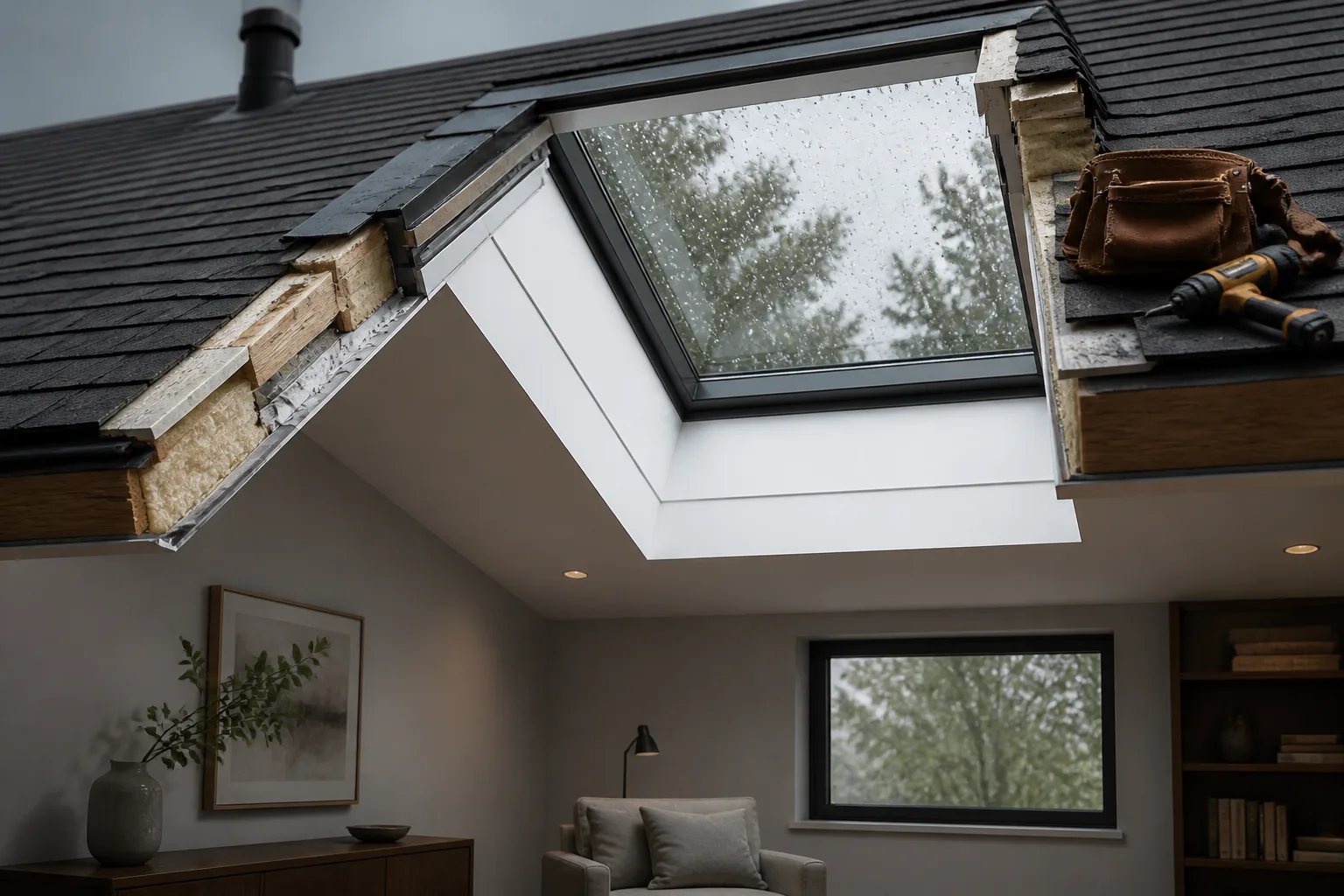
How Acoustic Skylight Design Helps Roofers Deliver Quieter Interiors
Acoustic skylight design gives roofing contractors a way to address two distinct sound problems: airborne noise entering from outside, such as traffic and aircraft, and impact noise from rain striking the glass. Tested sound performance applies to specific glazing configurations and complete installed assemblies, so the rating attached to one product does not transfer to another unit or installation.
For roofing contractors, acoustic design choices make skylights a measurable part of the home’s acoustic envelope, something that can be specified and priced like insulation.
How acoustic glazing blocks sound
Sound moves through glass by vibration. When outside sound hits the glazing, the glass can vibrate and transmit some of that energy indoors as sound.
Acoustic skylights disrupt that process in two ways. Manufacturers pair panes of different thicknesses so each resonates at a different frequency, and they bond a polyvinyl butyral interlayer between the sheets to absorb vibrational energy before it crosses the unit.
The cavity between panes can affect sound transmission, while argon fill offers little practical acoustic benefit. Argon fill improves thermal performance, and Pilkington’s noise-control guidance separates gas fills from the factors that actually cut sound: pane thickness, interlayers and cavity design.
The interlayer also makes laminated glass a safety glass, so the sheet holds together if a pane breaks.
Laminated glazing can also help damp the drumming of heavy rain on a skylight. Ask for rain-noise data for the assembly being specified.
The ratings that count outdoors
STC is the older laboratory rating. It measures how a partition attenuates airborne sound across mid-range frequencies, roughly the range of speech and television noise.
Outdoor-Indoor Transmission Class, or OITC, puts more weight on lower frequencies. It rates how a unit handles road traffic and low-flying aircraft.
In urban or airport-adjacent areas, roofers should request OITC figures from suppliers. A unit can post a respectable STC score and still transmit low-frequency rumble, because STC testing underweights those frequencies.
Ratings also apply to specific sizes and configurations. A figure quoted for one unit may not hold across an entire product line.
Frames and curbs carry sound too
Glazing is only part of the assembly. Structural vibration travels through frames and curbs, and it can bypass high-performance glass entirely when those components act as sound bridges.
Thermally broken frames and insulated curbs are designed to limit heat transfer, and that thermal rating does not establish sound performance.
The frame, joints, seals and the surrounding roof construction all need acoustic consideration. Sound can flank the glazing through any of these paths, so the assembly’s noise control depends on how each component is detailed, not on its thermal specification.
The range from Sunsquare includes curb-mounted and custom skylights, so contractors can start with the unit that fits the roof and then request sound data for that configuration.
On flat roofs, coordination with the roof assembly helps control vibration. Coordinate curb height, membrane termination, insulation continuity and flashing with the roof design, and check the installed details against the drawings.
Installation details that stop flanking noise
Flanking transmission is sound that bypasses the primary barrier through gaps and weaker materials around it. Even a skylight with a strong acoustic rating performs below that figure when air gaps or lighter adjacent constructions surround the opening.
Joint materials and air seals at the curb-to-deck connection should follow coordinated manufacturer specifications and acoustic design details, so the installed assembly matches the intended performance.
Flashing details need the same attention. Roof waterproofing and the assembly’s air seals serve distinct functions, and both require coordination so neither leaves a gap that lets airborne sound through.
Installers should also check the void between the curb and the interior finish. That perimeter, along with nearby materials, forms part of the acoustic assembly and warrants discussion with an acoustic specialist before sealing.
Because air leaks and sound leaks travel the same paths, the airtightness checks already standard on many flat roof jobs double as acoustic quality control.
Quoting the acoustic upgrade
Noise complaints concentrate in predictable places, including urban streets and airport flight paths. Homeowners in those locations often raise the issue themselves once a roof replacement puts skylights on the table.
Contractors who can explain STC and OITC figures position the skylight as a comfort upgrade with a defensible price. The conversation moves from leak risk and daylight to measurable decibel reduction.
Carrying a laminated acoustic unit as a quoting option also changes the contractor’s role. Pricing glass by acoustic performance requires the same envelope thinking as specifying insulation values.
Roofers can request OITC data and laminated glass options from suppliers before writing the next quote in a noise-affected neighborhood and build those figures into the proposal.