NVIDIA RTX 5080: New GPU Updates
NVIDIA has officially launched the RTX 5080, and while expectations were high, the results are underwhelming. With a $1,000 price tag, this new GPU offers only minor performance gains over its predecessor, raising questions about whether it’s worth the investment. Here’s an in-depth analysis of its specs, performance, and how it compares to previous generations.
RTX 5080 Specifications and Pricing
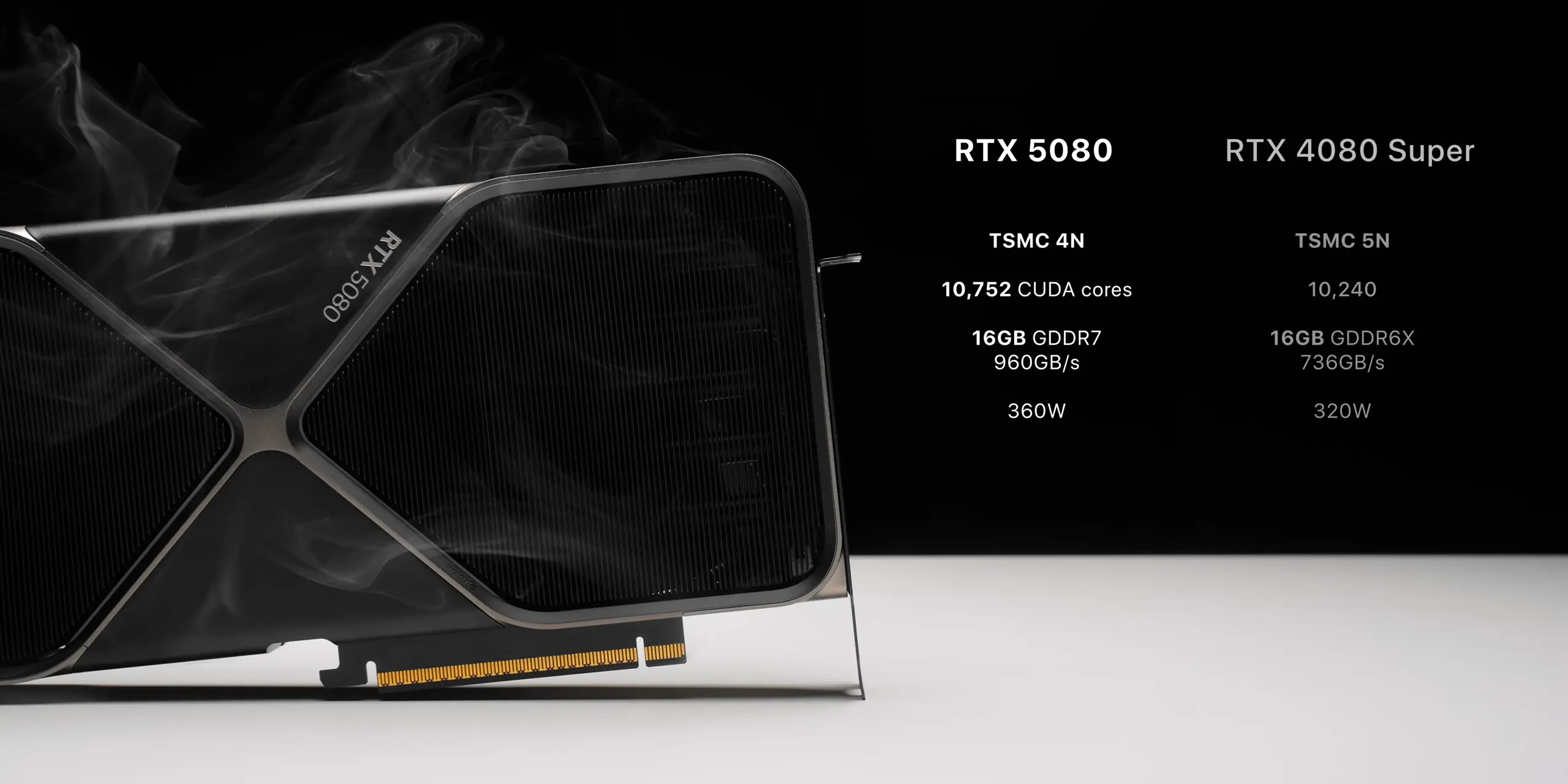
- Price: $1,000 (same as RTX 4080 Super)
- VRAM: 16GB GDDR7 (higher bandwidth but same capacity)
- TDP: 360W (actual power draw lower, averaging 273W)
- Shader Cores: Slightly increased over RTX 4080
- Cooling System: Reuses the RTX 5090 Founders Edition cooler
- DLSS 4 & Frame Generation: Exclusive new feature
At first glance, the RTX 5080 should have been an exciting release with improved efficiency and new DLSS 4 technology. However, once benchmarked, its performance increase is minimal, making it a tough sell for those expecting a meaningful generational leap.
Performance Benchmarks: A Small Improvement
RTX 5080 vs. RTX 4080 (Standard & Super Versions)
- The RTX 4080 had a 36% generational improvement over the RTX 3080
- The RTX 5080 offers just a 14% increase over the RTX 4080
- When compared to the RTX 4080 Super, the gain drops to only 9%
Game Performance (Percentage Increase Over RTX 4080 Super)
| Game | FPS Gain (%) |
|---|---|
| F1 24 | +23% |
| God of War | +21% |
| Cyberpunk 2077 | +4% |
| Black Ops 6 | +5% |
| Stalker 2 | +6% |
| Average Improvement | 9% |
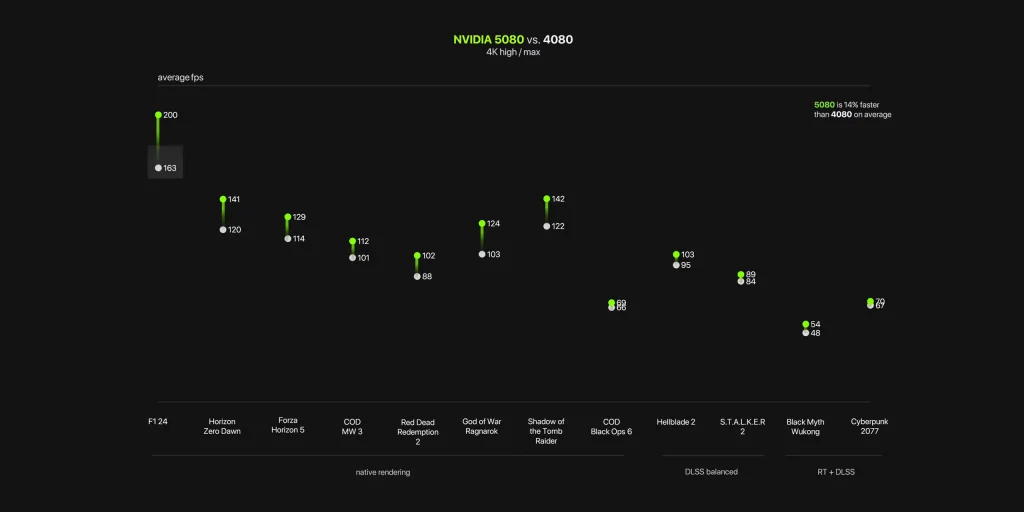
In some cases, the performance difference is barely noticeable, with certain games running at almost identical frame rates to the RTX 4080 Super. This makes the RTX 5080 one of the weakest generational upgrades in recent NVIDIA history.
Power Efficiency: A Double-Edged Sword
While the RTX 5080 is a lower power GPU (actual draw 273W vs. the 4080’s 320W), this doesn’t translate into a significant performance boost. The lower power consumption does improve cooling, with Founders Edition models hitting just 65°C under load.
However, many gamers would have preferred a higher power draw in exchange for better performance, making this efficiency feel more like a limitation than an advantage.
How Does It Compare to Previous Generations?
| GPU | Compared To | Performance Uplift |
|---|---|---|
| RTX 3080 → RTX 4080 | +36% | |
| RTX 4080 → RTX 5080 | +14% | |
| RTX 4080 Super → RTX 5080 | +9% |
- Unlike previous 80-class GPUs, which outperformed the previous flagship model (e.g., RTX 3080 > 2080 Ti, RTX 4080 > 3090), the RTX 5080 fails to surpass the RTX 4090.
- This breaks a long-standing trend in NVIDIA’s product lineup, where each new “80” series GPU was stronger than the previous flagship.
DLSS 4: A Mixed Bag
The RTX 5080 introduces DLSS 4 with multi-frame generation, a controversial feature that boosts frame rates by predicting frames rather than rendering them traditionally.
- Pros:
- Can triple frame rates in some cases (e.g., 80 FPS → 250 FPS).
- Works well when the base FPS is already high (80+ FPS).
- Ideal for single-player gaming on high-refresh-rate monitors (e.g., 4K 240Hz).
- Cons:
- Severe artifacting and ghosting issues at lower FPS (50 FPS or below).
- Increased input latency makes it unusable for competitive games.
- NVIDIA’s marketing has been aggressive, but real-world performance varies.
While DLSS 4 might be beneficial in some scenarios, it is not a substitute for real performance gains.
Should You Buy the RTX 5080?
Who Should Consider It?
✔ RTX 3080 owners or older – Offers 70%+ improvement in performance.
✔ If power efficiency and lower heat output matter to you.
✔ If you want access to DLSS 4 for single-player, high-FPS gaming.
Who Should Avoid It?
❌ RTX 4080 / 4080 Super owners – Minimal upgrade, not worth $1,000.
❌ Competitive gamers – DLSS 4 adds input lag and visual artifacts.
❌ Those looking for a significant performance leap – RTX 5080 feels more like an RTX 4070 Ti refresh than a true generational jump.
Better Alternatives?
- RTX 4080 Super (if priced lower) – Virtually identical performance, possibly cheaper.
- Used RTX 4090 – Costs slightly more but delivers 50%+ better performance.
Final Verdict: A Lackluster GPU Launch
The RTX 5080 is arguably NVIDIA’s weakest generational upgrade in a decade. With just a 9-14% performance increase, it barely justifies its $1,000 price tag. While power efficiency and DLSS 4 add some value, they don’t compensate for the disappointing frame rate gains.
If you own a 4080 or 4080 Super, there’s no reason to upgrade. If you’re still on a 3080 or older, it might be worth considering, but not at full price.
Ultimately, this feels like a missed opportunity for NVIDIA, leaving many gamers questioning whether to wait for the RTX 5090 or look elsewhere for better performance-per-dollar.