JAECOO vs BYD: Range, Practicality and Safety Compared
The JAECOO vs. BYD decision depends first on where you plan to buy: the JAECOO 7 and BYD Seal U DM-i compete as family SUVs in the UK, while the JAECOO J5 EV and BYD Atto 2 are electric crossovers in Australia. Their powertrains, prices, and range figures are market-specific, so a model’s name alone does not make the comparison like for like. Neither brand sells passenger vehicles through an authorized dealer network in the United States as of November 2026.
JAECOO and BYD model specifications
Model and variant | Market | Powertrain | Price | Range | Power |
|---|---|---|---|---|---|
JAECOO 7 petrol | UK | 1.6L turbo petrol | 147 hp | ||
JAECOO 7 plug-in hybrid | UK | Plug-in hybrid | Up to 56 mi electric | ||
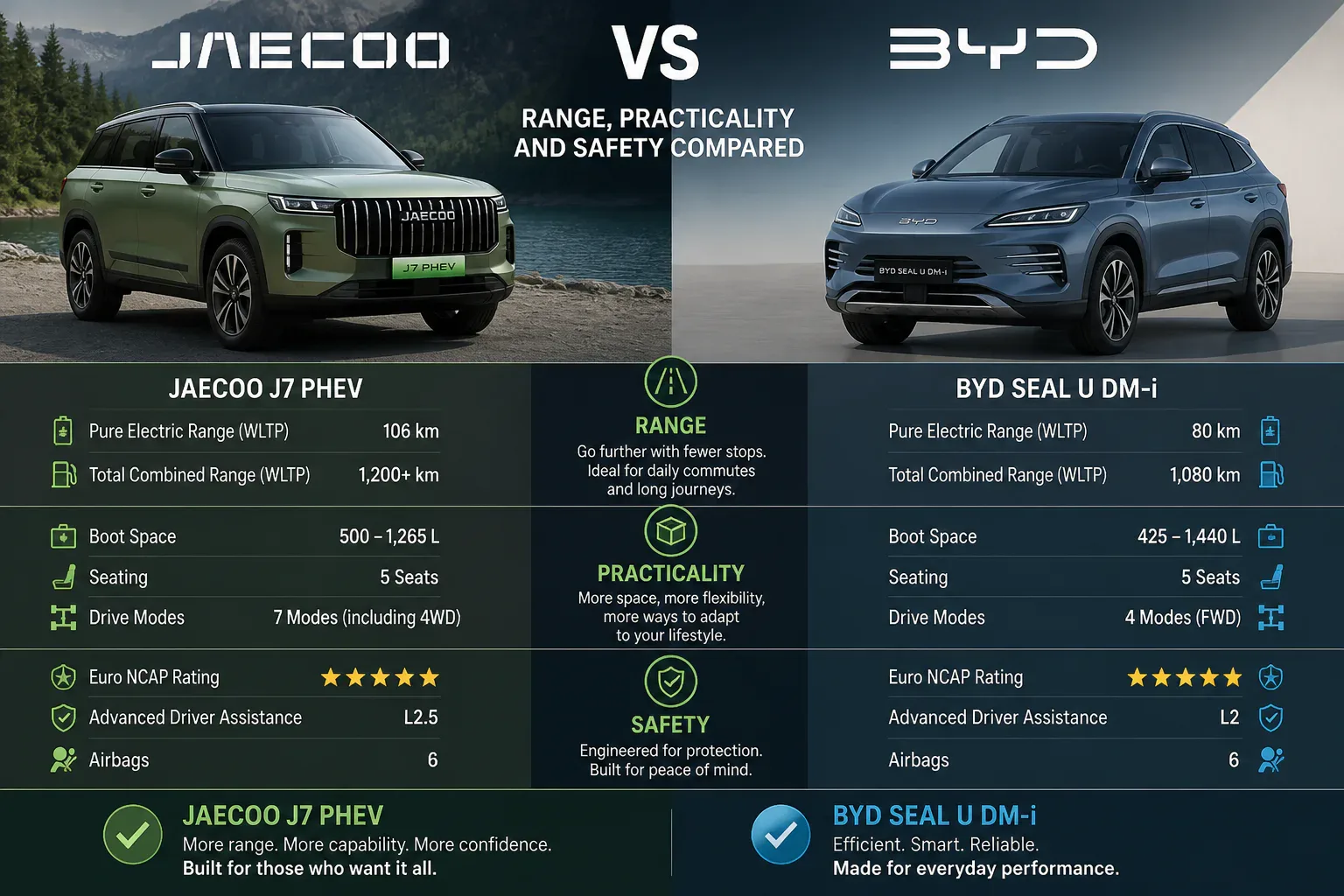
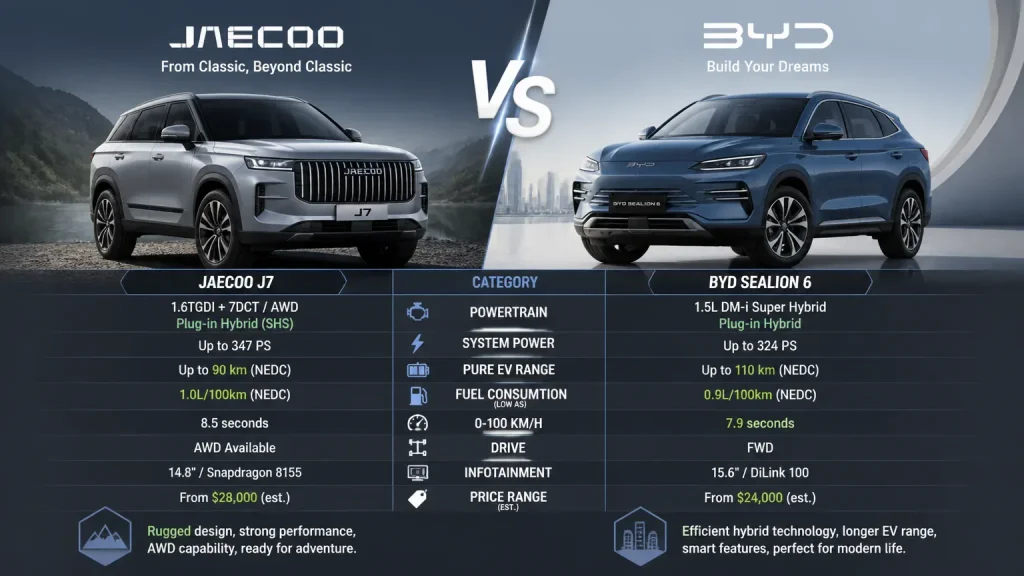
BYD Seal U DM-i | UK | Plug-in hybrid | Up to 78 mi electric; 699 mi combined | ||
JAECOO J5 EV Summit | Australia | Battery electric | A$36,990 drive-away | 402 km WLTP | 155 kW |
BYD Atto 2 Dynamic | Australia | Battery electric | A$31,990 before on-road costs | 345 km WLTP | 130 kW |
BYD Atto 2 Premium | Australia | Battery electric | A$35,990 before on-road costs | 345 km WLTP | 130 kW |
How price and powertrains differ
In the UK, the JAECOO 7 gives buyers a choice between a conventional petrol engine and a plug-in hybrid. The petrol version uses a 1.6-liter turbocharged four-cylinder engine rated at 147 hp; the plug-in hybrid adds electric-only driving for short journeys. The BYD Seal U DM-i is also a plug-in hybrid, so the UK comparison is between two family SUVs that can run on electric power as well as fuel.
Australian pricing highlights a different contest. The Atto 2 Dynamic starts at A$31,990 and the Premium at A$35,990, both before on-road costs. The JAECOO J5 EV Summit is A$36,990 drive-away, a price that includes those costs. Compare the final amount payable, not just the headline figures, and check which equipment and grade are included in each quote.
These prices and specifications apply to the named markets and trims. They are not US prices, and the Australian electric crossovers should not be treated as direct alternatives to the UK plug-in hybrids.
Which SUV suits your driving?
For UK drivers who can charge regularly, the BYD Seal U DM-i has the longer claimed electric-only range: up to 78 miles, compared with up to 56 miles for the JAECOO 7 plug-in hybrid. The Seal U DM-i’s claimed combined range is 699 miles. The JAECOO 7 petrol version is rated at up to 50 mpg, while the Seal U DM-i is rated at 44.6 mpg; real fuel use depends on charging and driving conditions.
In Australia, the JAECOO J5 EV has a 58.9 kWh LFP battery and a 402 km WLTP range. The Atto 2’s 51.13 kWh LFP battery gives it a 345 km WLTP range. The J5 EV also has more power at 155 kW versus 130 kW, while the Atto 2 produces slightly more torque: 290 Nm versus 288 Nm. Their 0–100 km/h times are 7.7 and 7.9 seconds, respectively.
Charging capability can matter as much as the published range. The J5 EV supports up to 130 kW DC charging, plus 6.6 kW single-phase and 10.3 kW three-phase AC charging. The Atto 2 supports up to 82 kW DC and 7 kW AC charging. Both Australian models have vehicle-to-load capability, which lets the car supply power to compatible external devices.
How much space and technology do they offer?
In the UK, the JAECOO 7 is 4,500 mm long, 1,865 mm wide, and 1,680 mm high. The longer BYD Seal U measures 4,785 mm by 2,085 mm by 1,668 mm. Boot capacity varies by JAECOO 7 powertrain: 500 liters in the petrol model and 410 liters in the plug-in hybrid. The Seal U DM-i has 426 liters of boot space.
With the rear seats folded, the JAECOO 7 provides 1,423 liters and the Seal U DM-i 1,440 liters. The JAECOO’s central display measures 13.2 inches, rising to 14.8 inches on top trims; the BYD has a 15.6-inch rotating touchscreen. Screen size alone does not settle the cabin comparison, so check the specific trim’s phone connectivity and controls before buying.
For Australian buyers, the J5 EV has a 480-liter boot and an additional 35-liter front storage compartment. The Atto 2 offers 380 liters, expanding to 1,320 liters with the rear seats folded. Those measurements favor the J5 EV for everyday luggage capacity, while the Atto 2’s folded-seat figure gives a separate view of its maximum cargo space.
What to know about safety and ownership
The BYD Seal U has a five-star Euro NCAP safety rating. The BYD Atto 3 also has a five-star rating, with scores of 91% for adult occupant protection, 89% for child occupant protection, 69% for vulnerable road users, and 74% for safety assist. Those ratings apply to the named models; they should not be assumed to cover the Atto 2, JAECOO 7, or J5 EV.
The Atto 2 warranty covers the vehicle for six years or 150,000 km and the battery for eight years or 160,000 km. The J5 EV has an eight-year, unlimited-kilometer warranty for both the vehicle and battery. BYD’s Blade Battery uses lithium iron phosphate (LFP) chemistry and a cell-to-pack design with blade-shaped cells; it is rated for more than 5,000 charge-discharge cycles.
Warranty length is useful for comparing ownership coverage, but it does not establish long-term reliability. For newer models, consider the local service network, parts access, warranty conditions, and the cost of routine servicing alongside the headline coverage.
JAECOO and BYD availability in the United States
Neither JAECOO nor BYD currently sells passenger vehicles through an authorized US dealer network. BYD has a commercial bus and truck presence in the country, but that does not provide a route to buy its passenger cars. JAECOO also lacks US passenger-car sales and an established dealer network.
High tariffs on Chinese-made vehicles, US safety and emissions certification requirements, and restrictions affecting connected-vehicle technology are major barriers to a US launch. Importing one privately is not a straightforward workaround: a vehicle must meet applicable federal requirements to be legally imported and registered for road use. A car sold in the UK or Australia is not automatically eligible for US roads.
Which JAECOO or BYD should you choose?
Choose the JAECOO 7 petrol if you want a UK family SUV without relying on charging and prioritize its stated fuel economy and larger petrol-model boot.
Compare the plug-in hybrids if you can charge at home or work. The Seal U DM-i has the longer claimed electric range; the JAECOO 7 plug-in hybrid has a smaller boot than its petrol counterpart.
Choose the JAECOO J5 EV if you are shopping in Australia and prioritize the longer WLTP range, higher power, faster DC charging, or larger boot.
Consider the BYD Atto 2 Dynamic if its lower listed starting price is the priority. The Premium costs more, and both grades share the stated range and power figures.
If you are in the United States, neither brand is currently a practical new-car purchase through an authorized local dealer.
FAQs
Is BYD or JAECOO better?
Neither brand is the better choice across every market and model. In the Australian EV comparison, the JAECOO J5 EV has more range, power, and boot space, while the BYD Atto 2 Dynamic has the lower listed starting price.
Who is BYD’s biggest competitor?
Tesla is BYD’s most prominent competitor in the global electric-vehicle market. The closest rival also depends on the country and vehicle type, since BYD sells both battery-electric and plug-in hybrid models.
What did Elon Musk say about BYD?
Elon Musk said that, without trade barriers, Chinese carmakers would “pretty much demolish most other car companies in the world.” The remark reflected his view of their competitiveness, including BYD’s position in electric vehicles.
Conclusion
Match the comparison to the market and powertrain you can actually buy: the UK choice is between family plug-in hybrids or a petrol SUV, while the Australian choice is between two battery-electric crossovers. In the United States, neither brand currently offers passenger cars through an authorized dealer network.