Driving Modes Guide: Eco, Sport, Track & More
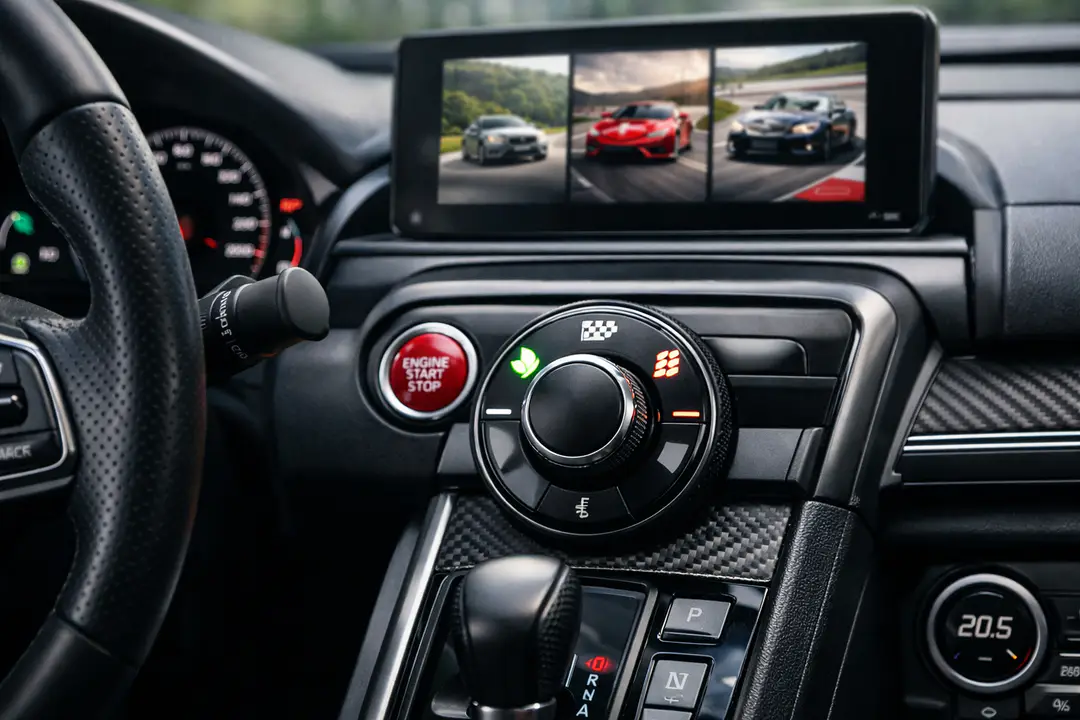
A driving mode is a selectable set of vehicle calibrations that changes how your car behaves—so one vehicle can feel economical on a commute, relaxed on a road trip, and sharper on a winding road. The value is simple: instead of buying “different cars for different days,” you choose a mode that tunes the vehicle’s character to match your conditions and priorities.
If you’ve ever toggled from Normal to Eco and wondered why the accelerator suddenly feels dull—or switched into Sport and noticed the gearbox holds gears longer—you’ve felt driving modes at work. Modern vehicles tie together software and hardware: the ECU (Engine Control Module), transmission logic, steering assist, traction control, and sometimes suspension stiffness, active exhaust, seat bolsters, and even ride height/ground clearance.
This guide explains how driving modes work, what they actually change (and what they don’t), and how common modes like Eco / Economy, Comfort, Sport / Dynamic, Sport+ / Track, Terrain / Off-road, Drift, Individual/custom, and PHEV / EV modes differ. You’ll also see real manufacturer naming examples and get practical, safety-minded advice for choosing modes in everyday driving.
What Are Driving Modes? An Overview
Driving modes are predefined (and sometimes customizable) settings that re-map how a vehicle responds to driver inputs and road conditions. Think of them as software profiles that tell the car how to interpret your accelerator position, how quickly the transmission should upshift, how much steering assist to provide, and how proactive stability systems should be.
At the center is the ECU (Engine Control Module) and related control units—often working as a network. When you select Eco, Comfort, Sport, or another mode, the vehicle loads a different power map and a bundle of calibrations. In an internal combustion vehicle, that power map heavily influences throttle response and sometimes turbo boost targets. In an EV, it typically changes the torque request curve, regenerative braking feel, and sometimes HVAC strategy to protect range.
Why this matters: cars are more capable—and more complex—than ever. A family crossover might have adaptive dampers, an 8–10 speed automatic, all-wheel drive with multiple clutch packs, and advanced driver aids. Driving modes give you a quick way to prioritize fuel economy, comfort, performance, or low-traction stability without needing to micromanage each system.
One important mindset: modes don’t create new physics. They can’t add grip beyond what tires and the road can provide. What they can do is reshape the way the vehicle uses its available grip and power, and how “busy” the car feels while doing it.
How Driving Modes Work (ECU, Power Maps, and Control Logic)
Driving modes work by changing software targets across multiple controllers—especially the ECU (Engine Control Module), the transmission controller, and chassis control modules. Each mode is essentially a calibrated “bundle” of behavior that prioritizes certain outcomes (efficiency, smoothness, response, off-road traction, or track consistency).
How it changes the car (typical systems adjusted):
- Throttle response: re-scales accelerator pedal input; same pedal angle can request less or more torque.
- Gearbox/transmission mapping: changes shift points, kickdown sensitivity, and torque converter lock-up strategy.
- Suspension stiffness: adaptive dampers can soften for comfort or firm up for body control.
- Steering feel: alters electric power steering assist and sometimes on-center weighting.
- Traction control: adjusts slip thresholds and how quickly torque is reduced or brakes are applied.
- Active exhaust: can open valves earlier in Sport/Sport+ for more sound (where fitted).
When to use it: Use modes as “intent statements” to the car—tell it whether you want calm and efficiency, or responsiveness and tighter control.
In many vehicles, the mode button doesn’t just change one map. It changes a set of coordinated parameters so the powertrain and chassis don’t fight each other. For example, a Sport mode might sharpen throttle response and also firm the dampers to reduce pitch during hard acceleration, while simultaneously relaxing traction control slightly to allow small wheel slip without abrupt power cuts.
As vehicles become more software-defined, this coordination has expanded. Some cars also adjust seat bolsters, instrument cluster layout, adaptive cruise behavior, or thermal management. If you’re interested in how fast-moving vehicle technology trends influence everyday features like this, it’s worth keeping an eye on broader automotive technology trends shaping modern cars.
What Driving Modes Actually Change (A Quick Checklist)
Driving modes are often marketed as personality switches, but the practical differences come from a repeatable checklist of system changes. Knowing what’s likely to change helps you predict what you’ll feel from the driver’s seat—and prevents confusion when a mode doesn’t behave as expected.
How it changes the car (checklist):
- Power map and torque request: the ECU (Engine Control Module) changes how your pedal position translates into engine torque (ICE) or motor torque (EV).
- Throttle response: usually the most noticeable change day-to-day; Eco softens, Sport sharpens.
- Gearbox/transmission mapping: updated shift points, downshift aggressiveness, and in some cases manual-mode behavior.
- Suspension stiffness: adaptive dampers and air suspension can shift between comfort-focused compliance and firmer control.
- Steering feel: more or less assist; sometimes added self-centering and heavier weighting in Sport.
- Traction control and stability control: different intervention thresholds; some Sport+ or Track modes allow more slip/yaw.
- AWD/4WD torque distribution: some modes bias rear for agility or lock center coupling for low-traction terrain.
- Active exhaust: valves open more readily for reduced backpressure and a louder tone (where equipped).
- Ground clearance: air suspension can raise for obstacles or lower for aerodynamics and stability.
- PHEV / EV mode logic: prioritizes electric drive, blended hybrid drive, or battery hold/charge strategies.
When to use it: Choose the mode that aligns with your limiting factor—range/fuel, comfort, response, grip, or clearance.
Common misconception: A sharper mode doesn’t automatically mean faster point-to-point. In traffic, too-aggressive throttle response and late shift points can feel busy and may even reduce smoothness and efficiency.
Quick self-test: On a safe, open road, hold a steady 20–30% pedal input in Normal, then switch to Eco and Sport (if the car allows changing on the move). Notice how the same pedal position produces different acceleration. That’s the power map and throttle response scaling in action.
Common Driving Modes Explained (Eco to Track)
Most vehicles group their core modes around efficiency, comfort, and performance. The labels vary, but the intent is consistent: Eco saves fuel/energy, Comfort reduces effort and harshness, and Sport increases immediacy. Sport+ and Track push further, often by changing traction control behavior and keeping the drivetrain “on standby.”
Eco / Economy Mode
Definition: Eco / Economy mode prioritizes fuel economy or electric range by reducing demand spikes and encouraging earlier upshifts.
- Throttle response: softened, especially in the first half of pedal travel.
- Gearbox/transmission mapping: earlier upshifts, less eager kickdown; lower RPM targets.
- Suspension stiffness: usually unchanged, though some cars default to softer settings.
- Steering feel: may be lighter for relaxed driving.
- Traction control: typically unchanged, sometimes tuned to reduce wheelspin energy loss.
When to use it: Stop-and-go commuting, steady highway trips, and anytime you’re trying to stretch a tank or charge.
Practical example: Many German brands use alternate naming—Mercedes has used “C” (Controlled Efficiency) on some models, while others label it “Eco Pro” or “Efficiency.” The behavior is similar: calmer pedal mapping and conservative shift points.
Common mistake: Assuming Eco makes the car “slow.” Eco reduces response, but full-throttle power is often still available; you just have to press further. That said, some cars also limit HVAC compressor use or reduce heated seat intensity to save energy—so comfort can change too.
Manufacturer callout:
| Brand | Eco-style label | What drivers notice most |
|---|---|---|
| BMW | Eco Pro | Relaxed throttle, early shifts, efficiency coaching |
| Mercedes-Benz | Eco / “C” | Smoother starts, calmer transmission behavior |
| Hyundai/Kia | Eco | Less jumpy pedal, earlier upshifts |
Comfort / Normal Mode
Definition: Comfort (or Normal) is the baseline calibration designed to feel predictable across the widest range of roads.
- Throttle response: linear and easy to modulate.
- Gearbox/transmission mapping: balanced shift points; downshifts without drama.
- Suspension stiffness: softer if Comfort is separate; Normal is often the “middle” damper setting.
- Steering feel: medium assist for low effort without feeling vague.
- Traction control: full stability systems active with standard thresholds.
When to use it: Everyday mixed driving, unfamiliar roads, rain where you want full stability systems with predictable response.
Practical application: If your car has adaptive dampers, Comfort is often the best mode for rough pavement because it allows more wheel travel and reduces impact harshness. For long highway stints, Comfort/Normal also tends to avoid constant gear hunting on mild grades.
Common mistake: Leaving the car in Sport because it “feels better,” then wondering why it seems tiring on longer drives. A firmer suspension stiffness setting and heavier steering can increase workload, especially on imperfect roads.
Related insight: Normal/Comfort is also a good reference point when diagnosing issues. If the car feels jerky only in Sport, it may be normal calibration. If it’s jerky in Normal too, you might be looking at a driveline or transmission behavior problem worth checking.
Sport / Dynamic Mode
Definition: Sport (often called Dynamic) prioritizes responsiveness by sharpening the power map, holding gears longer, and tightening chassis settings where available.
- Throttle response: sharper initial response; less pedal travel for the same torque request.
- Gearbox/transmission mapping: later upshift points, quicker downshifts, more aggressive kickdown logic.
- Suspension stiffness: firmer damping to control roll and pitch (adaptive cars).
- Steering feel: heavier weighting; sometimes quicker ratio on variable-rack setups.
- Traction control: may allow slightly more slip before intervention.
- Active exhaust: more likely to open valves under moderate throttle.
When to use it: Passing maneuvers, hilly roads where you want fewer upshifts, and spirited driving on dry pavement.
Case-style example: In many turbocharged cars, Sport also changes boost and torque management targets—so the engine feels more immediate when you roll into the throttle. In an EV, Sport typically changes torque delivery and can reduce the “dead band” at small pedal inputs.
Common mistake: Using Sport in slick conditions because it “feels more planted.” If Sport also relaxes traction control and stability thresholds, it can make wheelspin easier to provoke on cold tires or wet roads. If you want stability with better response, consider Individual/custom mode (if available) to mix Sport powertrain with Normal traction settings.
Sport+ / Track Mode
Definition: Sport+ and Track modes are performance-focused calibrations that increase responsiveness and reduce electronic intervention for skilled drivers and closed-course use.
- Throttle response: most aggressive mapping; immediate torque request.
- Gearbox/transmission mapping: holds gears near peak power; very late shift points; faster downshifts.
- Suspension stiffness: firmest damping; some cars lower ride height for aero and stability.
- Steering feel: heaviest weighting; maximum feedback emphasis.
- Traction control: higher slip thresholds or partial-off settings; stability may be reduced.
When to use it: Track days, autocross, or specific situations where you understand the car’s limits and have space to manage them.
Practical note: Track mode often bundles other changes that matter more than sound and shift drama. Some cars increase cooling targets, change brake assist logic, adjust electronic limited-slip differential behavior, or alter regenerative braking blending (hybrids/EVs) to maintain repeatability lap after lap.
Common mistake: Treating Track like “the best mode” for street driving. The firmest suspension stiffness and relaxed traction control can reduce safety margins on public roads with debris, cold tires, or mid-corner bumps. Also, aggressive shift points can keep the engine at higher RPM, increasing noise and fuel use.
Manufacturer callout: Porsche’s Sport Plus is often paired with sharper PDK shift behavior and more aggressive stability logic; many Ford Performance products offer Track that modifies stability control and throttle mapping substantially. Always read the mode description in the cluster—some explicitly state that driver aids are reduced.
Off-Road and Specialty Modes (Terrain, 4WD Selectors, Drift, EV/PHEV)
Beyond the core on-road modes, many SUVs and performance cars include specialized settings for traction-limited surfaces or specific handling behaviors. These modes can feel dramatic because they re-prioritize traction control strategy, drivetrain coupling, and (where fitted) ground clearance.
How it changes the car (typical systems adjusted):
- Throttle response: often softened for low-speed control on loose surfaces.
- Gearbox/transmission mapping: may start in 2nd gear, hold lower gears, or lock torque converter to reduce heat.
- Traction control: recalibrated for sand/mud/snow; sometimes allows more wheelspin to clear treads.
- AWD/4WD behavior: uses 2H/4A/4H/4L (drive selector) logic; may lock center coupling.
- Ground clearance: air suspension can raise; hill descent control may activate.
When to use it: Snowy starts, muddy trails, sand, steep descents, or controlled environments for Drift mode.
Terrain / Off-road Mode
Definition: Terrain modes (sometimes called Terrain Response) optimize traction and drivability on loose or uneven surfaces by coordinating throttle, braking, and driveline coupling.
Example: In a sand mode, the system may permit more wheelspin than Normal because wheelspin can help maintain momentum. In a rock-crawl mode, it often does the opposite: very gentle throttle response and maximum low-speed control, frequently paired with 4L.
Common mistake: Using 4L on high-traction pavement. Low range is for low-speed, low-grip or steep conditions; using it on dry pavement can cause driveline binding in part-time systems.
2H/4A/4H/4L: What the Selector Means
| Setting | Typical use | What changes |
|---|---|---|
| 2H | Dry roads, best efficiency | Rear-wheel drive (or default axle) only |
| 4A | Mixed conditions | Auto-couples front axle when slip is detected/predicted |
| 4H | Snow, gravel, light trails | More consistent torque to both axles; higher traction focus |
| 4L | Steep, slow, technical off-road | Low-range gearing for torque multiplication and control |
Drift Mode
Definition: Drift mode biases power delivery toward the rear axle and relaxes traction control/stability intervention to make sustained oversteer easier.
Practical reality: It’s designed for controlled environments. On public roads, it reduces safety margins and increases tire wear quickly. If your car includes Drift mode, the owner’s manual typically states it’s intended for track use.
PHEV / EV Mode
Definition: PHEV / EV mode changes how the vehicle uses electric drive versus the engine, and often changes regenerative braking feel.
What drivers notice: smoother low-speed response, stronger regen “one-pedal” sensation (in some EVs), and different HVAC priorities. In some EVs, mode selection can materially change range by altering acceleration demand and regen strategy—an issue that comes up often with new models, including discussions around how EV drive settings affect real-world consumption.
Manufacturer Naming Differences (And What They Usually Mean)
Driving modes are conceptually similar across brands, but names and bundling differ. One company might separate Comfort and Normal; another might roll them into a single default mode and reserve Comfort for models with adaptive dampers. Performance brands may include Sport Plus, Track, or bespoke settings like “Race.”
How it changes the car (what to watch regardless of brand):
- Power map: does Sport change the torque curve, or just the pedal scaling?
- Gearbox/transmission mapping: does it alter shift points significantly or simply reduce upshifts?
- Traction control: is it normal, sport, or reduced/off?
- Suspension stiffness and ground clearance: are dampers/air suspension involved?
When to use it: Use the mode description in your cluster/infotainment as the “truth,” not the badge on the button.
| Manufacturer | Common labels | Typical personality |
|---|---|---|
| BMW | Eco Pro / Comfort / Sport (+) / Adaptive | Clear separation of comfort vs response; Sport often tightens steering and dampers |
| Porsche | Normal / Sport / Sport Plus | Sport Plus often changes stability logic and shift strategy dramatically |
| Mercedes-Benz | Eco / Comfort / Sport / Sport+ | Comfort is smooth; Sport+ may reduce stability intervention depending on model |
| Ford | Normal / Eco / Sport / Track / Slippery / Sand | Drive modes often include surface-based traction calibrations |
| Hyundai (N models) | Normal / Sport / N / N Custom | Granular customization: engine, suspension, e-LSD, exhaust |
| Land Rover | Terrain Response (Grass/Gravel/Snow, Mud/Ruts, Sand, Rock) | Surface-first logic with driveline and traction management emphasis |
Tip: Some brands add “Adaptive” modes that monitor driver behavior and road conditions, then blend settings dynamically. These can work well in mixed driving, but if you want consistency (for example, on a long mountain descent), selecting a fixed mode is often preferable.
For readers interested in the broader context of how manufacturers design driver-facing controls—and how safety expectations shape everyday operation—there’s a useful parallel in discussions about braking behavior and risk management, where the “best” setting depends heavily on conditions and predictability.
When to Use Each Mode (Real-World Scenarios and Safety Notes)
Choosing a mode is less about “which is best” and more about matching the car’s behavior to the constraints you face: traffic, weather, visibility, road quality, and your own attention bandwidth. The safest approach is to default to Normal/Comfort, then change only when you have a clear reason.
How it changes the car (what you’re really selecting):
- Response vs smoothness: throttle response and shift points determine how “busy” the car feels.
- Body control vs compliance: suspension stiffness trades ride comfort for roll/pitch control.
- Freedom vs guardrails: traction control thresholds affect how quickly the car steps in.
When to use it (scenario guidance):
- Rush-hour traffic: Eco or Comfort reduces lurchiness and can make stop-start smoother; it also discourages unnecessary acceleration spikes.
- Long highway cruising: Comfort/Normal is usually best. Eco can help range, but watch for frequent downshifts on hills if your gearbox/transmission mapping becomes too eager to upshift.
- Two-lane passing: Sport can be useful because it preps the transmission—higher RPM, quicker downshifts—reducing the “wait” for acceleration.
- Rain or cold tires: Normal/Comfort with full traction control is typically safer than Sport+, which may allow more slip.
- Snowy neighborhood streets: Slippery/Snow mode (if available) often softens throttle response and changes traction control logic. Pair with 4A/4H as appropriate for your system.
- Rough pavement: Comfort (softer damping) can improve tire contact and reduce skittering over sharp bumps.
- Track day: Track mode can improve consistency, but bring the car up to temperature and understand what driver aids are reduced.
Common mistake: Switching to a more aggressive mode to “feel safer” at speed. Heavier steering feel doesn’t create more grip; it mainly changes effort and feedback. Tires, alignment, and road surface dominate real stability.
Pro tip: If your car has Individual/custom mode, create two presets: (1) an “Efficient Daily” setup (Eco power map, Normal steering, Comfort suspension) and (2) a “Back Road” setup (Sport power map, Sport transmission, Normal traction control). It gives you most of the benefit without the extremes.
Practical Tips and Best Practices
Driving modes are most useful when you treat them as tools, not trophies. The goal is to reduce workload and increase predictability, not to keep the car in its most aggressive setting.
- Learn one change at a time: If your car allows it, first compare only the powertrain (throttle response and gearbox/transmission mapping). Then explore suspension stiffness and steering feel changes separately in Individual/custom mode.
- Use Eco strategically: Eco shines when your right foot is the biggest variable. In stop-and-go, it can smooth inputs and reduce consumption. On steep hills, you may prefer Normal to avoid frequent shifts.
- Don’t confuse sound with speed: Active exhaust and louder cabin audio (some cars add synthetic sound) can make Sport feel faster even when the real advantage is simply responsiveness.
- Respect reduced driver aids: Sport+ / Track may reduce traction control intervention. If conditions are wet, icy, or visibility is limited, pick a mode that keeps full stability systems active.
- Match off-road modes to the surface: Sand often needs momentum (and therefore different traction control logic) than rocks, which demand low-speed precision. If your SUV offers specific terrain modes, use them rather than guessing.
- Watch tire temperature and wear: Aggressive modes often encourage harder acceleration and later shift points. On cold tires, that can increase slip; over time it can shorten tire life.
- Remember the comfort stack: For passengers, Comfort suspension stiffness and calmer shift behavior usually matter more than steering feel.
Things to avoid: Don’t use 4L on dry pavement, don’t rely on Sport steering weight as a proxy for grip, and don’t assume Track mode is appropriate outside controlled environments. If you’re unsure what a mode changes, check the owner’s manual—manufacturers often list exactly which systems are affected.
Frequently Asked Questions About Driving Modes
Do driving modes change horsepower?
Usually, they don’t change the engine’s peak rated output, but they can change how quickly you access it. A different power map and throttle response scaling can make the car feel stronger because torque arrives sooner for a given pedal input. Some performance cars may alter boost targets or hybrid assist aggressiveness, which can affect repeatability and responsiveness more than peak numbers.
Why does Eco mode feel “laggy”?
Eco typically remaps throttle response so early pedal travel requests less torque, and it often uses conservative gearbox/transmission mapping with earlier upshifts. That combination reduces sudden demand spikes, which helps economy. If you need immediate acceleration, press further or switch to Normal/Sport for more direct response.
Can Sport mode damage my transmission?
In a healthy vehicle, Sport mode is an engineered calibration and should not inherently cause damage. It can increase heat and wear over time because it holds higher RPM and may downshift more aggressively. If you tow, drive in extreme heat, or notice harsh shifts in all modes, maintenance and fluid condition matter more than the mode itself.
Is it better to drive in Comfort or Normal in the rain?
Either can be fine, but prioritize the mode that keeps full traction control and stability control behavior. Many cars keep these unchanged in Comfort/Normal and only relax them in Sport+ or Track. The bigger factors are tire tread depth, tire compound, and speed relative to available grip.
What’s the point of Individual/custom mode?
Individual/custom mode lets you mix settings—like a Sport power map with Comfort suspension stiffness—so you can tailor the car to your roads and preferences. It’s especially useful if you like a responsive drivetrain but don’t want firm damping, heavy steering feel, or reduced traction control thresholds.
Conclusion
Driving modes are coordinated software profiles that let one car behave like several, depending on what you need. By changing throttle response, ECU (Engine Control Module) power map logic, gearbox/transmission mapping and shift points, suspension stiffness, steering feel, traction control thresholds, and sometimes active exhaust and ground clearance, modes reshape both the car’s reactions and your workload as a driver.
The most effective way to use them is practical: Eco when you’re trying to smooth inputs and save fuel or range, Comfort/Normal for predictable everyday driving, Sport for better response when conditions are dry and you want quicker access to performance, and Sport+ / Track for controlled environments where you understand the reduced safety nets. Terrain / Off-road modes and 2H/4A/4H/4L settings are about traction and control, not speed.
Next step: spend a week intentionally using two modes—Normal and Eco—then add Sport for specific situations like passing. Once you can describe what changed (shift points, steering weight, suspension stiffness, traction control behavior), you’ll get the real benefit of driving modes: a car that fits the day instead of forcing you to adapt to the car.