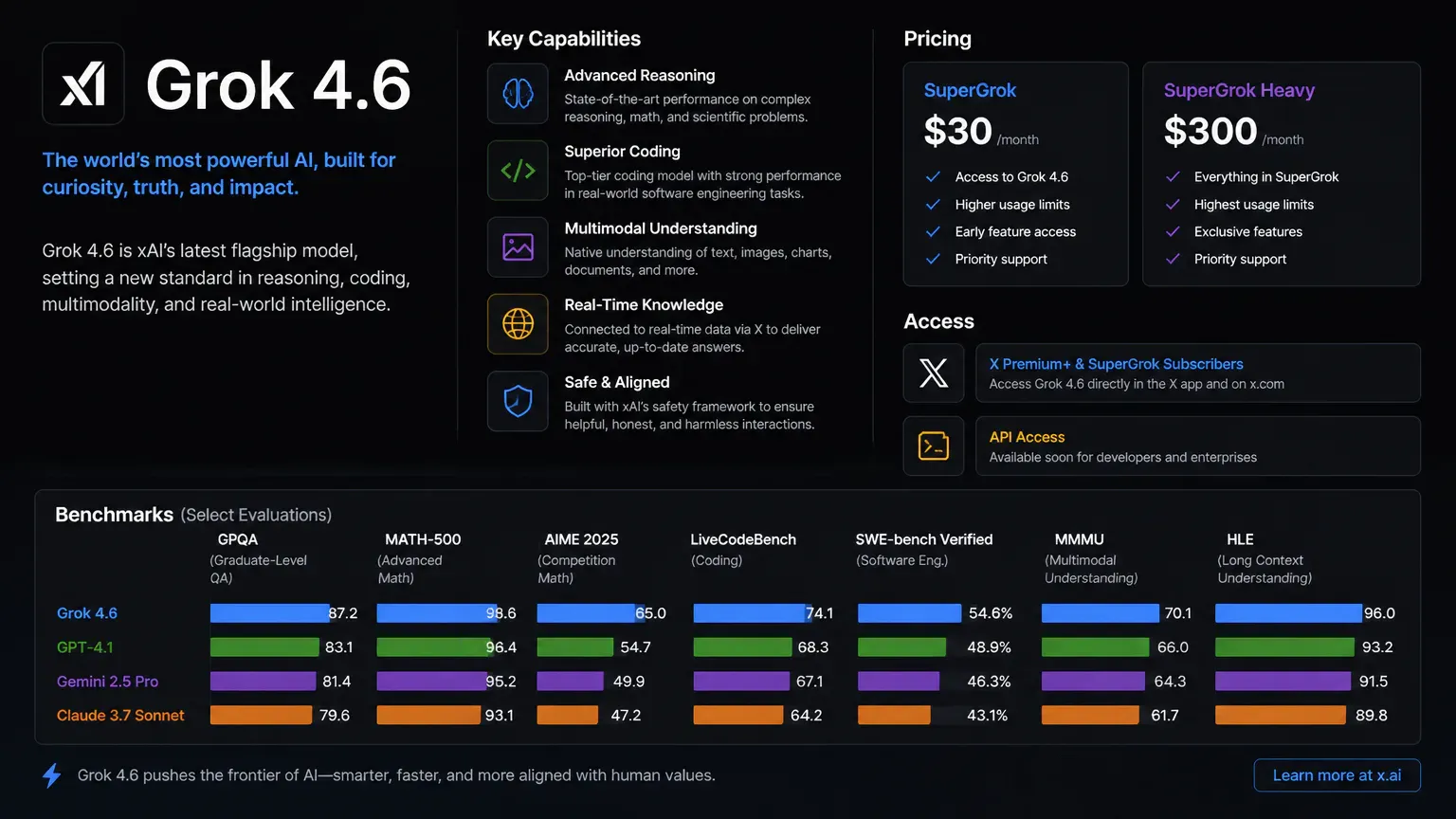
Grok 4.6: Capabilities, Pricing, Access & Benchmarks
Grok 4.6 is xAI’s reasoning model for coding, research, knowledge work and long-running agent tasks. You can access it through developer and coding platforms, though context limits and pricing vary by platform. It scores 61 on the Artificial Analysis Intelligence Index at high reasoning effort, matching GPT-5.6 Sol. Token costs and response time are also worth weighing for daily use.
Grok 4.6 specs and pricing
Specification or price | Grok 4.6 details |
|---|---|
API context window | 500,000 tokens |
Cursor context limit | 256,000 tokens |
Input types | Text and images |
Output type | Text |
Knowledge cutoff | February 1, 2026 |
Reasoning effort | Low, medium, high, xhigh |
Artificial Analysis Intelligence Index | 61 (high effort) |
Standard input | $2 per 1M tokens |
Cached input | $0.50 per 1M tokens |
Standard output | $6 per 1M tokens |
Fast input | $4 per 1M tokens |
Fast cached input | $1 per 1M tokens |
Fast output | $12 per 1M tokens |
Long-context threshold | More than 200,000 tokens |
Long-context input | $4 per 1M tokens |
Long-context cached input | $1 per 1M tokens |
Long-context output | $12 per 1M tokens |
Cost per Artificial Analysis index task | $0.84 per task |
Time to first answer token | 40.44 seconds |
The 500,000-token context window applies to the API; Cursor has a 256,000-token limit. Long-context rates apply to requests exceeding 200,000 tokens. Fast requests cost twice as much per token as standard requests, so using the lower-latency option can raise costs substantially on long prompts or large outputs.
What Grok 4.6 does best
Grok 4.6 is suited to tasks with multiple steps and repeated checks, such as researching a topic, analyzing documents or changing code across a codebase. It supports function calling, web search, X search, code execution, collections search and remote MCP, which connects it to tools and services.
The model accepts images and returns text, so you can combine visual material with written instructions. Its interactive and visual capabilities also suit work such as building applications and other work artifacts. In an agent workflow, the model needs to retain task context and use tools appropriately, not just produce a strong first response.
You can set reasoning effort to low, medium, high or xhigh. Higher effort gives the model more room to work through difficult problems. Lower effort may suit simpler requests where speed and token use matter more.

How Grok 4.6 performs on benchmarks
At high reasoning effort, Grok 4.6 scores 61 on the Artificial Analysis Intelligence Index, matching GPT-5.6 Sol. Its cost per index task is $0.84, and its time to first answer token is 40.44 seconds. The score measures evaluated capability; task cost and first-token time affect what it takes to use the model in practice.
Benchmark results depend on the test set, reasoning setting, available tools and evaluation method. A tie on one index does not mean two models perform identically at coding, research or everyday chat. When comparing Grok 4.6 with Claude Opus 5, use the same tasks and token mix; per-token rates alone do not show which model will cost less to complete a job.
The 40.44-second first-token time can be a tradeoff in interactive work, where frequent back-and-forth may feel slow. For longer agent runs, the quality of the completed task and the amount of generated output may matter more than the first response.

What changed from Grok 4.5
Grok 4.6 builds on Grok 4.5 with a greater focus on long-running agents and ambitious interactive and visual tasks. It is intended to handle complex work over multiple stages, such as investigating a question, checking information and continuing through a codebase or application project.
More output on evaluated tasks: Grok 4.6 produced about 20% more output tokens than Grok 4.5 on the same Artificial Analysis tests.
More control over reasoning effort: Developers can choose from four reasoning levels.
Longer context: The API context window is 500,000 tokens; Cursor has a separate 256,000-token limit.
The additional output can increase token use on longer tasks. Its 40.44-second time to first answer token is another tradeoff to consider for interactive workflows.
How much Grok 4.6 costs
The xAI API’s standard rate is $2 per million input tokens and $6 per million output tokens. Cached input costs $0.50 per million tokens. Fast requests cost $4 per million input tokens and $12 per million output tokens, with cached input at $1 per million tokens.
Requests exceeding 200,000 tokens use separate long-context rates: $4 per million input tokens, $1 per million cached input tokens and $12 per million output tokens. The long-context rate applies before you choose the fast option. When estimating usage, account for both prompt size and generated output.
The API is not free at these listed token rates. Consumer access depends on the applicable X or xAI plan, and paid X/xAI tiers share a unified weekly usage pool. The per-token API rates do not include a fixed consumer subscription price.
Where to access Grok 4.6
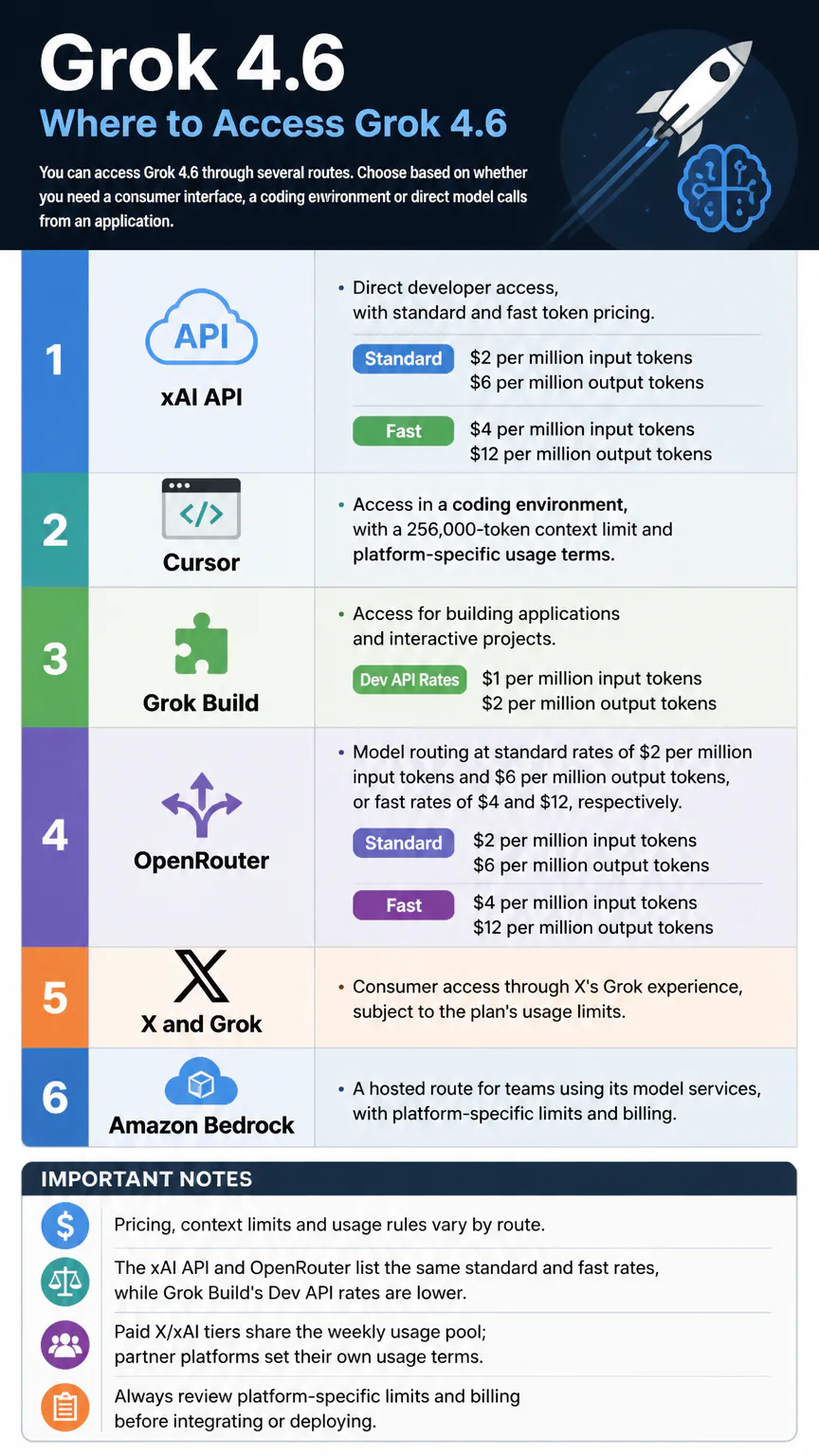
You can access Grok 4.6 through several routes. Choose based on whether you need a consumer interface, a coding environment or direct model calls from an application.
xAI API: Direct developer access, with standard and fast token pricing.
Cursor: Access in a coding environment, with a 256,000-token context limit and platform-specific usage terms.
Grok Build: Access for building applications and interactive projects. The Grok 4.6 Dev API rate is $1 per million input tokens and $2 per million output tokens; the fast rate is $2 per million input tokens and $4 per million output tokens.
OpenRouter: Model routing at standard rates of $2 per million input tokens and $6 per million output tokens, or fast rates of $4 and $12, respectively.
X and Grok: Consumer access through X’s Grok experience, subject to the plan’s usage limits.
Amazon Bedrock: A hosted route for teams using its model services, with platform-specific limits and billing.
Pricing, context limits and usage rules vary by route. The xAI API and OpenRouter list the same standard and fast rates, while Grok Build’s Dev API rates are lower. Paid X/xAI tiers share the weekly usage pool; partner platforms set their own usage terms.
How to start using Grok 4.6
For API access, choose the route that fits your software stack and billing needs. Start with a short test request to check response length and confirm the model suits the task before moving a larger workflow over.
Choose an access route: Use the xAI API for direct calls, Cursor for coding, Grok Build for interactive projects or OpenRouter for model routing.
Set up access: Create or sign in to the account required by the service, then configure billing or a subscription.
Prepare a request: For API access, create a key in the xAI Console and select the Grok 4.6 model identifier, grok-4.6.
Set reasoning effort: Choose low, medium, high or xhigh to match the task’s complexity.
Test a representative task: Check the answer, tool behavior, latency and token use before expanding the workflow.
Cursor gives you an in-editor option for coding without building an API integration. For application development or automated agent runs, API access gives you more control over requests and tool connections.
Is Grok 4.6 worth using?
Grok 4.6 is suited to sustained reasoning, coding across a larger context and tool-assisted research. Its 500,000-token API context window and support for web search, code execution and remote MCP suit workflows that require more than a single text response.
High-volume or highly interactive use can cost more: standard output is $6 per million tokens, fast output is $12, and the time to first answer token is 40.44 seconds. A benchmark score alone does not show what a particular workload will cost or how long it will take.
Grok 4.6 is not categorically better than ChatGPT. It matches GPT-5.6 Sol on the Artificial Analysis Intelligence Index, but that does not establish an advantage across every task or product experience. If your team already uses Claude Opus 5, test both models on the same representative jobs and compare completion quality, latency and total cost.
FAQs
Why is Grok rude?
Grok’s replies can sound blunt or sarcastic depending on the prompt and conversational context. That tone is generated text, not evidence of intent. Clear instructions about tone and audience can make responses more professional.
Is Grok 4.6 down?
Availability can vary by route: an xAI API interruption does not necessarily mean X, Cursor, Grok Build or OpenRouter is also unavailable. A timeout may also result from a rate limit or request error rather than a model-wide outage.
Conclusion
Test Grok 4.6 on long-running coding, research and agent tasks if its tools and context window fit your workflow. Compare it with your current model on representative jobs, including output volume, latency and platform-specific limits.