Edge AI for Real-time Analytics: Faster Insights at the Source
Edge AI for real-time analytics means AI models process data where it is created, on local devices, instead of sending everything to distant cloud servers first. That shift matters because decisions can happen immediately, whether a factory sensor detects a fault, a hospital device flags a change, or a retail camera spots a stock issue. In 2026, this local approach has become essential for organizations that need faster insights, stronger privacy, and more reliable operations even when connectivity is limited.
Traditional cloud AI still plays an important role in large-scale storage and centralized analysis, but it adds travel time for data. Edge AI removes much of that delay by keeping computation close to the source. The result is real-time analytics that can monitor signals, respond autonomously, and support day-to-day decisions without waiting on the network.
What is Edge AI?
Define the core idea
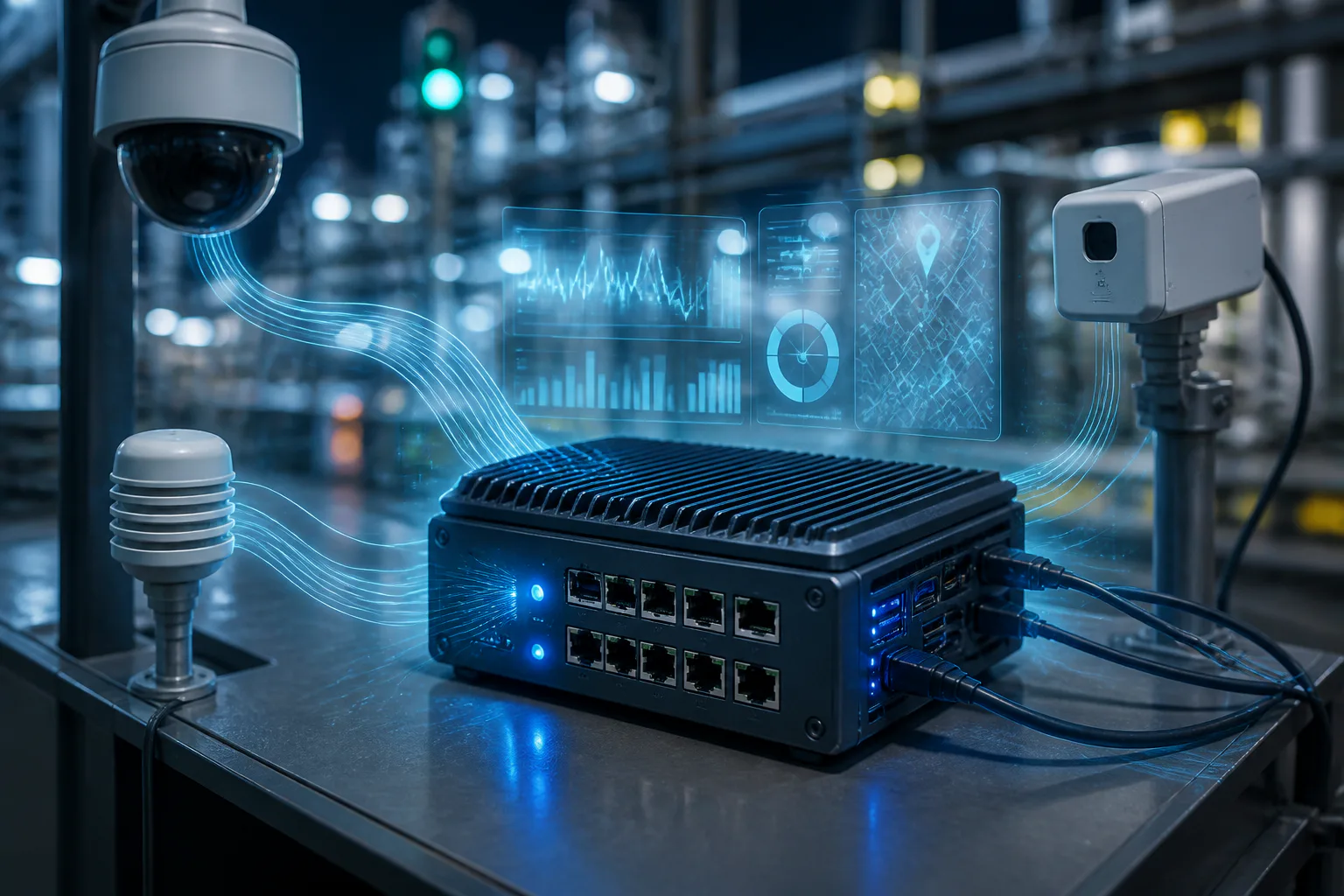
Edge AI is the use of artificial intelligence on devices at or near the place where data is generated. Instead of sending raw data to a centralized cloud for processing, the device itself handles the analysis locally. That device could be a camera, sensor, machine controller, medical device, or other endpoint that receives constant streams of information.
This is what makes edge AI so useful for real-time analytics. Analytics becomes real time when data is processed quickly enough to support immediate action, not a delayed report. If a production line camera identifies a defect and the system reacts instantly, that is edge AI turning live data into a usable decision on the spot.
Compare edge and cloud AI
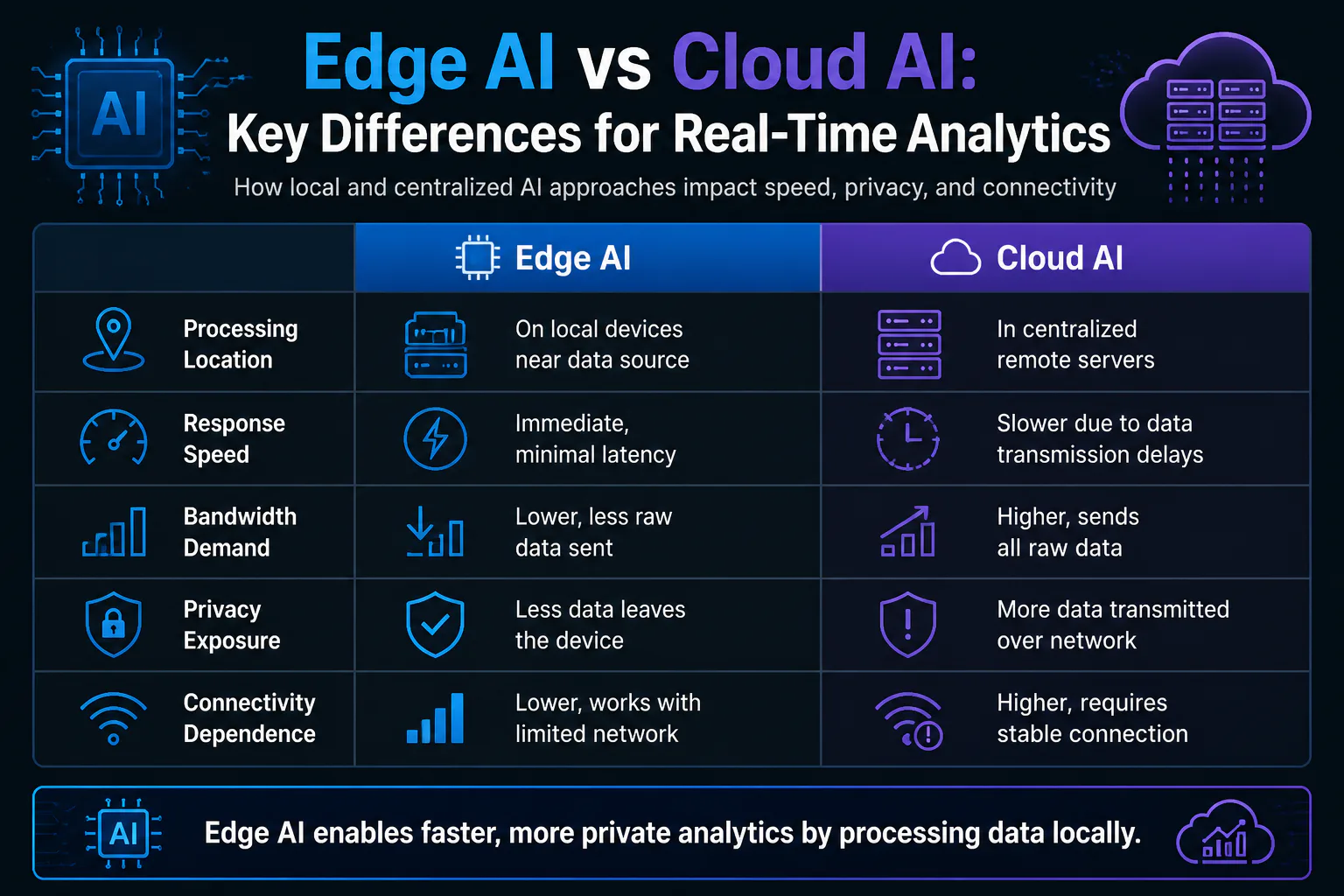
Cloud AI depends on moving data from the device to a remote server, processing it there, and sending back a result. That model works well for broad aggregation and historical analysis, but it introduces latency and relies heavily on stable connectivity. Edge AI keeps the loop local, which reduces delay and lowers bandwidth use.
The difference is practical, not just architectural. A smart shelf in retail can detect low inventory without waiting for a cloud round trip. A manufacturing system can monitor vibration or temperature signals and act before a machine fails. A healthcare device can process sensitive data locally, which strengthens privacy while still supporting fast clinical alerts.
See why it matters now
By 2026, distributed operations generate more data than centralized systems can efficiently handle in every moment. Businesses need immediate responses, not only dashboards after the fact. Edge AI answers that need by combining local data processing, real-time signal monitoring, and autonomous action inside the operational environment itself.
It also supports embedded AI agents, which are software systems that can interpret live inputs and act on predefined goals without waiting for human review on every event. That is especially valuable in settings where seconds matter. Teams already dealing with high-load agentic AI problems often face the same core issue: intelligence has to stay responsive when data volumes surge.
Recognize the tradeoffs
Edge AI is not automatically better in every case. Local devices have tighter limits on processing power, memory, and storage than large cloud environments. Security still requires careful design, and deploying AI across many edge devices adds management complexity over time.
Still, for real-time analytics, the tradeoff is often worth it. Organizations gain speed, resilience, and control over sensitive information. That is why edge AI has moved from a specialized option to a mainstream strategy for operational decision-making.
How Edge AI Enables Real-Time Analytics
Process data locally
- A device captures data.
- The AI model analyzes it locally.
- The system produces an immediate result.
- Because the data does not have to travel to a distant server first, the delay is much shorter.
- This local loop enables real-time analytics in environments that cannot wait for cloud processing.
Monitor signals continuously
Edge AI is especially effective for real-time signal monitoring. It can watch sensor readings, video feeds, machine conditions, or patient signals as they happen, then identify meaningful changes in the moment. That constant monitoring improves operational efficiency because the system can act as soon as a threshold, anomaly, or pattern appears.
Support autonomous action
Once live signals are analyzed, edge AI can support autonomous workflow execution. In simple terms, that means the system does more than detect a condition; it also initiates a response without waiting for cloud delays. Security teams see a related pattern in AI-generated video phishing attacks, where speed matters because a delayed response turns a warning into a breach.
Key Benefits of Edge AI for Real-Time Analytics
Focus on operational gains
- Reduced latency: Decisions happen near the data source, so alerts and actions arrive faster.
- Lower bandwidth use: Less raw data needs to be sent to the cloud, which reduces network load.
- Better privacy: Sensitive data can stay on the device instead of being transmitted elsewhere.
- Higher reliability: Local analytics keeps working even when network quality is poor.
- Improved efficiency: Teams can respond to issues immediately rather than after a centralized review.
- Autonomous decisions: Embedded AI agents can monitor live conditions and act in real time.
Compare edge and cloud outcomes
| Factor | Edge AI | Cloud AI |
|---|---|---|
| Processing location | On local devices | In centralized servers |
| Response speed | Immediate | Slower due to transmission |
| Bandwidth demand | Lower | Higher |
| Privacy exposure | Less data leaves the device | More data is transmitted |
| Connectivity dependence | Lower | Higher |
Industry Applications in 2026
Manufacturing
Factories use edge AI to analyze machine signals locally and respond before downtime spreads across a production line. A device monitoring heat, vibration, or movement can detect a problem instantly and support immediate corrective action. That makes real-time analytics useful not just for reporting, but for preventing losses while operations are still running.
Healthcare
Healthcare settings benefit when sensitive information is processed on local devices instead of being constantly transmitted. Edge AI supports faster alerts from monitoring equipment while improving privacy and security. In practice, this helps clinicians work with live signals and shorter response times.
Retail and smart environments
Retail teams use edge AI to monitor in-store conditions, product availability, and customer flow without waiting on the cloud for every decision. Similar ideas extend to smart buildings and city systems, where local analytics helps operators act on live conditions across distributed locations. The same logic behind better PC security applies here too: moving detection closer to the endpoint shortens response time and limits exposure.
- Capture live data from sensors, cameras, or devices.
- Analyze it locally with an AI model.
- Detect a condition that needs attention.
- Act immediately or alert a human operator.
Challenges
Work within device limits
The biggest constraint is hardware. Edge devices often have limited CPU capacity, memory, and storage compared with cloud environments. That means AI models must be optimized to run efficiently on low-power systems without slowing down the local analytics process.
Protect distributed systems
Security and privacy remain major concerns even though local processing reduces cloud exposure. A distributed edge environment creates many endpoints to secure, and each device needs strong controls around data access, software integrity, and update management. Local processing improves privacy, but it does not remove the need for careful protection.
Manage complexity over time
- Model optimization is necessary for devices with limited compute resources.
- Lifecycle management becomes harder as the number of edge devices grows.
- Integration can be complex when local systems and cloud systems must still work together.
- Operations teams need consistent monitoring across many distributed endpoints.
Future Trends in Edge AI and Real-Time Analytics
Expect more autonomous operations
The next phase of edge AI is more autonomous decision-making inside everyday operations. Instead of just detecting events, edge systems increasingly interpret context and execute responses locally. That trend is growing because organizations want faster, more reliable analytics in distributed environments where cloud dependence creates friction.
Blend local and centralized intelligence
In 2026, the strongest setups combine edge and cloud rather than treating them as opposites. The edge handles immediate analysis and response, while centralized systems manage broader coordination and long-term insights. This hybrid pattern lets organizations keep speed at the endpoint without losing a wider operational view.
FAQs
What is the main advantage of edge AI?
The main advantage is speed. Edge AI processes data locally, which reduces latency and enables immediate insights and actions.
How is edge AI different from cloud AI?
Edge AI runs analysis on or near the device that creates the data, while cloud AI sends data to centralized servers for processing. That makes edge AI faster for real-time use cases and less dependent on network quality.
Which industries use edge AI for analytics?
Manufacturing, healthcare, and retail are major users. Any industry that relies on live signals and quick decisions can benefit from local AI processing.
Does edge AI replace the cloud?
No. Edge AI handles immediate local analysis, while the cloud remains useful for centralized storage, coordination, and broader analytics.
Conclusion
Edge AI has become a practical way to deliver real-time analytics by keeping processing close to the source, where fast decisions, privacy, and reliability matter most.