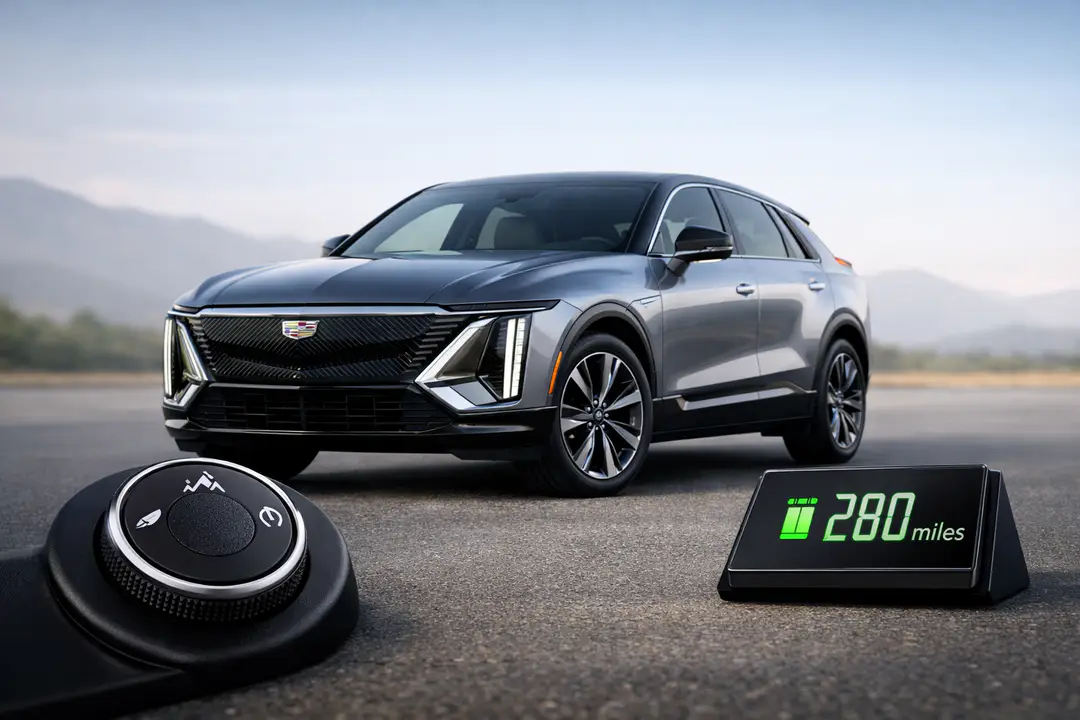
Cadillac Lyriq driving modes: range guide
Yes—Cadillac Lyriq driving modes can change your real-world range and battery usage, even though they do not change the vehicle’s battery capacity. On the Lyriq’s GM Ultium Platform (102 kWh lithium‑ion pack), the Driver Mode Selector mainly reshapes throttle response, torque delivery, regenerative braking (including regen braking feel), and stability/traction logic—factors that directly influence how many kWh you consume per mile.
That matters because the Lyriq’s EPA-estimated range is strong on paper—326 miles (RWD) and 319 miles (AWD)—but the way you drive and the mode you choose can move that number meaningfully in everyday commuting, highway cruising, or winter conditions. Sport Mode, for example, is commonly associated with an estimated 8–15% range reduction (and some reports cite 10–20%, with “up to 15% during prolonged use”). One‑Pedal Driving, meanwhile, can improve efficiency by an estimated 5–10% in city driving when used correctly.
This guide breaks down each Lyriq mode (Tour, Sport, Snow/Ice, My Mode, and One‑Pedal Driving), explains the mechanics behind the range impact, shares realistic percent estimates, and gives step-by-step advice for configuring My Mode for range optimization—plus practical tips to protect long-term battery health.
What are driving modes in the Cadillac Lyriq? (Overview)
Driving modes in the Cadillac Lyriq are software-defined calibrations selected through the Driver Mode Selector that adjust how the vehicle responds to driver inputs and road conditions. Think of them as different “profiles” for the same EV: the physical hardware—motor(s), inverter, brakes, and the 102 kWh pack—stays the same, but the control strategy changes.
At a high level, Lyriq modes influence:
- Throttle response: how quickly the vehicle responds to pedal movement.
- Torque delivery: how aggressively power is delivered, especially at low speeds.
- Regenerative braking / regen braking: the amount and ramp-in of energy recovery when you lift off the accelerator or brake.
- Traction control and stability tuning: how readily the system reduces wheel slip or tempers torque on low-grip surfaces.
- Drivetrain behavior: how the vehicle prioritizes smoothness vs responsiveness in RWD/AWD operation (where applicable).
These calibrations matter because EV efficiency is highly sensitive to driver demand. A sharper pedal map and stronger initial torque can prompt more frequent high-power events, which raise consumption. Conversely, smoother mappings and effective energy recovery can lower kWh/mi in stop-and-go driving. The point isn’t that one mode is always “best”; it’s that each mode matches a use case, and selecting the wrong one for your conditions can quietly cost you miles.
Importantly, modes don’t increase your battery capacity or magically unlock extra energy. They simply change how quickly and how often you access that energy—and how much you can recapture through regenerative braking.
Quick answer: Do Lyriq driving modes change range?
They can—often by a noticeable margin—because modes change the efficiency of how you use power, not how much energy the battery can store. In practice, the largest swings come from Sport Mode (more aggressive mapping, typically lower efficiency) and from how well you use One‑Pedal Driving and regenerative braking in city traffic (potentially higher efficiency).
Specific effects that influence range impact include:
- Higher peak power requests due to sharper throttle response (usually reduces range).
- Different regen braking feel, changing how much energy recovery you get when lifting off or slowing down (can increase or decrease range depending on driving).
- Traction control intervention in Snow/Ice that can limit torque spikes and wheel slip (often improves controllability; efficiency can vary with conditions).
- Driver behavior: the mode encourages a style of driving (smooth vs eager) that tends to move consumption.
Realistic expectation: If you run Sport Mode for an entire trip and use its responsiveness often, it’s reasonable to see an estimated 8–15% range reduction (with some reports citing 10–20% and “up to 15% during prolonged use”). If you use One‑Pedal Driving effectively in urban traffic, you may see an estimated 5–10% efficiency improvement.
Common mistake: attributing all range variation to the mode. Speed, temperature, tires, wind, elevation, and HVAC use can dwarf the mode change on some days—especially at highway speeds.
Lyriq driving modes at a glance (Tour, Sport, Snow/Ice, My Mode, One‑Pedal)
This section is your fast reference. Each mode adjusts a few core levers—power request, energy recovery, and stability logic—so you can match the Lyriq to your route.
- Tour Mode: baseline balance of smooth response and efficiency.
- Sport Mode: sharper throttle response and more immediate torque delivery.
- Snow/Ice Mode: softer torque application and enhanced traction control strategies for low grip.
- My Mode: user-tunable profile to blend comfort, steering feel, and responsiveness.
- One‑Pedal Driving: driving style feature that increases deceleration via regenerative braking when lifting off the accelerator.
| Mode / Feature | Throttle response | Torque delivery | Regenerative braking / energy recovery | Traction control & stability | Typical range impact (estimate) |
|---|---|---|---|---|---|
| Tour Mode | Moderate, progressive | Smooth, predictable | Balanced; good for everyday regen braking | Standard calibration | Baseline (closest to EPA if conditions match) |
| Sport Mode | Sharper, more sensitive | More immediate, stronger “tip-in” | Often feels more eager; net efficiency depends on restraint | Sportier feel; still stable but allows a more responsive character | ~8–15% lower (some reports 10–20%; “up to 15% prolonged”) |
| Snow/Ice Mode | Softer mapping | Gentler launch; limits slip-inducing spikes | Typically tuned for stability; regen may be moderated on slick surfaces | More proactive traction control | Varies; can help efficiency vs wheelspin, but winter losses dominate |
| My Mode | User-adjusted | User-adjusted within safe bounds | Depending on settings, can support range optimization | Generally standard with preference tweaks | 0–10% swing depending on setup & driving |
| One‑Pedal Driving (feature) | No direct change | No direct change | Increases regen braking on lift; boosts energy recovery in stop-go | Works alongside stability systems | ~5–10% better in urban settings (estimated) |
Tip: Treat Sport as a “performance mode” for short bursts, Tour as your default, Snow/Ice as a traction tool, and My Mode as your personalized efficiency mode—then layer One‑Pedal Driving when traffic patterns support it.
How the Lyriq’s modes work (what changes in the software)
The Lyriq’s driving modes feel different because GM changes the translation between your foot and the motors, then coordinates regenerative braking and stability systems to match. The battery doesn’t shrink or grow; the controls decide how quickly you draw power and how smoothly you recover it.
1) Pedal mapping: throttle response and torque delivery
Summary: Pedal mapping is the biggest reason Sport Mode costs range for many drivers. The same pedal movement requests more torque sooner, which encourages higher power draw.
- Sharper tip-in means more frequent high-kW spikes from stops and during merges.
- More immediate torque delivery can feel effortless, but it can raise average consumption if you keep exploiting it.
- Smoother mapping (Tour/Snow) makes it easier to stay in the efficient zone without trying.
Example: Two identical 12-mile commutes: In Sport, a driver repeatedly accelerates briskly to gaps in traffic; in Tour, the same driver accelerates progressively. The travel time difference may be minor, but the Sport run can show a noticeably higher kWh/mi due to repeated power surges—one reason Sport is often linked to an ~8–15% reduction over prolonged use.
Common mistake: using Sport on the highway assuming it only changes steering feel. Even if you hold steady speed, the sharper mapping can lead to micro-accelerations and less stable pacing, which still costs energy.
2) Regenerative braking and blended braking strategy
Summary: Regenerative braking determines how much kinetic energy becomes stored electricity again. Done well, it improves efficiency in stop-and-go driving; done poorly (or replaced by friction brakes), it wastes energy as heat.
- Lift-off regen strength can differ in feel and ramp rate by mode/setting.
- Blended braking aims to maximize energy recovery before friction brakes contribute.
- Road grip matters: on slick surfaces, regen braking may be moderated to maintain stability.
Example: In city traffic, a driver using One‑Pedal Driving anticipates red lights early and decelerates via regen braking instead of last-second braking. The car captures more energy recovery events, often translating to an estimated 5–10% efficiency boost in urban settings.
Common mistake: “late braking” habits. If you wait too long and brake hard, you can force more friction braking, reducing energy recovery even in a mode that supports strong regen.
3) Traction control tuning and stability priorities
Summary: Snow/Ice Mode changes how quickly torque is allowed to rise and how aggressively traction control intervenes. That primarily improves safety, and it can indirectly affect efficiency by reducing wheelspin.
- Torque ramp limits help prevent sudden slip on ice.
- More proactive traction control trims torque sooner when slip is detected.
- AWD vs RWD: AWD may manage front/rear torque distribution to maintain grip, which can slightly increase drivetrain losses but reduce slip waste.
Example: On a slushy incline, Tour Mode may allow enough torque to trigger slip events that the system then corrects. Snow/Ice can prevent the slip in the first place. Even though winter conditions usually reduce range significantly, avoiding repeated wheelspin can keep consumption from getting even worse.
Estimated real-world impact: percent range changes by mode
Mode-to-mode range impact is real, but it’s not a fixed number because it depends on speed, temperature, elevation, and driving style. Still, you can use practical percent ranges to set expectations and plan charging stops.
- Tour Mode: Your best bet for hitting something close to the EPA-estimated range when conditions are favorable and speeds are moderate.
- Sport Mode: Often estimated at 8–15% less range if used consistently; some sources cite 10–20% depending on driving intensity, with “up to 15% during prolonged use.”
- Snow/Ice Mode: The mode itself isn’t the big range hit; cold weather, winter tires, slush, and cabin heating are. Snow/Ice may reduce waste from wheelspin but can’t overcome physics.
- My Mode: Potentially neutral to helpful if you tune it to reduce aggressive response and drive smoothly; can also become “Sport-lite” if configured that way.
- One‑Pedal Driving: Estimated 5–10% efficiency improvement in urban settings when it reduces friction braking and encourages anticipation.
Scenario-based examples (what the numbers can look like)
Example 1: Mixed suburban commute (RWD, mild weather)
A driver averaging 35–50 mph with frequent lights may see Tour and One‑Pedal Driving deliver similar or slightly better results than Tour alone, because energy recovery opportunities are frequent. Sport Mode may increase consumption if the driver takes advantage of brisk launches.
Example 2: Highway road trip (AWD, 70–75 mph)
At steady highway speeds, aerodynamic drag dominates. Tour vs Sport may look closer if you truly hold speed—yet Sport’s sharper response can still lead to small speed oscillations and extra passing accelerations. In this environment, the biggest “mode” win is often simply choosing the calmer mapping that makes smooth cruising easier.
Example 3: Winter errands (any drivetrain)
Snow/Ice improves controllability. Even if it doesn’t raise range, it can reduce slip-related waste. The larger lever is preconditioning and cabin heat management, which can matter more than any mode change.
Planning takeaway: If you’re routing near the edge of your comfortable buffer, assume Sport Mode could cost roughly a tenth of your miles on that leg, and assume city One‑Pedal Driving can sometimes claw back a meaningful chunk in stop-and-go.
How to configure My Mode for maximum range
My Mode is where you can build a personal “efficiency mode” that still feels like a Cadillac. The goal isn’t to make the Lyriq slow—it’s to reduce unnecessary power spikes and make smooth driving the default.
- Target outcome: softer throttle response, predictable torque delivery, and a regen braking feel you can consistently use.
- Best use case: daily commuting and longer drives where you want comfort and repeatable efficiency.
Step-by-step: a practical efficiency-first My Mode setup
- Start from Tour-like response, not Sport. Choose the most progressive pedal mapping available in My Mode settings.
- Prioritize smoothness in acceleration settings. Your goal is to avoid the “surge” that invites you to accelerate harder than needed.
- Pick a regen braking feel you can modulate without thinking. If it’s too strong and jerky, you’ll revert to the brake pedal and lose energy recovery opportunities.
- Validate with a repeat route: drive the same 10–20 miles twice and compare efficiency (kWh/mi) in the trip display.
- Keep steering/suspension comfort-oriented if you want. Those changes typically have far less impact on battery usage than pedal behavior.
A real-world “check your work” method
Summary: Don’t guess—measure. The Lyriq gives you enough trip data to see whether My Mode is helping.
- Reset a trip meter.
- Drive a familiar loop with similar traffic and weather.
- Compare kWh/mi (or mi/kWh, depending on display) between Tour, My Mode, and Sport.
Common mistake: changing multiple variables at once—mode, route, speed, and HVAC—then crediting the result to My Mode. To isolate mode effects, keep the route and driving pattern as consistent as possible.
Practical tips: when to use each mode (city, highway, winter)
The best mode is the one that reduces workload and keeps you from wasting energy for the conditions you’re in. Below is a decision guide that maps modes to common situations.
City driving and stop-and-go
- Use: Tour or an efficiency-tuned My Mode, plus One‑Pedal Driving if traffic is dense.
- Why: City driving offers many opportunities for energy recovery via regenerative braking.
- Tip: Lift early and coast into regen instead of late braking. You’ll feel the car slow while recapturing energy.
Example: If your commute is 40 minutes with frequent lights, One‑Pedal Driving can help you settle into smoother deceleration patterns—where the estimated 5–10% efficiency improvement is most plausible.
Highway cruising and road trips
- Use: Tour or My Mode with calm throttle response.
- Why: Aerodynamic drag rises sharply with speed; minimizing speed fluctuations is key.
- Tip: Set a consistent pace and avoid repeated hard passes; those spikes cost more than many drivers expect.
Common mistake: leaving Sport on “because it feels better.” If it causes you to accelerate harder out of every small slow-down, your charging stops get longer even if your average speed doesn’t change much.
Snow, ice, and cold rain
- Use: Snow/Ice Mode when traction is limited.
- Why: It moderates torque delivery and coordinates traction control to reduce slip.
- Tip: Keep inputs gentle—abrupt steering, abrupt pedal, and abrupt braking reduce stability and can increase consumption through repeated corrections.
For broader context on how automakers implement multi-mode logic across different models, it’s useful to compare the Lyriq approach with a general overview of how driving modes are typically tuned—especially the trade-off between performance mode response and efficiency mode calibration.
Quick “if-this-then-that” decision list
- If you’re trying to maximize miles per charge, then start in Tour or an efficiency My Mode and keep accelerations modest.
- If you need confident passing on a short on-ramp, then Sport can be useful—just switch back after.
- If the road is slick, then Snow/Ice beats “careful driving in Sport” every time.
Battery care and charging recommendations to protect range
Driving modes shape day-to-day efficiency; charging habits shape both convenience and long-term performance. The Lyriq’s 102 kWh Ultium pack is designed for daily use, but smart routines can help preserve usable range over time.
- Use a thoughtful charging strategy: For routine commuting, consider setting a daily charge limit (often around 70–85% if it fits your needs). Save 100% charges for days you truly need maximum range.
- Precondition when it’s cold: Warming the pack before departure (when plugged in) can reduce early-trip consumption and improve regen braking availability.
- Don’t chase regen on ice: In slippery conditions, prioritize stability. Regen braking can be moderated by the system for safety—this is normal.
- Mind speed more than mode on road trips: At high speeds, the “range impact” from air drag can outweigh the calibration differences between Tour and My Mode.
- Watch tires and alignment: Low tire pressure increases rolling resistance and can make your best mode choices irrelevant.
- Use HVAC efficiently: Heated seats/steering often use less energy than blasting cabin heat. Small adjustments can preserve miles.
Practical example: If you plan a winter highway leg near your comfortable buffer, the best move is often: precondition while plugged in, select Tour/My Mode, reduce cruising speed slightly, and avoid repeated hard accelerations. That combination typically yields more than toggling modes alone.
Common mistake: frequent fast charging to high state-of-charge “just because.” It’s fine when needed, but for day-to-day use a calmer routine can reduce time spent waiting at chargers and may support better long-term consistency in real-world range.
Practical tips / best practices (range optimization checklist)
If you want the most miles per charge from the Cadillac Lyriq, focus on making efficient behavior easy and repeatable. Modes help, but they’re only one part of the outcome.
- Default to Tour for most driving; it’s the most consistent baseline for efficiency.
- Use Sport intentionally (on-ramps, short bursts), then switch back. Prolonged use is where the estimated 8–15% range reduction is most likely to show up.
- Lean on One‑Pedal Driving in town when it reduces brake use. Aim for smooth, early deceleration to maximize energy recovery.
- Build a true efficiency My Mode: progressive throttle response, predictable regen braking feel, and comfort-focused settings that discourage aggressive driving.
- Avoid “accordion driving” in traffic—accelerating to close gaps then braking. It’s a double penalty: energy used, then energy not fully recovered.
- Track kWh/mi over time across your normal routes. Your vehicle’s trip data is more useful than a single day’s experience.
- Plan charging around conditions, not just distance. Wind, rain, cold, and speed can shift real-world range more than a mode toggle.
Things to avoid:
- Expecting any mode to “increase battery capacity.” It can’t—only change how you use the stored energy.
- Assuming strong regen braking always means better range; if it’s too abrupt and you compensate with friction brakes, efficiency may drop.
- Using Snow/Ice as a “winter efficiency mode.” It’s primarily for traction control and stability, not maximizing miles.
FAQ: driving modes, regen, and Lyriq range
Do Lyriq driving modes change the battery capacity?
No. The Lyriq’s battery capacity remains the same (102 kWh on the Ultium Platform). Modes change how quickly the vehicle requests power, how regenerative braking feels, and how traction/stability systems manage torque—factors that influence battery usage and real-world range.
How much range do you lose in Sport Mode?
It varies by driving style, but prolonged Sport use is commonly associated with roughly an 8–15% range reduction, and some reports cite 10–20% depending on how often you exploit the sharper throttle response and stronger torque delivery. If you use Sport briefly for passing, the net impact can be small.
Does One‑Pedal Driving always improve efficiency?
Not always, but it often helps in urban traffic where you can maximize energy recovery and reduce friction braking. An estimated 5–10% improvement is plausible in stop-and-go patterns when you anticipate stops early. On the highway, One‑Pedal Driving typically has little benefit because there are fewer deceleration events to recover energy.
Is Snow/Ice Mode better for range in winter?
Snow/Ice Mode is better for control, not necessarily for range. Winter range loss usually comes from cold temperatures, higher rolling resistance (snow/slush), and cabin heating. Snow/Ice can reduce waste from wheelspin, but it can’t overcome those broader losses.
Will Tour Mode match the EPA-estimated range?
Tour Mode is the most likely to align with the EPA-estimated range when conditions are similar to EPA testing and your speeds are moderate. Real-world range will still vary with temperature, speed, wind, terrain, tires, and HVAC use. Consider the EPA number a benchmark, not a guarantee.
Conclusion
Cadillac Lyriq driving modes don’t change the car’s battery capacity, but they absolutely can change how quickly the Lyriq spends energy—and how effectively it recovers energy through regenerative braking. With a 102 kWh Ultium Platform battery and EPA-estimated range of 326 miles (RWD) or 319 miles (AWD), the Lyriq starts with a strong foundation; your mode choice determines how much of that potential shows up on your daily drive.
For most owners, the winning formula is simple: use Tour as your baseline, reserve Sport for brief moments when you need immediate torque delivery, switch to Snow/Ice when traction is limited, and tune My Mode to make smooth throttle response your default. Add One‑Pedal Driving in city traffic to capture more energy recovery—where the estimated 5–10% efficiency gain is most realistic.
Next step: pick one familiar route, run it in Tour, then in your efficiency-tuned My Mode, and compare kWh/mi. A little measurement quickly turns “range anxiety” into predictable planning—especially when you pair smart mode selection with a sensible charging strategy.
For additional perspective on extending long-term vehicle performance with simple routines that complement EV efficiency habits, consider these simple maintenance checks that help preserve everyday performance.