The Digital Stadium: Sports & Media Brands Are Taking B
For a long time, the physical stadium represented the main engine of engagement—buy a ticket, enter, watch a game, have a hot dog, and most importantly, shout and discuss your views with people around you. Everything from consuming to chatting happened in one on-site setting.
But then digital sports platforms arrived and turned everything around.
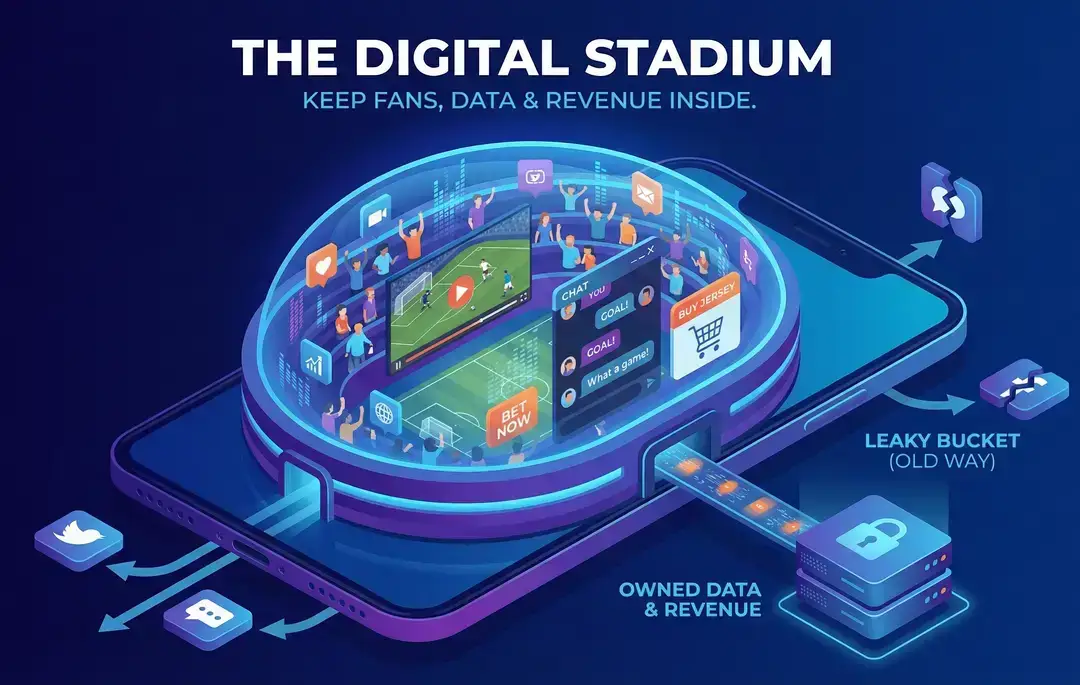
In today’s world, most sports apps are dealing with a “leaky bucket” problem. They are great at broadcasting a live game and displaying statistics. However, once a user wants to express excitement about a goal or dissatisfaction about a red card shown to one of their players, they leave. They shut down the app to open a messaging app like WhatsApp, X (Twitter), or Discord.
This takes energy, data, and session time, and gives it to a third-party social network. What you’ve developed is now effectively just a tool (a video player or stat sheet), while the community exists elsewhere. We all work for social media, when they don’t properly help us.
That’s why more sports and media properties are embracing what we define as the digital stadium: a way of doing business where the experience stops outsourcing fan energy to social platforms and instead incorporates the social aspect into the product.
The “Second Screen” Disconnection
Just consider a normal football club app. Fans open the app to check the score or watch the highlight. However, in order to celebrate the goal of their favorite team, they must leave the app.
This results in a disconnection. If you are directing your users to Discord or X (Twitter), you are losing attention, but more importantly, you are losing ownership as well.
What you lose if the conversation takes place elsewhere:
- You cannot monetize a conversation on Reddit.
- You cannot grow your app retention due to Whatsapp group
- You cannot correlate chat behaviors with subscription tier, churn risk, or purchase intent inside your own app — signals that define fan engagement in sports.
The purpose of the digital stadium is straightforward: keep the fan in their seat. The community layer enables this by keeping the conversation:
- as an overlay on the video player, or
- alongside stats and highlights.
Your application becomes an active social platform, not just a passive broadcaster.
Building the Roar (Without the Engineering Nightmare)
This is such an important capability. Why haven’t more teams developed it?
Because a real-time community is like an endless roadmap. It is not “a text box.” At scale, you will require:
- WebSocket infrastructure that scales even when tens of thousands react at the same time
- servers supporting peak loads during matches
- a stable, low-latency experience
- moderation and abuse prevention that doesn’t overwhelm your support team
Each team is left with two paths:
1) In-house development
- Long development times
- Costly maintenance
- Moderation and operations become a constant cost center
2) Using traditional SDKs
- Quicker to start up, but often leads to “version hell”
- Small changes (weekend poll, bug fix) may still necessitate app store updates and waiting for users to update
This is what Watchers’ WebView-based architecture is all about. Product teams can implement a comprehensive social experience in days. More importantly, product capabilities such as a social widget or an event skin can be shipped server-side and appear in the fan app immediately.
Monetizing the Passion
When the conversation stays in-house, chat can lead to action.
Three typical monetization options:
- Gamification & loyalty programs: If a user is a “Gold Member,” their status can show up in chat. Reward levels and badges may depend on activity.
- Copy-dealing mechanics (as applicable): Users can share transactions decisions, and others can repeat after them with social widgets.
- Merchandise in the moment: Clubs or creators can share merch links during moments of high emotion (e.g., scoring a goal, playing a rival team, celebrating a win), when the intent to buy is highest.
The Safety Barrier
The common objection concerning in-app communities is: “What if it becomes a dumpster fire?”
That’s a fair point. If you open the space without protection, things can go downhill pretty quickly, and you can’t just solve it with “security guards in the aisle.”
You need systems that work in milliseconds. Watchers employs a five-layer moderation approach that goes beyond a simple “bad words” list. It is intended to:
- identify aggression, scam attempts, and spam based on intent and patterns
- automatically mask personal information like phone numbers to prevent doxxing or fraud
- keep heated debate alive without letting it turn into abuse
This makes it possible to engage in passionate debates over sports without crossing the line into toxicity.
Conclusion
The silent app era is over. The audience wants to participate. It wants to engage.
Sports and media brands have handed community engagement to social media giants for years. It’s time to take it back.
Creating a digital stadium with watchers.io allows you to keep fans, data, and revenue where they belong: within your app.
Further Reading

![How to Create a Discord Account [Step-by-Step Guide]](https://thegeekinsights.com/wp-content/uploads/2024/02/How-to-Create-a-Discord-Account-768x576.webp)