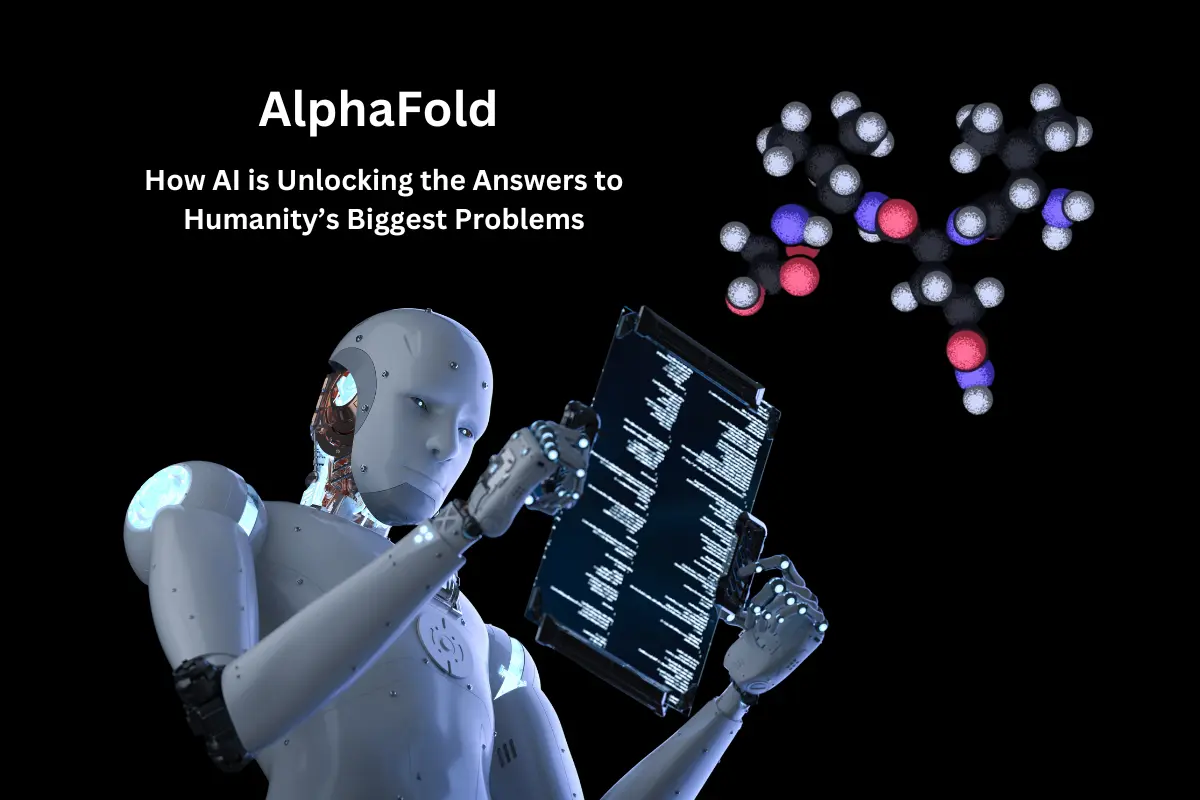
The Universal Solution AlphaFold: How AI is Unlocking the Answers to Humanity’s Biggest Problems
Introduction
What if all of the world’s biggest problems—from climate change to curing diseases and managing plastic waste—had the same solution? A solution so small that it is invisible to the human eye? The answer might lie in the recent breakthroughs in artificial intelligence (AI) and molecular biology, specifically in the field of protein folding.
A recent revolutionary development has shown how AI-driven solutions can solve complex scientific challenges, unlocking possibilities that were previously unimaginable. This breakthrough, led by DeepMind’s AlphaFold, has already made significant contributions to medicine, environmental science, and materials engineering. But what does this mean for the future, and how can AI reshape our understanding of life itself?
The Protein Folding Problem: A Grand Challenge in Biology
Proteins are essential molecules that drive almost every biological function. Each protein is made of a string of amino acids, which fold into a unique three-dimensional structure that determines its function. Understanding these structures has been one of the most significant challenges in molecular biology.
For decades, scientists used experimental techniques like X-ray crystallography to determine protein structures, but the process was slow and expensive. For instance, British biochemist John Kendrew took 12 years to determine the structure of myoglobin, an oxygen-storing protein found in muscles. Over the next six decades, biologists resolved only around 150,000 protein structures.
Enter AlphaFold: an AI-driven system capable of predicting protein structures with remarkable accuracy. In just a few years, AlphaFold determined the structure of over 200 million proteins—essentially mapping nearly all known proteins in nature. This advancement represents a transformation in biological sciences, comparable to the impact of the Human Genome Project.
How AlphaFold Works
AlphaFold uses deep learning to predict protein structures from their amino acid sequences. Traditional methods relied on labor-intensive experiments, but AI revolutionized this process by identifying patterns in protein structures across species.
- Evolutionary Clues – Proteins evolve over time, and their structures remain conserved across species. By analyzing these evolutionary patterns, AlphaFold can predict how amino acids interact in a folded protein.
- Neural Networks and Attention Mechanisms – AlphaFold employs advanced AI techniques, including transformers (the same technology behind ChatGPT), to understand protein folding dynamics.
- Pair Representation and Geometric Constraints – The AI builds a model of how amino acids interact in 3D space, refining its predictions iteratively until it achieves near-perfect accuracy.
In the 2020 CASP (Critical Assessment of Structure Prediction) competition, AlphaFold 2 achieved scores over 90—effectively solving the long-standing protein folding problem. This victory was a turning point for AI-driven scientific research.
Applications: Transforming Science and Medicine
The implications of AlphaFold’s breakthrough extend far beyond molecular biology. Scientists are now leveraging AI-powered protein design for groundbreaking applications in medicine, materials science, and environmental sustainability.
1. Medical Advancements
- Drug Discovery: AlphaFold accelerates the development of new drugs by predicting protein-drug interactions, making it easier to design effective treatments.
- Personalized Medicine: Understanding protein structures allows researchers to tailor treatments for genetic diseases, such as cancer and neurodegenerative disorders.
- Vaccine Development: AI-assisted protein modeling played a role in designing vaccines for malaria and other infectious diseases.
2. Fighting Antibiotic Resistance
One of the biggest challenges in modern medicine is antibiotic resistance. Many bacteria have evolved mechanisms to break down antibiotics, rendering treatments ineffective. By using AlphaFold, researchers have developed new inhibitors that block these resistance enzymes, revitalizing the effectiveness of existing drugs.
3. Environmental Applications
- Plastic Degradation: Scientists are designing enzymes that can break down plastic waste efficiently, potentially reducing global plastic pollution.
- Carbon Capture: AI-designed proteins are being explored to capture greenhouse gases like carbon dioxide and methane, mitigating climate change.
- Synthetic Biology: Engineered proteins could be used in biofuels and sustainable agriculture, offering eco-friendly alternatives to fossil fuels and chemical fertilizers.
The Next Frontier: AI-Designed Proteins
Beyond understanding existing proteins, AI is now being used to create entirely new proteins. David Baker’s lab has pioneered an AI-driven method called RF Diffusion, which designs synthetic proteins from scratch. This technique mirrors the way generative AI (like DALL-E) creates images from text prompts.
For example, researchers have designed synthetic antibodies that neutralize venom from snake bites, eliminating the need for animal-based antivenoms. This breakthrough could revolutionize emergency medicine, especially in regions where traditional antivenoms are scarce.
Beyond Biology: AI’s Role in Material Science
DeepMind’s AI-powered research isn’t limited to biology. Their GNoME project has discovered over 400,000 new stable materials, including potential superconductors and advanced battery materials. These discoveries could lead to:
- More efficient solar panels
- Faster-charging batteries
- Stronger, lighter materials for construction and aerospace
The Future: AI and the Expansion of Human Knowledge
AlphaFold’s success exemplifies how AI can accelerate scientific discovery. By solving problems that once took decades in a matter of months, AI is opening doors to entirely new fields of research. Tools like online video translators, which help bridge language gaps instantly, show how AI is making even the communication of scientific ideas faster and more accessible. The ability to design molecular machines at will—whether for medicine, energy, or materials—ushers in a new era of scientific exploration.
Will AI cure all diseases? Can we create materials with properties never before seen in nature? Can we reverse climate change using AI-designed enzymes?
The answers may arrive sooner than we think. As AI continues to advance, it is not merely improving science—it is redefining what is possible.
Conclusion
Artificial intelligence is proving to be a powerful force in solving some of the world’s most complex challenges. From understanding the microscopic intricacies of protein folding to designing new materials and fighting climate change, AI-driven innovations are reshaping the future. The ability to solve fundamental scientific problems at scale has the potential to unlock revolutionary advancements across multiple fields.
Whether it is curing diseases, cleaning up our planet, or engineering the future, AI’s impact on science is only beginning. As we move forward, the challenge will not be whether AI can help us solve these problems, but how quickly we can implement its solutions.
A future shaped by AI might just be the breakthrough humanity has been waiting for.