The Rise of Vanadium Redox Flow Batteries
In recent years, vanadium redox flow batteries (VRFBs) have emerged as a promising solution for large-scale energy storage, particularly in the renewable energy sector. With massive projects coming online in China, Japan, and Switzerland, VRFBs are proving their potential to revolutionize energy storage systems. Yet, despite their advantages, these batteries remain relatively rare in North America. This article explores the technology behind VRFBs, their growing popularity, and the challenges preventing their widespread adoption.
What Are Vanadium Redox Flow Batteries?
Vanadium redox flow batteries are a type of flow battery, a technology that stores energy in liquid electrolytes contained in external tanks. Unlike conventional batteries, which store energy in solid electrodes, flow batteries separate energy storage from power generation. This unique design allows for easy scalability and long lifespans.
How Do They Work?
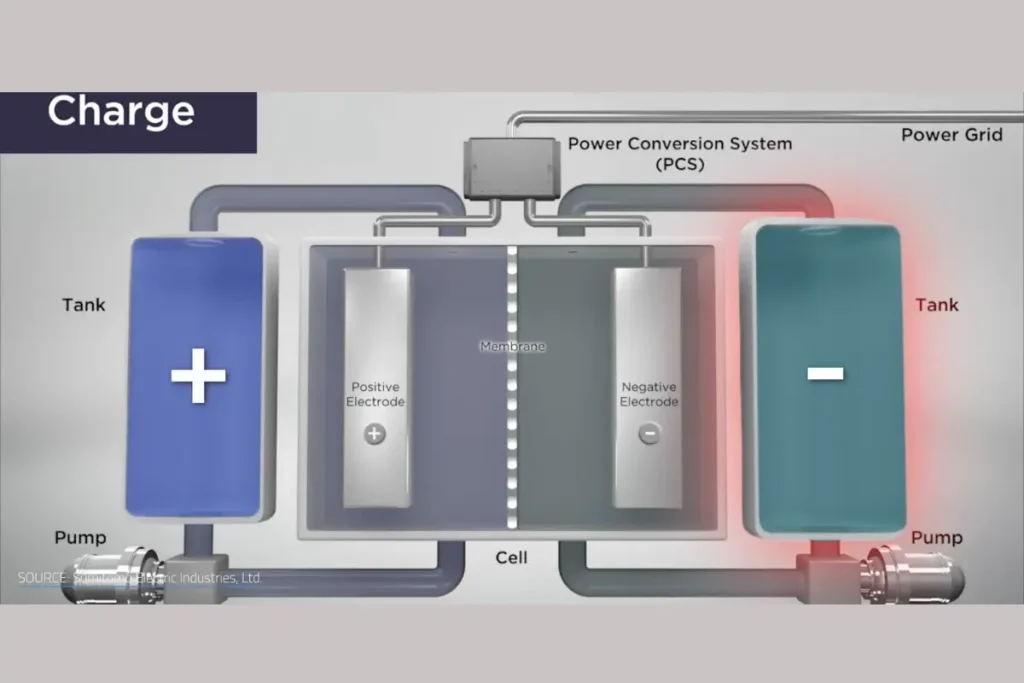
A VRFB consists of two large tanks filled with electrolyte solutions—one positively charged and one negatively charged. These tanks are connected to a central chamber called a “stack.” When the electrolytes are pumped through the stack, an ion exchange occurs, creating a redox (reduction-oxidation) reaction. During charging, electricity is used to move ions from the positive side to the negative side. When discharging, the process reverses, releasing stored energy as electricity.
Vanadium is particularly well-suited for this process because it can exist in four different oxidation states, allowing it to serve as both the positive and negative electrolyte. This eliminates the risk of cross-contamination between the two solutions, a common issue in other flow battery chemistries.
The Rise of VRFBs: From Labs to Grid-Scale Storage
The concept of flow batteries dates back to the 19th century, but it wasn’t until the 1980s that researchers at the University of New South Wales (UNSW) in Australia successfully demonstrated vanadium redox flow chemistry. This breakthrough led to the development of a stable and efficient electrolyte solution using vanadium dissolved in sulfuric acid.
Despite their potential, VRFBs remained niche for decades due to high costs and limited demand. However, the expiration of key patents in 2006 sparked renewed interest and investment in the technology. By 2012, advancements in electrolyte formulations and membrane technology made VRFBs more viable for commercial use.
Today, VRFBs are being deployed at an unprecedented scale. Some of the most notable projects include:
- Rongke Power’s Xinhua Ushi Energy Storage Project (China): At 175 MW and 700 MWh, this is currently the largest VRFB facility in the world.
- Hokkaido Electric Power Network (Japan): A 51 MW system that powers 27,000 homes for four hours.
- FlexBase’s Swiss Facility (Switzerland): Set to become the largest VRFB in the world at 500 MW and 1.2 GWh, this project will support a massive data center and renewable energy integration.
Why Are VRFBs Gaining Popularity?
Several factors have contributed to the recent surge in VRFB adoption:
1. Scalability
VRFBs excel in large-scale applications. Increasing storage capacity is as simple as adding larger electrolyte tanks, while power output can be scaled independently by adjusting the size of the stack. This flexibility makes them ideal for grid-scale energy storage.
2. Long Lifespan
VRFBs can endure 15,000–20,000 charge-discharge cycles, significantly outperforming lithium-ion batteries. Their robust chemistry and ability to remain discharged without degradation contribute to their longevity.
3. Safety
Unlike lithium-ion batteries, VRFBs use non-flammable electrolytes and are less sensitive to temperature fluctuations. This makes them safer for use in wildfire-prone areas and other challenging environments.
4. Recyclability
Vanadium electrolytes can be recycled and reused in new batteries, reducing waste and lowering long-term costs. Companies like US Vanadium and Sumitomo Electric have demonstrated recycling rates as high as 97%.
5. Renewable Energy Integration
As countries invest in solar and wind power, the need for reliable energy storage grows. VRFBs are well-suited to store excess renewable energy and release it when needed, addressing the intermittency of these energy sources.
Challenges and Limitations
Despite their advantages, VRFBs face several hurdles that have slowed their adoption, particularly in North America:
1. High Upfront Costs
Vanadium is more expensive than lithium, making VRFBs cost-prohibitive for some applications. While their long lifespan and low maintenance costs can offset this over time, the initial investment remains a barrier.
2. Supply Chain Constraints
Approximately 75% of the world’s vanadium supply comes from just 10 steel mills in China and Russia. This concentration creates a bottleneck, limiting the availability of vanadium for battery production. Although the U.S. has significant untapped vanadium deposits, developing these resources would require substantial investment.
3. Size and Weight
VRFBs are bulky and heavy, making them unsuitable for portable applications like electric vehicles or consumer electronics. Their size is less of an issue for grid-scale storage but limits their use in residential settings.
4. Round-Trip Efficiency
While small-scale VRFBs have a round-trip efficiency (RTE) of 85–90%, larger systems often see RTEs drop to 57–75% due to hydraulic losses and shunt currents. This inefficiency can be a drawback for large energy storage projects.
The Future of VRFBs
Despite these challenges, VRFBs are poised to play a critical role in the global transition to renewable energy. Their scalability, safety, and long lifespan make them an attractive option for grid-scale storage, particularly in regions with abundant solar and wind resources.
In the U.S., increased investment in vanadium mining and recycling could help overcome supply chain issues. Additionally, advancements in membrane technology and electrolyte formulations may further reduce costs and improve efficiency.
As more countries commit to decarbonization, the demand for reliable energy storage solutions will only grow. While VRFBs may not replace lithium-ion batteries in all applications, they offer a compelling alternative for large-scale energy storage. With projects like Rongke Power’s Xinhua facility and FlexBase’s Swiss data center leading the way, the future of VRFBs looks bright—even if their path to widespread adoption remains uncertain.
Conclusion
Vanadium redox flow batteries represent a revolutionary step forward in energy storage technology. Their unique design, scalability, and safety features make them an ideal solution for integrating renewable energy into the grid. However, high costs, supply chain constraints, and inefficiencies have limited their adoption in North America.
As the world continues to embrace renewable energy, VRFBs could become a cornerstone of the global energy transition. With ongoing research and investment, these batteries may soon overcome their current limitations, paving the way for a cleaner, more sustainable future. The question remains: will the U.S. and other countries seize the opportunity to harness this revolutionary technology? Only time will tell.