
Bethesda Confirms Fallout 5 Is in Preproduction, Plus Fallout 3 and New Vegas Remasters
Bethesda has confirmed that Fallout 5 is in preproduction and is planned for Creation Engine 3, while Fallout 3 and Fallout: New Vegas remasters are also in development. The studio framed Fallout 5 as its long-range destination, but it also said multiple Fallout projects are already in active development, which makes this update more significant than a single sequel announcement.
For fans, the message is mixed but clear. The next mainline Fallout exists, the underlying toolset has been chosen, and Bethesda’s roadmap now includes both remaster work and at least one separate new Fallout game tied to Obsidian Entertainment. At the same time, the timeline still looks long, especially with The Elder Scrolls 6 remaining ahead in the broader studio pipeline.
What Bethesda confirmed
The core update contains five major points that define the current status of the Fallout franchise. First, Fallout 5 is real and in early preproduction. Second, it is being built on Creation Engine 3, Bethesda’s current proprietary engine direction. Third, remasters of Fallout 3 and Fallout: New Vegas are in development. Fourth, Bethesda says Fallout 5 remains the long-range destination. Fifth, the company says multiple Fallout projects are now in active development.
-
Fallout 5 is in early preproduction
-
Fallout 5 is planned for Creation Engine 3
-
Fallout 3 remaster is in development
-
Fallout: New Vegas remaster is in development
-
Multiple Fallout projects are in active development
-
A separate Fallout project involves Obsidian Entertainment
-
A Fallout Shelter TV adaptation is also in development
Fallout 5 status
The most important takeaway is that Fallout 5 has moved beyond vague long-term talk and into formal preproduction. In game development terms, that means core planning, staffing, systems direction, technical decisions, and early world or design work are underway, but it does not mean full content production is complete or close to release.
Bethesda’s wording matters here because it separates aspiration from pipeline reality. Calling Fallout 5 the long-range destination signals commitment, while the preproduction label confirms the project is still early. That explains why excitement is high but expectations on timing should stay measured.
Why preproduction matters
Preproduction is where Bethesda Game Studios defines scope, aligns teams, and tests the framework that will support full production later. For a post-apocalyptic RPG as large as Fallout 5, this phase also shapes quest structure, world simulation goals, and how the studio wants Creation Engine 3 to support the next generation of systems.
That kind of planning tends to matter more at Bethesda than at many studios because its games rely on interlocking systems rather than narrow linear campaigns. The studio needs the engine, content pipeline, and design rules to agree early, or later expansion becomes harder.
Creation Engine 3 implications
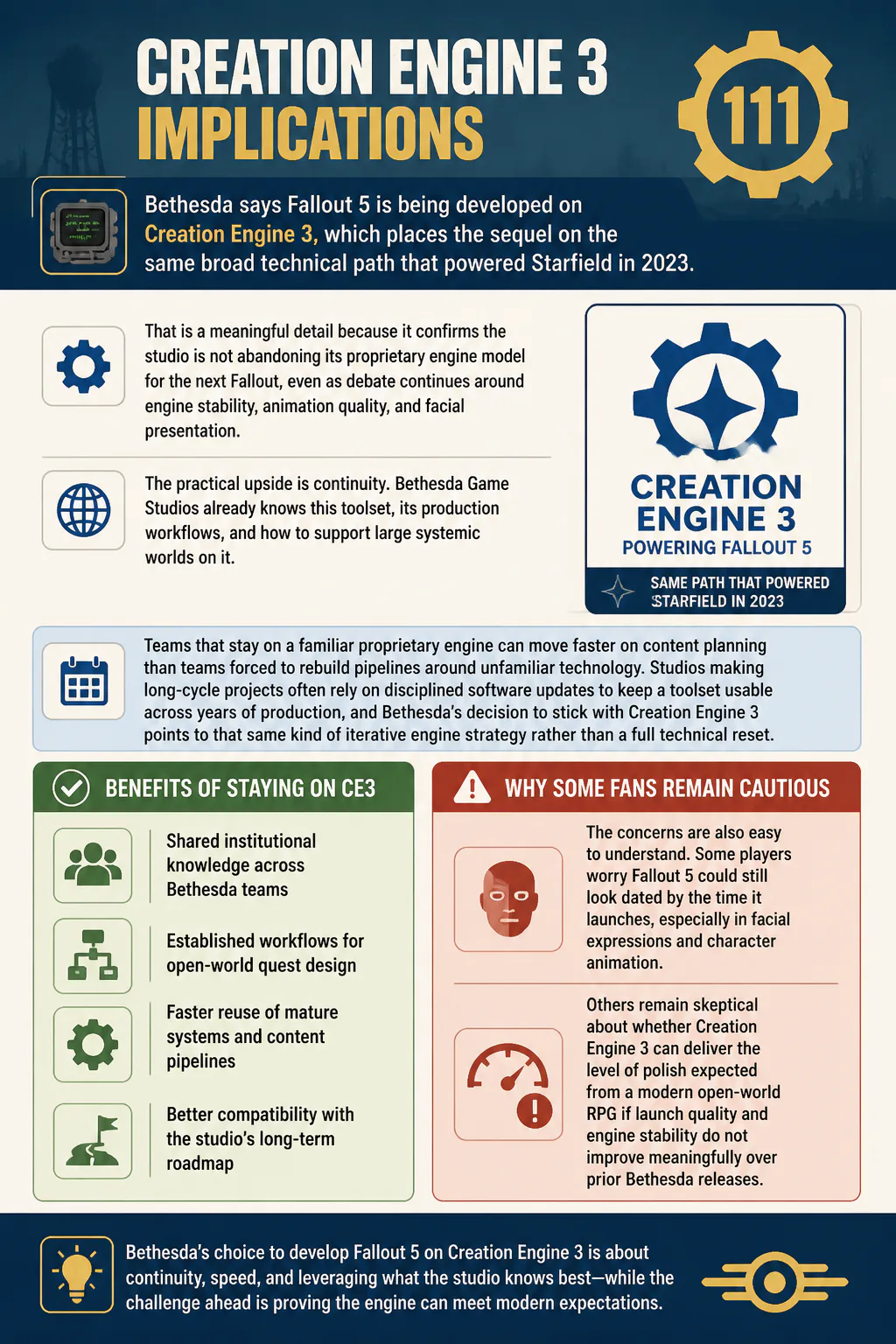
Bethesda says Fallout 5 is being developed on Creation Engine 3, which places the sequel on the same broad technical path that powered Starfield in 2023. That is a meaningful detail because it confirms the studio is not abandoning its proprietary engine model for the next Fallout, even as debate continues around engine stability, animation quality, and facial presentation.
The practical upside is continuity. Bethesda Game Studios already knows this toolset, its production workflows, and how to support large systemic worlds on it. Teams that stay on a familiar proprietary engine can move faster on content planning than teams forced to rebuild pipelines around unfamiliar technology.
Studios making long-cycle projects often rely on disciplined software updates to keep a toolset usable across years of production, and Bethesda’s decision to stick with Creation Engine 3 points to that same kind of iterative engine strategy rather than a full technical reset.
Benefits of staying on CE3
-
Shared institutional knowledge across Bethesda teams
-
Established workflows for open-world quest design
-
Faster reuse of mature systems and content pipelines
-
Better compatibility with the studio’s long-term roadmap
Why some fans remain cautious
The concerns are also easy to understand. Some players worry Fallout 5 could still look dated by the time it launches, especially in facial expressions and character animation. Others remain skeptical about whether Creation Engine 3 can deliver the level of polish expected from a modern open-world RPG if launch quality and engine stability do not improve meaningfully over prior Bethesda releases.
Remasters in development
The confirmation that Fallout 3 and Fallout: New Vegas remasters are in development is arguably the most immediate part of the announcement for longtime fans. A remaster is not the same as a remake, so the expectation should be upgraded presentation, compatibility improvements, and modern platform support rather than a total rebuild.
That said, even a careful remaster could be a major event for the Fallout franchise. Fallout 3 remains a landmark Bethesda RPG, and New Vegas still holds a special place for players who prefer denser role-playing choices, faction writing, and Obsidian’s approach to consequence-driven quest design.
Why these remasters matter
-
They can bring older Fallout games to current hardware more cleanly
-
They help fill the gap before Fallout 5 reaches full production
-
They renew interest in the franchise without changing its direction
-
They create a bridge between Bethesda and Obsidian-era Fallout audiences
Remasters also make commercial sense inside Microsoft’s broader portfolio strategy. Reintroducing older RPGs can extend audience reach, support subscription ecosystems, and keep a flagship series visible during a long wait between mainline entries.
The Obsidian angle
Bethesda’s update also points to a separate new Fallout game being made with Obsidian Entertainment, and it does not appear to be Fallout 5. That distinction matters because it suggests Bethesda is expanding the franchise on multiple tracks instead of treating every new entry as a direct sequel handled only by Bethesda Game Studios.
For fans of Fallout: New Vegas, this is one of the most interesting developments in the entire roadmap. Obsidian brings a different design identity to the series, especially around dialogue, faction tension, and reactive quest outcomes. If that separate project moves faster than Fallout 5, it could become the next major playable Fallout before the numbered sequel arrives.
That split approach also reflects a broader entertainment strategy where brands stretch across games, television, and adjacent media; even outside gaming, voice avatar tools are reshaping how franchises think about character presence and transmedia production pipelines.
Timeline pressure
The biggest issue hanging over this announcement is not whether Fallout 5 exists. It does. The real issue is where it sits on Bethesda’s roadmap relative to The Elder Scrolls 6. Current framing still places The Elder Scrolls 6 at least a couple of years away, which reinforces concern that Fallout 5 may not arrive until well after that project.
If that sequence holds, Fallout 5 remains a distant release even with active development around the wider franchise. The remasters and the separate Obsidian-linked game therefore matter not just as side projects, but as practical ways to keep Fallout active while Bethesda’s mainline schedule unfolds slowly.
What likely comes first
|
Project |
Current status |
Near-term visibility |
|---|---|---|
|
Fallout 3 remaster |
In development |
Higher than Fallout 5 |
|
Fallout: New Vegas remaster |
In development |
Higher than Fallout 5 |
|
Separate Obsidian Fallout project |
In active development |
Potentially ahead of Fallout 5 |
|
The Elder Scrolls 6 |
Still years away |
Ahead of Fallout 5 in roadmap logic |
|
Fallout 5 |
Preproduction |
Long-range project |
Studio concerns
Not all of the surrounding news is positive. The broader report tied to this update says Bethesda’s QA department was decimated after layoffs, raising obvious concerns about quality assurance capacity at a time when the company is juggling remasters, franchise expansion, and long-horizon RPG production.
For a studio known for very large systemic games, quality assurance is not a minor support function. QA teams are central to testing quest logic, save stability, traversal issues, physics interactions, progression bugs, and the edge cases that emerge in a highly interactive open world. If staffing has been cut sharply, players will naturally question whether launch quality can keep pace with ambition.
That is especially relevant for Bethesda because engine stability and bug management are recurring parts of public discussion around its releases. In practical terms, better QA discipline may matter as much to Fallout 5’s reception as any graphical upgrade or new world design feature.
The same pressure is visible across software teams that use monitoring software to track productivity and compliance during restructuring, though in game development the more important metric is whether reduced staffing harms testing depth and release readiness.
What this means for players
If you wanted confirmation that Bethesda has not sidelined Fallout, this update delivers it. The franchise now has a clearer multi-project future than it did before: a mainline sequel in preproduction, two remasters in development, a separate Obsidian-connected game in active development, and even a Fallout Shelter TV project extending the brand.
If you wanted a short path to Fallout 5, this update does not offer that. The sequel is real, but still far enough out that the remaster projects and any non-Fallout-5 release could become the franchise’s practical near-term focus.
FAQ
Is Fallout 5 in active development?
Fallout 5 is in preproduction, and Bethesda says multiple Fallout projects are in active development. The wording indicates the franchise overall is active, while Fallout 5 itself remains in an early formal phase.
What engine is Fallout 5 using?
Fallout 5 is planned for Creation Engine 3, the current Bethesda engine path associated with Starfield.
Are Fallout 3 and New Vegas getting remasters?
Yes. Bethesda has confirmed that remasters of Fallout 3 and Fallout: New Vegas are in development.
Is Obsidian making Fallout 5?
No. The separate Fallout project linked to Obsidian Entertainment does not appear to be Fallout 5.
Will Fallout 5 release before The Elder Scrolls 6?
Nothing in Bethesda’s update suggests that. Current framing continues to support the view that Fallout 5 is likely to arrive after The Elder Scrolls 6.
Bottom line
The headline is straightforward: Bethesda has formally put Fallout 5 into preproduction on Creation Engine 3, while Fallout 3 and Fallout: New Vegas remasters move ahead in parallel. For most players, the remasters and the separate Obsidian-linked project are the developments to watch first, because they are far more likely to shape the Fallout franchise before the next numbered sequel is ready.