
Asus OLED vs. Asus IPS Gaming Monitors: Quick Review
When it comes to high-end gaming monitors, two of the most prominent display technologies are OLED and IPS. Asus offers two top-tier gaming monitors: the Asus PG27AQDM (OLED) and the Asus PG27AQN (IPS). Both have been rigorously tested over a period of three months, and while both offer exceptional performance, they excel in different aspects.
This article dives deep into the image quality, gaming performance, motion clarity, and long-term usability of OLED versus IPS technology to help you decide which one best suits your gaming needs.
OLED vs IPS: Key Specifications
- Asus PG27AQDM (OLED)
- Panel Type: OLED
- Refresh Rate: 240Hz
- Response Time: 0.1ms
- Brightness: ~250 nits (with firmware update)
- Image Quality: Superior contrast and color accuracy
- Ghosting: Nearly zero ghosting
- Asus PG27AQN (IPS)
- Panel Type: IPS
- Refresh Rate: 360Hz
- Response Time: 1.5ms
- Brightness: Industry-leading for IPS monitors
- Image Quality: High-quality but less contrasty than OLED
- Ghosting: Minor ghosting compared to OLED
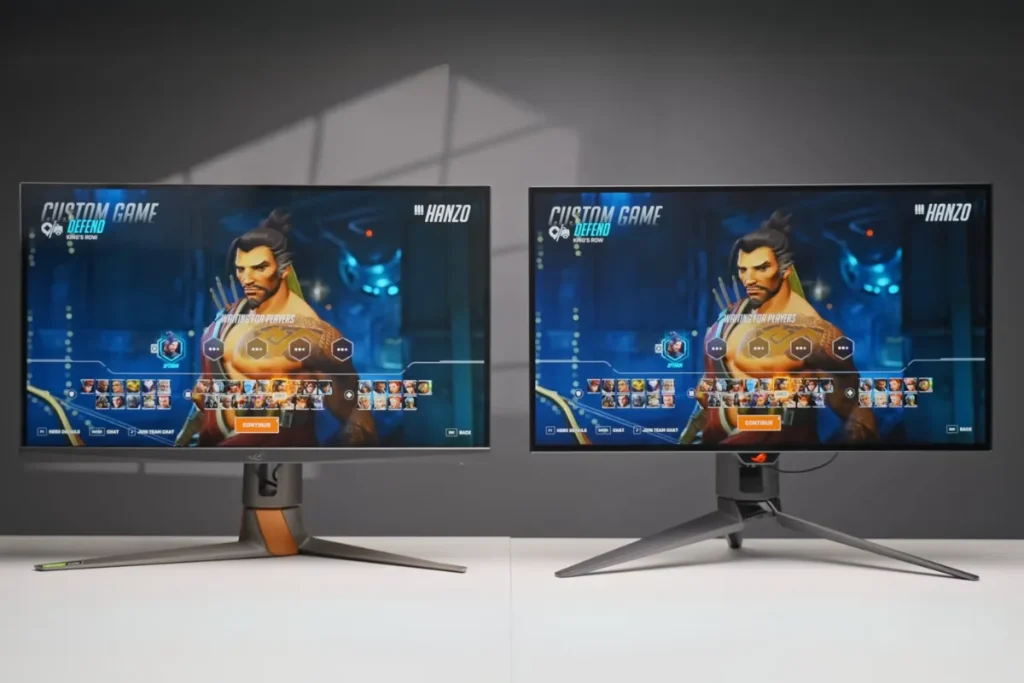
Image Quality Comparison
OLED – Unmatched Contrast and Depth
One of the biggest advantages of OLED is its ability to deliver deep blacks and superior contrast, which enhances the mid-range contrast as well. This makes images appear more “3D-like” compared to IPS, where some elements might look hazy or muddy.
Additionally, OLED panels have a punchy and unfiltered look, offering an immersive gaming experience. In contrast, IPS displays often feel more like “looking at a screen,” whereas OLED gives the illusion of reaching into the game world.
IPS – Bright and Consistent
While IPS panels don’t match OLED in contrast, they hold their ground with better brightness levels. The PG27AQN is one of the brightest gaming monitors available, making it ideal for well-lit environments. It also has excellent out-of-the-box color accuracy.
For those who game in bright rooms or prefer a more traditional display with consistent performance across different scenarios, IPS is still a solid choice.
Gaming Performance: Response Time and Refresh Rate
OLED – Virtually Instant Response Times
- The OLED monitor features a 0.1ms response time, which means zero ghosting and ultra-crisp motion.
- Each frame is displayed cleanly, without trailing or lingering pixels from previous frames.
- This creates a smoother and clearer gaming experience, especially in fast-paced titles like Overwatch 2.
IPS – Higher Refresh Rate, Slightly More Motion Blur
- The 360Hz refresh rate on the PG27AQN does offer an advantage in terms of overall smoothness.
- The IPS panel has 1.5ms response time, which is still excellent, but it does introduce minor ghosting.
- Motion blur is present on both monitors, but the difference in perceived smoothness is small between 240Hz OLED and 360Hz IPS.
- The 360Hz refresh rate is noticeable, but the improvement over 240Hz is not dramatic.
If your priority is absolute speed and smoothness, IPS at 360Hz is a better choice. However, OLED still provides a better visual experience with minimal drawbacks.

Motion Clarity and Ghosting
Ghosting occurs when pixels take too long to transition between colors, leading to a trailing effect. The OLED panel has near-zero ghosting, whereas the IPS panel has slight ghosting due to its longer response time.
However, motion blur is still present on both monitors, primarily because of how our eyes perceive images on sample-and-hold displays. This is why technologies like backlight strobing (ULMB, DyAc) are sometimes used to reduce blur. Unfortunately, OLED panels currently lack this feature due to brightness limitations.
For maximum clarity, a backlight-strobing-enabled IPS panel might still be preferable for competitive gamers, but OLED is superior in terms of pure pixel response time.
Long-Term Usability: Burn-in and Text Clarity
Burn-in Risks on OLED
A common concern with OLED panels is burn-in, which occurs when static images remain on the screen for too long, leading to permanent image retention.
- After hundreds of hours of usage, there are no signs of burn-in on either the LG or Asus OLED monitors.
- With proper pixel cleaning and varied content, OLED monitors should last at least 1.5 years or more without noticeable issues.
- However, intense, abnormal, and prolonged static content can still pose a risk over time.
Text Clarity – IPS is Superior
One downside of OLED is its subpixel layout, which can cause text to appear slightly blurry. This is noticeable during desktop use, especially for tasks like coding or reading long documents.
- If your primary use case includes a lot of text-based work, an IPS monitor will be the better option.
- However, for occasional desktop usage, the issue is not significant.
Which One Should You Choose?
Choose OLED if:
- You prioritize image quality, contrast, and immersive gaming.
- You play single-player and HDR games where visual depth matters.
- You want instant pixel response times with virtually no ghosting.
- You don’t mind a 240Hz refresh rate instead of 360Hz.
Choose IPS if:
- You play in very bright environments where a higher brightness level is essential.
- You focus on pure smoothness and speed, needing 360Hz refresh rate.
- You are sensitive to text clarity and use the monitor for work as well.
- You want zero concerns about burn-in.
Final Verdict: OLED Is the Future
While both monitors offer top-tier gaming experiences, OLED feels more immersive, and the superior contrast, color accuracy, and response times make it the better choice for most gamers.
However, if you are a hardcore competitive player chasing the absolute highest refresh rate, the 360Hz IPS panel still holds an edge in smoothness.
Looking ahead, OLED technology is expected to reach 360Hz and even 480Hz in the near future, making it the ultimate display choice for gaming. Until then, both OLED and IPS remain excellent options, each catering to different priorities.
Would you pick OLED for the stunning visuals, or IPS for its brightness and smoothness? Let us know what you think!