
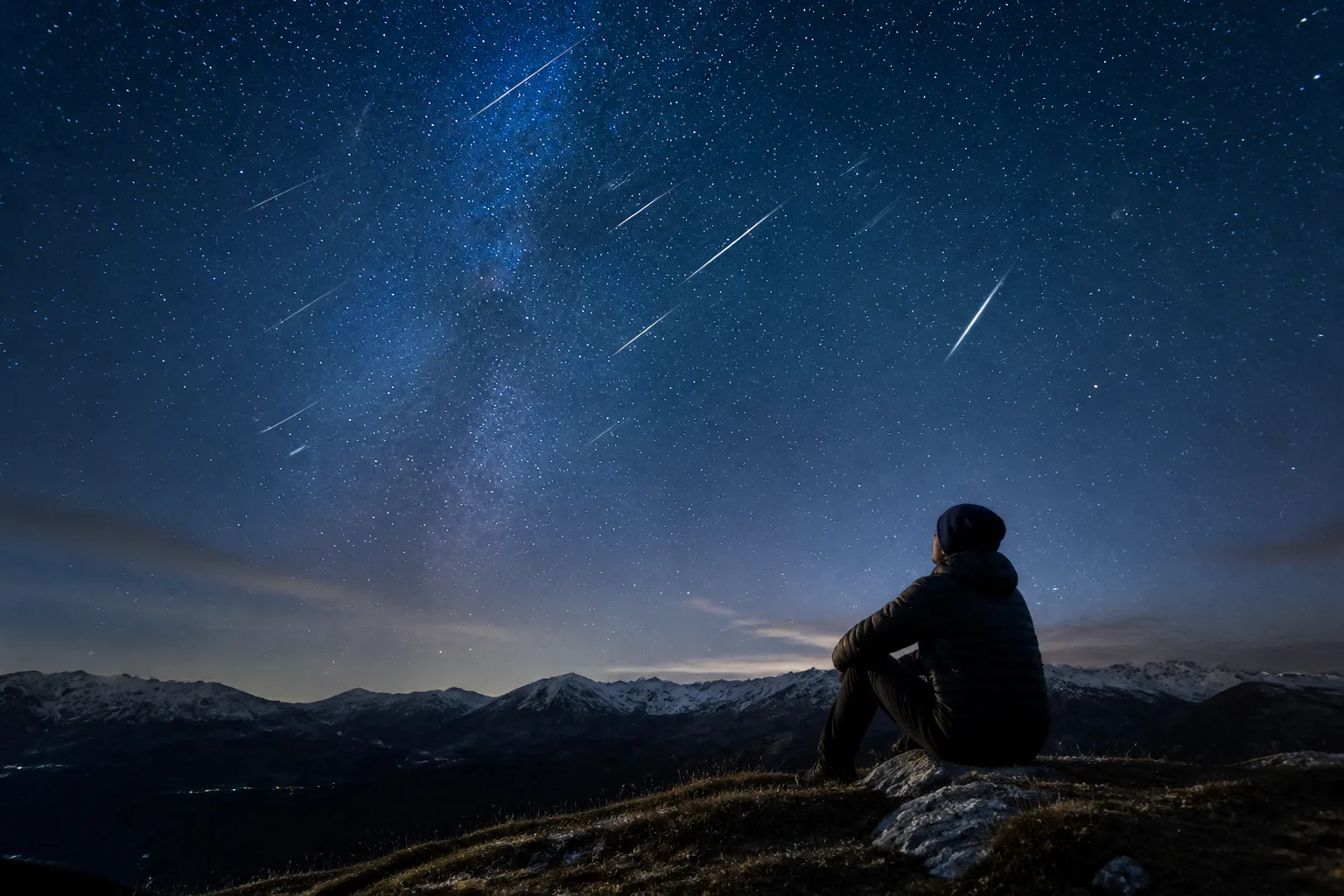
Meteor Shower Tonight: When to Watch the Perseids and How Many to Expect
If you are looking for a meteor shower tonight, the best target on August 12, 2026 is the Perseids. The Perseid meteor shower is active until August 24, 2026, and its peak night falls on August 12 to 13, with the best viewing after midnight and especially before dawn. In 2026, the moon phase is near new moon at peak, which gives unusually dark skies and excellent viewing conditions.
Under a true dark sky location, the Perseids can produce up to 100 meteors per hour at peak, though many observers will see fewer depending on horizon obstructions, local weather, and light pollution. If you are in the northern hemisphere, tonight is one of the strongest meteor-watching nights of the year.
What to watch tonight
The Perseids are the main meteor shower to watch tonight. This shower is caused by comet debris from comet 109P/Swift-Tuttle, the shower’s parent object, and its radiant lies near Perseus.
The shower is currently active, and tonight aligns with its strongest annual activity window. Unlike some years when a bright moon washes out faint meteors, 2026 offers very favorable visibility because the moon is near new moon during the Perseid peak.
Best viewing time
The best time to watch is after midnight through before dawn. That is when your side of Earth turns more directly into the stream of meteoroids, increasing the visible hourly rate.
Evening viewing can still produce a few bright fireballs, but the strongest counts usually arrive in the early morning hours. If you can only go out once tonight, choose the darkest period between moonless late night and dawn twilight.
How many meteors to expect
For the Perseids, published peak estimates range from about 50 to 75 meteors per hour at a dark site, with upper-end figures reaching 100 per hour under ideal conditions. Those top numbers are closer to the shower’s ZHR, or zenithal hourly rate, which assumes perfect skies and the radiant high overhead.
Real-world counts are usually lower than ZHR. City lights, haze, trees, and time spent looking away from the sky all reduce what you actually see.
Where to look
You do not need to stare directly at Perseus to see the most meteors. The radiant marks the point from which the streaks appear to originate, but longer, easier-to-see meteors often appear 30 to 60 degrees away from it.
Find a wide, open view of the sky and look generally upward rather than at the horizon. A reclining chair or blanket helps because meteor watching works best when you can scan a large section of sky without neck strain.
Viewing conditions
Moon phase tonight
The moon phase near the 2026 Perseid peak is close to new moon, which is ideal. That matters because showers seen under a bright full moon or strong waxing gibbous light lose many faint meteors.
Dark skies matter
A dark sky location away from city lights will make the biggest difference tonight. If you are planning a viewing trip, stable trip prep matters almost as much as sky choice, much like sorting travel benefits before you leave helps avoid distractions once you arrive.
North vs south
The Perseids favor the northern hemisphere because the radiant climbs higher there. Observers in the southern hemisphere can still see Perseid meteors, but the shower is generally lower and less productive.
How to watch properly
-
Go to a dark sky location with minimal light pollution.
-
Arrive at least 20 to 30 minutes early so your eyes can adapt.
-
Watch from after midnight to before dawn.
-
Look high in the sky, not straight at the radiant.
-
Avoid phone screens, white flashlights, and car headlights.
-
Dress for a long, still session outdoors.
Comfort changes how long you keep watching. Small practical details, including layers, water, and planning around local access timings, often decide whether you stay out long enough to catch the best burst of meteors.
What counts as a meteor
A meteor shower happens when Earth passes through streams of orbital debris, and tiny meteoroids burn in the atmosphere as visible streaks often called shooting stars. If a piece survives to reach the ground, it becomes a meteorite.
Most shower particles are tiny and never reach the surface. A very intense outburst is called a meteor storm, but the Perseids tonight are a strong annual shower, not a storm.
Other active showers in August
Two other showers remain active in mid-August 2026, though neither is likely to outperform the Perseids tonight.
|
Shower |
Active dates |
Peak |
Typical strength |
Tonight |
|---|---|---|---|---|
|
Perseids |
Until August 24, 2026 |
August 12-13, 2026 |
Up to 100 per hour at peak |
Best choice tonight |
|
Southern delta Aquariids |
Until August 23, 2026 |
July 30-31, 2026 |
About 25 per hour |
Past peak |
|
alpha Capricornids |
Until August 15, 2026 |
July 30-31, 2026 |
Lower rates, noted for bright meteors |
Occasional bright meteor possible |
The Southern delta Aquariids suffered from a near 99% full moon at their 2026 peak, so their best window was much less favorable. The alpha Capricornids are weaker overall, but they can produce memorable bright fireballs.
What comes next
After the Perseids, the next notable showers in 2026 include the Orionids, Southern Taurids, Northern Taurids, and Leonids. The Orionids are active from October 2 to November 7 and peak on October 21 to 22, 2026; they come from comet 1P/Halley and usually produce about 10 to 20 meteors per hour, with stronger years occasionally reaching 50 to 75.
Later in the year, the Southern Taurids peak on November 4 to 5 and the Northern Taurids on November 11 to 12, both linked to comet 2P/Encke and usually producing around 5 meteors per hour. The Leonids peak on November 16 to 17, 2026, are tied to comet 55P/Tempel-Tuttle, and often produce around 15 meteors per hour.
Meteor calendar highlights
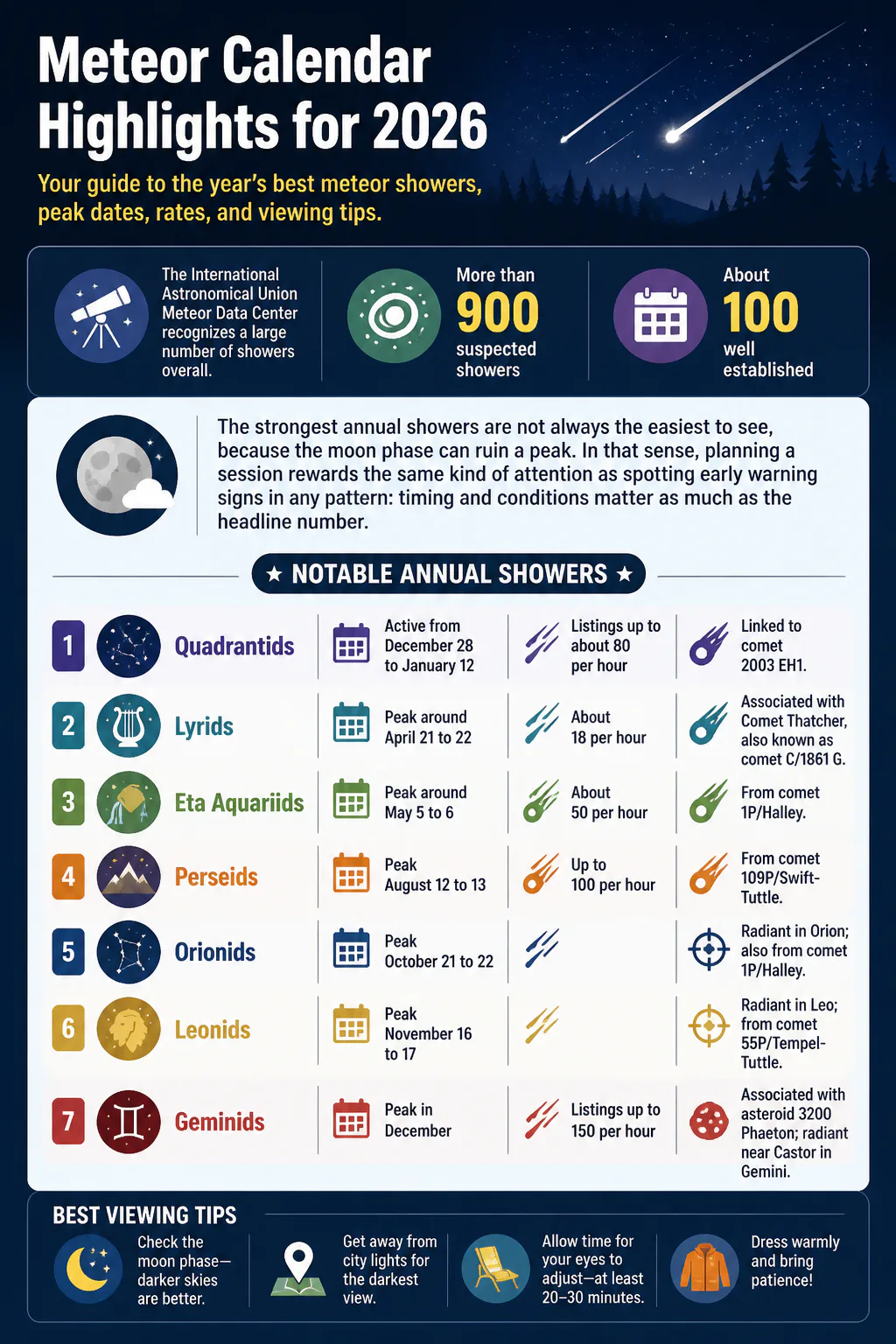
A full meteor shower calendar for 2026 also includes the Lyrids, Eta Aquariids, Quadrantids, Geminids, and Ursids. The International Astronomical Union Meteor Data Center recognizes a large number of showers overall, with more than 900 suspected showers and about 100 well established.
The strongest annual showers are not always the easiest to see, because the moon phase can ruin a peak. In that sense, planning a session rewards the same kind of attention as spotting early warning signs in any pattern: timing and conditions matter as much as the headline number.
Notable annual showers
-
Quadrantids: active from December 28 to January 12, with listings up to about 80 per hour; linked to comet 2003 EH1.
-
Lyrids: peak around April 21 to 22, about 18 per hour; associated with Comet Thatcher, also known as comet C/1861 G.
-
Eta Aquariids: peak around May 5 to 6, about 50 per hour; from comet 1P/Halley.
-
Perseids: peak August 12 to 13, up to 100 per hour; from comet 109P/Swift-Tuttle.
-
Orionids: peak October 21 to 22; radiant in Orion; also from comet 1P/Halley.
-
Leonids: peak November 16 to 17; radiant in Leo; from comet 55P/Tempel-Tuttle.
-
Geminids: peak in December, with listings up to 150 per hour; associated with asteroid 3200 Phaeton; radiant near Castor in Gemini.
FAQ
Is there a meteor shower tonight?
Yes. On the night of August 12, 2026, the Perseid meteor shower is active and at peak, making it the main shower to watch tonight.
What time is best tonight?
The best window is after midnight through before dawn. That is usually when meteor shower rates are highest.
Do I need a telescope?
No. Meteors are best seen with the naked eye because they can appear anywhere across a large part of the sky.
Can I see meteors from a city?
Yes, but far fewer. Light pollution hides faint meteors, so a dark sky location gives much better results.
Where is the Perseid radiant?
The Perseid radiant is near Perseus. You do not need to look directly at it to see meteors.
How is a meteor different from a meteorite?
A meteor is the bright streak in the atmosphere. A meteorite is the material that survives the fall and reaches the ground.
Bottom line
Tonight is an excellent night to watch the Perseids. Get to a dark location, look up after midnight, stay out until before dawn if you can, and let your eyes adjust fully. In 2026, the near-new moon timing makes this one of the best meteor-watching opportunities of the year.