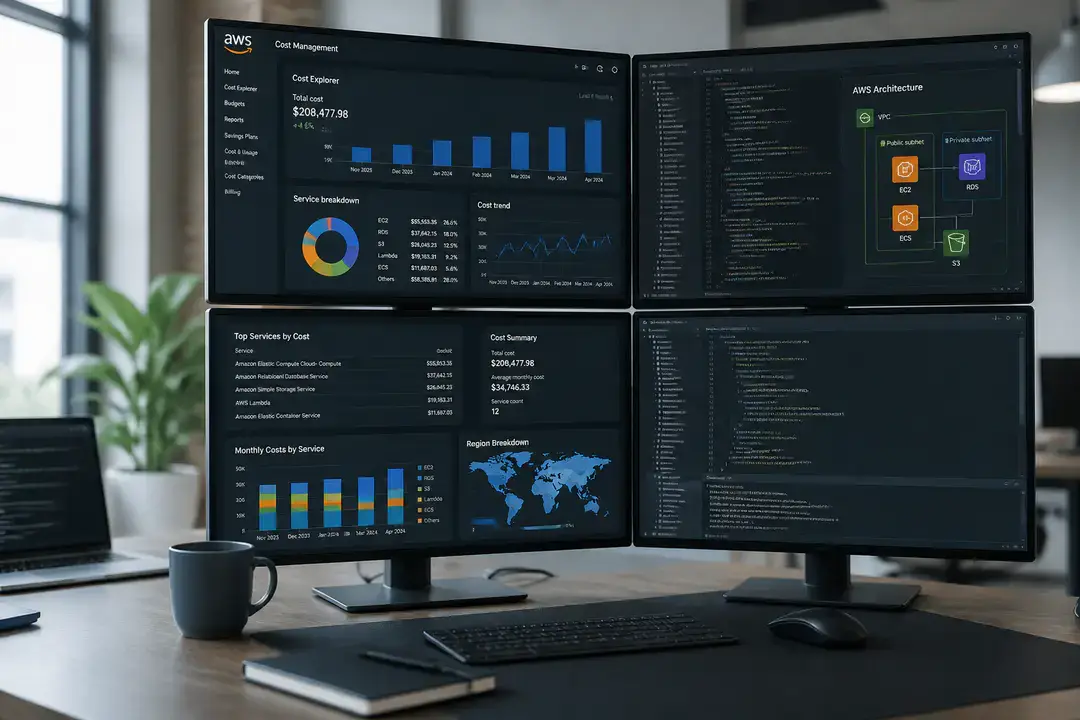
Why US Cloud Leaders Are Treating AWS Cost Transparency as an Engineering Discipline?
Cloud bills have started reading like incident reports. Flexera’s 2026 cloud research points to estimated waste rising to 29 percent after years of decline. For US cloud leaders, that number is no longer a finance problem. It is a design signal. That is why AWS cost transparency is moving from monthly review decks into engineering routines. A dashboard can show where money went. It cannot explain why a service was built in a way that made the bill hard to read. That gap sits inside the engineering system.
The better question is, “Can we trace this cost to a product, team, workload, release, tenant, or design choice?” When the answer is yes, cost becomes feedback. When the answer is no, cost becomes politics. That is the practical core of AWS cost transparency.
Cost Transparency Beyond Reporting
Most AWS cost programs begin with the right tools: Cost Explorer, Budgets, Cost and Usage Reports, Data Exports, anomaly alerts, and dashboards. These are useful. They are also downstream.
By the time a report shows rising NAT Gateway processing, cross-Region data transfer, idle EBS volumes, oversized RDS, or high S3 retrieval activity, the design has already shipped. Someone now has to reconstruct intent from billing lines. That work is slow, and it often lands on people who did not make the decision.
AWS cost transparency works when teams can answer three questions without a finance investigation:
Who owns this spend?
What behavior created it?
What engineering choice can change it?
The answer sits across account structure, tags, service boundaries, deployment metadata, resource naming, usage patterns, and product context. Reporting can rank expenses. It cannot create accountability where architecture never carried ownership data.
Why Engineers Need Cost Visibility Before the Bill Arrives
Engineers do not need a lecture about savings. They need specific signals in the systems where work already happens.
AWS cost visibility matters because the people with the best context are often far from the invoice. A platform engineer knows why a workload needs provisioned throughput. A data engineer knows why a Glue job runs longer at month-end. A product engineer knows whether a new feature increased API calls.
Timing decides whether that knowledge is useful.
Cost signals that arrive thirty days late become archaeology. Cost signals attached to pull requests, architecture reviews, backlog planning, and post-release checks become usable.
|
Engineering moment |
Cost signal that belongs there |
Better question |
|---|---|---|
|
Architecture review |
Expected usage pattern and main cost drivers |
What cost grows with traffic, storage, retries, or data movement? |
|
Pull request |
New managed services, instance families, retention changes |
Does this change add a recurring cost path? |
|
Release review |
Cost per transaction, job, tenant, or product area |
Did the release change unit economics? |
|
Incident review |
Cost impact of retries, failover, logs, and queues |
Did resilience behavior create avoidable spend? |
AWS cost visibility should sit near the decision, not behind the invoice, where aws cloud consulting services help align architecture, FinOps, and engineering accountability. Engineers do not need to become FinOps analysts. They need enough cost context to treat spend as one production characteristic alongside reliability, latency, and security.
Tagging and Allocation Are Part of Delivery
AWS tagging discipline is often described as governance. That makes it sound administrative. In practice, tagging is part of the software delivery contract.
A weak tag strategy creates arguments. A strong one creates attribution.
AWS documentation is clear that user-defined cost allocation tags must be applied and activated in Billing and Cost Management before they appear in cost allocation reporting. Many teams miss the second step. They add tags, then wonder why allocation reports still look incomplete.
AWS cost transparency depends on a small set of tags that are enforced well. Ten trusted tags beat forty optional tags that nobody believes. Common fields include product, service, environment, owner, cost center, application, lifecycle, and data classification. Better teams also carry deployment metadata, so spend can be traced to release movement instead of static ownership alone.
AWS tagging discipline should be enforced in infrastructure as code. CI checks should fail when required metadata is missing. Exceptions should expire.
A useful allocation model separates three cost types:
|
Cost type |
Example |
Ownership treatment |
|---|---|---|
|
Direct product cost |
EC2, Lambda, RDS, DynamoDB, S3 tied to a service |
Assigned to the owning product or platform team |
|
Shared platform cost |
EKS, observability, CI runners, security tooling |
Allocated through a usage driver |
|
Enterprise baseline cost |
Support, central networking, compliance tooling |
Allocated by policy or held centrally with visibility |
This is where AWS chargeback models become sensitive. Chargeback can improve accountability, but it can also create defensive tagging and budget games. Showback is often the cleaner starting point. Let teams see spend, challenge the rules, and clean ownership data before budgets move.
Mature AWS chargeback models follow engineering reality. Shared clusters, platform services, data lakes, and AI workloads need allocation logic tied to consumption. Equal splits may look fair on paper. They hide the heaviest users.
Architecture Ownership Changes the Cost Conversation
Many AWS bills are expensive because they are vague. The issue is often less about the line item and more about the missing design owner.
Cost-aware architecture AWS practices bring cost behavior into architecture work. Teams document data transfer paths, retry volume, log retention, storage class decisions, endpoint choices, backup policy, idle capacity, and tenancy model while the design is still open.
A service can be technically sound and financially opaque. A team may choose shared networking, centralized logging, managed databases, and asynchronous processing. Each choice may be valid. Without ownership data, the monthly bill turns into a shared bucket of suspicion.
Cost-aware architecture AWS reviews should capture:
- Expected steady-state cost drivers
- Usage metric that explains growth
- Owner for each shared component
- Unit cost target or watch range
- Decommission trigger for temporary resources
- Retention rule for logs, snapshots, and backups
- Exception path for expensive design choices
Connecting Cost Signals to Design Decisions
The richest cost insight comes from joining billing data with engineering context.
CUR 2.0 gives teams a more consistent schema than earlier Cost and Usage Reports. AWS Data Exports also lets teams define selected billing exports with SQL-style fields. The direction is clear: cost data is becoming an engineering data source, not just a finance file.
Cloud cost transparency engineering connects billing data with deployment IDs, service catalogs, incident records, feature flags, observability metrics, and product usage. The output is more useful than a “top spenders” chart.
It can answer sharper questions:
- Which release changed cost per order?
- Which tenant drives the highest storage and retrieval cost?
- Which retry pattern increased queue, Lambda, and database spend?
- Which data product creates the month-end processing spike?
- Which feature has low usage but high fixed infrastructure cost?
- These questions reduce blame. They make cost part of technical diagnosis.
Cloud cost transparency engineering also gives leaders a better operating narrative. “AWS spend is up 18 percent” is a number. “Checkout traffic rose, unit cost fell, observability cost increased because debug logs stayed on for two services, and the fix is in the sprint” is control.
Building Cost-Aware AWS Teams
FinOps engineering culture is built through habits, not posters.
Start with ownership. Every meaningful AWS resource should map to a team, product, service, or platform function. Unknown spend should enter the same queue as reliability defects.
Second, add a light cost section to architecture decision records. Ask for the cost driver, unit metric, owner, fallback option, and review date. This keeps cost in design without creating a heavy approval ritual.
Third, make tagging part of delivery. Required metadata should ship with infrastructure code. Manual cleanup after deployment is too late and too fragile.
Fourth, use allocation rules that engineers believe. If the model feels arbitrary, teams will argue with the model instead of improving the system. Shared platforms need transparent usage drivers. Temporary environments need expiry rules. Central services need a policy that teams can understand.
Fifth, make FinOps engineering culture visible in incentives. Reward cost improvements that protect customer experience. Do not celebrate random cuts. Celebrate better unit economics, cleaner ownership, reduced waste, smarter storage policies, and design choices that lower recurring spend without hurting reliability.
|
Capability |
Old habit |
Better engineering habit |
|---|---|---|
|
Reporting |
Monthly spend review |
Weekly service-level cost review |
|
Tagging |
Manual cleanup |
Required metadata in infrastructure code |
|
Allocation |
Finance spreadsheet mapping |
Product and platform ownership model |
|
Architecture |
Performance and availability review |
Reliability, security, and cost behavior reviewed together |
|
Optimization |
One-off savings campaign |
Backlog items tied to cost signals |
The Leadership Shift
AWS cost transparency has become a leadership skill because cloud spend now carries product, architecture, and operating signals. The leaders who stand out in 2026 are not the ones with prettier dashboards. They are the ones who can explain why spend moved, who owns it, what value it supported, and which design choices need correction.
That is the discipline: making cloud spend explainable by the same people who design the systems that create it.
When that happens, finance stops chasing explanations after the bill closes. Engineering starts seeing cost as part of system behavior. Product teams get cleaner trade-offs. Leaders get fewer surprises.
AWS cost transparency is no longer a report. It is engineering instrumentation.
Further Reading