How Daily Word Games Became Part of Online Culture
Every morning, millions of people open a browser tab or app not for news or email, but for a five-letter word. That ritual (guessing once, sharing results as colored emoji squares, then moving on) didn’t exist a decade ago. Daily word games evolved from solitary newspaper puzzles into a recurring online habit that thrives on anticipation, friendly competition, and the need to post your score before lunch. The shift wasn’t just about technology. It was about transforming a mental exercise into social currency.
From Crosswords to Wordle: The Origins of Daily Word Games
The first crossword puzzle appeared in the New York World in 1913, a Sunday supplement novelty that spread quickly across American newspapers. The New York Times initially dismissed crossword solvers in a 1924 editorial as engaging in “a primitive sort of mental exercise,” then reversed course and published its first crossword about 20 years later during WWII blackouts, when readers craved distraction. The crossword became a fixture, so much so that The New York Times Games was officially established seven decades later as a strategic investment in puzzles, bundling crosswords with new formats like the Mini Crossword, Spelling Bee, and Letter Boxed.
Josh Wardle created Wordle in 2021 as a personal game for his partner during the pandemic. The game’s uncomplicated design (guess a five-letter word in six attempts, get color-coded feedback) spread through group chats and social media with no marketing push. The New York Times acquired it in early 2022, adding it to a portfolio that already included Connections, Strands, and The Crossword. Tens of millions of people now play New York Times Games every single day, with over half of weekly users playing more than one word each day.
Why Wordle Changed the Game
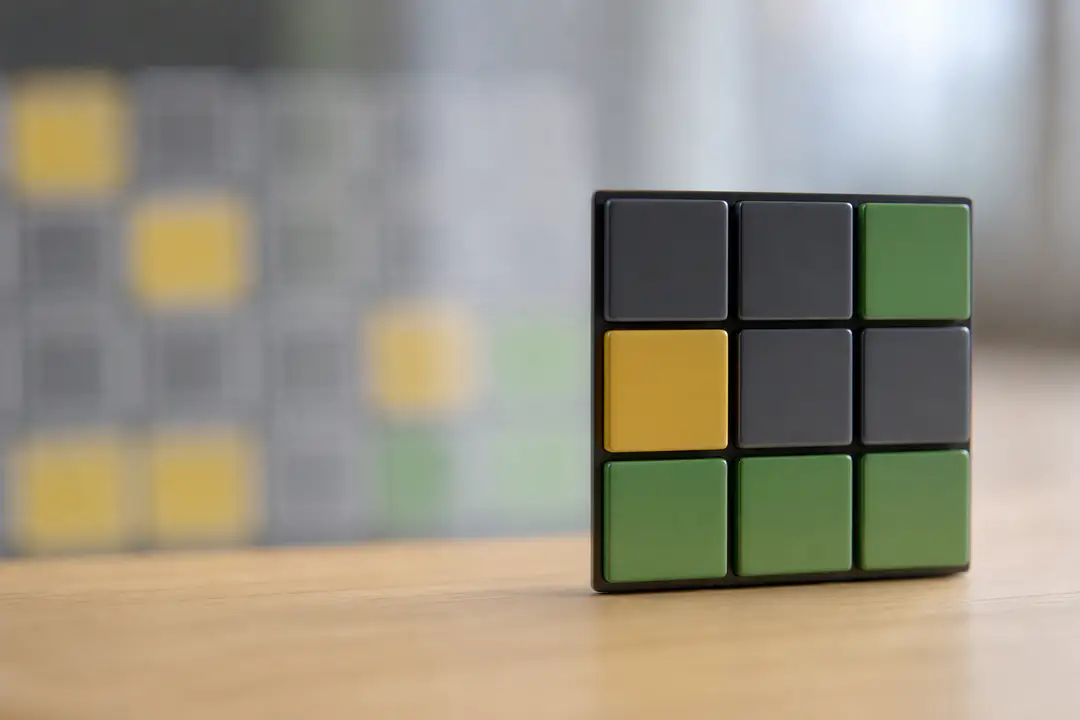
Wordle introduced a constraint that older puzzles never had: one word each day, the same for everyone, with no archive to binge. That artificial scarcity created anticipation. You couldn’t skip ahead or play catch-up. The daily puzzle reset at midnight, and the next morning, social media filled with results posted as emoji squares:
- Green for correct letters in the right spot
- Yellow for correct letters in the wrong spot
- Gray for misses
The format was instantly recognizable, spoiler-free, and competitive without leaderboards.
The shareable results turned performance into a gaming tips conversation starter. Posting your score wasn’t bragging; it was proof you’d participated in the day’s shared challenge. The five-letter word became a daily ritual that required logical reasoning, deduction, and pattern recognition, but the real hook was belongingness: everyone played the same puzzle, so everyone had something to talk about. That sense of camaraderie extended to other daily word games like Connections, where players grouped four words by theme, and Spelling Bee, where the goal was finding as many words as possible from seven letters.
The Psychology Behind the Daily Puzzle Habit
Daily word games satisfy three core psychological needs:
- Competence comes from solving the puzzle, whether in three tries or six. Finishing gives you a win.
- Autonomy comes from choosing your opener, your strategy, and your pace. There’s no timer or forced difficulty curve.
- Belongingness comes from the online community. You’re not just solving a puzzle; you’re participating in a shared cultural moment.
The daily cadence creates a low-stakes habit loop. Unlike open-ended games that demand hours, a daily puzzle takes two to five minutes. The instant gratification of colored feedback after each guess keeps you engaged without overwhelming you. The lack of ads, microtransactions, or notifications makes the experience feel like a mental exercise rather than a Skinner box. That restraint is deliberate. The New York Times positioned these games as a recurring reason to visit the site, not a monetization funnel.
Anticipation drives retention. Players return every morning because the puzzle resets, and missing a day feels like breaking a streak. That sense of routine mirrors morning coffee or checking the weather; it’s a small, predictable pleasure that anchors the start of the day. Crosswords had the same effect in the analog era, but digital distribution and social sharing amplified the reach and frequency. The digital age transformed solitary problem-solving into a networked ritual.
How Word Games Became Social Currency
The viral phenomenon of Wordle wasn’t just about the game; it was about the emoji grid. Posting your results on Twitter, Slack, or group texts became a way to signal participation without spoiling the answer. The grid was abstract enough to avoid giving away the solution but specific enough to show your path: a first-row solve meant you nailed the opener, a sixth-row solve meant you barely scraped by, and a failed attempt meant you’d own up to a tough word.
That transparency created friendly competition without rankings. You weren’t competing for a high score or a leaderboard spot; you were comparing notes with friends. The conversation shifted from “Did you play?” to “How many tries?” and “What was your opener?” Players developed preferred starting words (SLATE, CRANE, ADIEU) and debated optimal strategies, turning a simple word guess into a topic of ongoing discussion. The social media feed became a daily scoreboard where everyone could see who played, who struggled, and who got lucky.
Other daily word games followed the same formula. Connections, which debuted in 2023, asks players to group 16 words into four categories of four. The difficulty ramps up with each category, and the shareable results show how many mistakes you made before solving. Spelling Bee rewards finding all possible words in a set of seven letters, with a “genius” threshold that drives completionists to hunt for obscure terms. Each game offers a different kind of cognitive challenge (deduction for Wordle, lateral thinking for Connections, vocabulary depth for Spelling Bee), but all share the daily reset and the shareable result.
What The New York Times Did to Build Puzzle Culture
The New York Times didn’t invent daily word games, but it combined them into a single destination. The Games app and website bundle The Crossword, Mini Crossword, Wordle, Connections, Spelling Bee, Letter Boxed, and Strands under one subscription. Over half of weekly users play more than one puzzle, creating a habit stack that keeps readership engaged beyond news articles. The Games section became a revenue driver. Subscriptions grew as players returned daily for multiple puzzles, not just one.
The Mini Crossword serves as an entry point: it takes under a minute to complete, requires no deep trivia knowledge, and resets daily. Players who finish the Mini often move on to Wordle or Connections, turning a quick win into a longer session. The New York Times also maintained the original Wordle’s no-ads, no-monetization design after acquiring it, preserving the game’s reputation as a genuine mental exercise rather than a cash grab. That restraint built trust and kept the Wordle obsession alive.
The New York Times Games section also avoided the common pitfall of difficulty creep. The company has stated publicly that Wordle’s difficulty hasn’t changed since acquisition, even though some puzzles feel trickier due to uncommon letters or repeated ones. That consistency matters. Players return because they know what to expect, and variance in perceived difficulty keeps the challenge fresh without frustrating casual solvers. The crossword puzzles still follow the Monday-easy, Saturday-hard cadence established decades ago, and newer games like Strands maintain a similar approachable-but-satisfying balance.
Daily Word Games as a Genre
Wordle spawned dozens of imitators and spin-offs: Dordle (two words at once), Quordle (four words), Heardle (guess the song from audio snippets), and genre-specific variants like Nerdle (math equations) and Worldle (geography). Most faded after initial buzz, but the ones that survived shared Wordle’s core loop: one puzzle per day, shareable results, and a clear win condition. The daily cadence is non-negotiable. Games that let you play unlimited rounds lose the anticipation and the shared moment.
The format works because it respects the player’s time. A daily word game fits into a coffee break, a commute, or a waiting room. It doesn’t demand progression systems, unlockables, or grinding. You play, you finish, you share, you’re done. That brevity is a feature, not a limitation. The digital age rewards gaming news about instant-hit mechanics, but daily word games prove that slow-burn habits can scale just as effectively.
The genre also benefits from low technical barriers. Wordle runs in a browser with no app download, no login, and no install friction. Connections and Spelling Bee follow the same model. That accessibility mirrors the original appeal of newspaper crossword puzzles. Anyone with access to the publication could play, no special equipment required. The modern equivalent is anyone with a web browser, and the shareable results extend the reach to anyone with a social media account.
Daily Word Games by Type
Wordle
Guess a five-letter word in six attempts. Green tiles mark correct letters in the right spot, yellow tiles mark correct letters in the wrong spot, gray tiles mark letters not in the word. No time limit, one puzzle per day. The game offers no hints beyond the color feedback, so strategy revolves around choosing an opener with common vowels and consonants (SLATE, CRANE, ADIEU are popular) and using deduction to narrow possibilities. The lack of an official archive means missed days stay missed, though unofficial archives exist.
Connections
Group 16 words into four categories of four. Each category has a theme (sometimes obvious like types of fruit, sometimes lateral like words that follow “fire”). You get four mistakes before losing. The difficulty ramps: yellow is easiest, green is medium, blue is hard, purple is hardest. The shareable results show how many mistakes you made and whether you solved all four categories. Players often look for Connections hints after getting strikes from wrong answers, so they can solve the puzzle without spoiling the full answer.
Spelling Bee
Find as many words as possible using seven letters, with one center letter that must appear in every word. Words must be at least four letters long, and pangrams (using all seven letters) earn bonus points. The scoring tiers range from “Good” to “Genius” to “Queen Bee” (finding every possible word). There’s no daily reset penalty; you can revisit yesterday’s puzzle, but the community treats each day’s puzzle as the main event. The game rewards vocabulary depth and lateral thinking: obscure words like “tutu” or “nene” often appear, and players learn new terms through repeated play.
Mini Crossword
A 5×5 crossword grid that takes 30 seconds to two minutes. Clues are straightforward, no trivia deep cuts. The Mini resets daily and tracks your solve time, creating a speedrun leaderboard among friends. It’s designed as a gateway to the full-size New York Times Crossword, which runs Monday-easy to Saturday-hard. The Mini’s brevity makes it a warm-up or a standalone quick win, and its simplicity keeps the barrier to entry low.
Letter Boxed
Connect letters on the perimeter of a square to form words, with the constraint that consecutive letters can’t come from the same side. Each word must start with the last letter of the previous word. The goal is to use all 12 letters in as few words as possible. There’s no daily limit on attempts, but the challenge resets daily. The game rewards vocabulary breadth and spatial reasoning, and the shareable results show how many words you used versus the minimum possible.
Strands
Find themed words hidden in a letter grid. Each puzzle has a central theme (announced at the start), and words can snake horizontally, vertically, or diagonally. The game tracks which words you’ve found and hints at remaining ones. Strands launched in 2024 as the newest addition to The New York Times Games lineup, targeting players who like word searches but want a thematic constraint. The daily puzzle format and shareable results follow the same model as Wordle and Connections.
The Crossword
The flagship puzzle that started it all. The New York Times Crossword runs daily, with difficulty increasing through the week: Monday is easiest, Saturday is hardest, and Sunday is large but mid-week difficulty. Clues range from straightforward definitions to wordplay, puns, and trivia. The crossword community is the oldest and most dedicated, with solvers tracking streaks, debating clue fairness, and analyzing constructor styles. The digital version tracks solve time and offers a “check” feature to verify answers mid-solve, though purists avoid it.
The Bottom Line
Daily word games became part of online culture because they turned solitary problem-solving into a shared ritual. The five-letter word, the emoji grid, the morning routine: these aren’t just mechanics, they’re social infrastructure. As long as anticipation and camaraderie drive engagement more effectively than leaderboards and unlockables, the daily puzzle will remain a fixture of digital life.
FAQs
What makes daily word games different from other puzzle games?
Daily word games reset once per day with the same puzzle for everyone, creating a shared experience and preventing binge-playing. The constraint builds anticipation and makes results socially comparable without leaderboards.
Why did Wordle become so popular?
Wordle combined a simple five-letter guessing mechanic with shareable emoji results that showed your performance without spoiling the answer. The daily reset and lack of ads made it feel like a genuine mental exercise, and the social proof drove viral growth through group chats and social media.
How many people play New York Times daily word games?
Tens of millions of people play New York Times Games every single day, with over half of weekly users playing more than one puzzle. The Games section became a major revenue driver through subscriptions.
Do daily word games improve cognitive functions?
Daily word games exercise logical reasoning, deduction, vocabulary, and pattern recognition. The New York Times originally called crossword solving “a primitive sort of mental exercise” in 1924, but modern research shows puzzle-solving can support mental sharpness and provide low-stress cognitive challenges.
Can I play old Wordle puzzles?
The official Wordle game has no archive, but several unofficial websites have compiled past puzzles. The New York Times doesn’t endorse these versions, and they may not reflect the current word list. Other games like Spelling Bee allow revisiting recent puzzles, but the daily cadence remains the main draw.
What’s the best starting word for Wordle?
Popular openers include SLATE, CRANE, and ADIEU because they test common vowels and high-frequency consonants like S, T, R, and N. Some players analyze letter frequency in past answers to optimize their opener, but there’s no objectively perfect choice.
Is Wordle getting harder?
The New York Times states that Wordle’s difficulty hasn’t changed since acquisition, though some puzzles feel trickier due to uncommon letters or repeated ones. Perceived difficulty varies day to day, but the underlying word list and mechanics remain consistent.